








Do I Need an MC Number for Intrastate? USDOT vs. MC
Tell us how you run. We work out which numbers, filings and testing program apply to you, and file them.
- We file MC, USDOT, BOC-3, UCR and MCS-150 in-house
- Foley runs its own DOT random testing consortium
- Answer in one call — no guessing at your state's rules
Tell us how you run. We file what you need.
Three questions about your freight, lanes and drivers, and we file the ones you owe.
Do You Need an MC Number or a USDOT Number? The Short Answer
Do I need an MC number for intrastate?
Generally, no. An MC number is operating authority, and FMCSA grants it under federal rule for the for-hire transport of regulated commodities or passengers in interstate commerce. If every load you haul begins and ends inside one state, and is not part of a longer interstate movement, federal operating authority does not apply to you. Your state may still require its own intrastate authority or motor carrier permit.
Do I need a DOT number for intrastate?
Usually, yes. A USDOT number is required for anyone operating a commercial motor vehicle in interstate commerce as defined at federal rule. It is also required for intrastate-only carriers in the large majority of states, because most states have adopted the Federal Motor Carrier Safety Regulations for intrastate operations. Any intrastate carrier hauling a quantity of hazardous materials that requires placarding must have a USDOT number regardless of state.
- MC number: interstate, for-hire, regulated commodity or passengers — federal rule
- USDOT number: all interstate CMVs, plus intrastate in most states and all placardable hazmat
- Both numbers are separate applications, and having one does not create the other
- Intrastate does not mean unregulated — driver qualification, hours of service, and drug and alcohol testing usually still apply
FMCSA is moving carrier registration onto Motus, the system announced in the Federal Register on 29 April 2026. Motus replaces the Unified Registration System, the registration side of MCMIS, and the legacy ICC Licensing and Insurance system. Phase I went live in December 2025 for supporting companies such as process agents and insurance filers; Phase II opened the system to motor carriers, brokers and freight forwarders through the second quarter of 2026.
No regulation changed and no new deadline was created. What changed is the front door: the next biennial update, USDOT-number change, operating-authority change or BOC-3 filing is where most carriers will meet it. Fleets with several affiliated entities should expect to re-validate logins and authorisations, because each entity keeps its own record. Foley files through whichever system is live on the day, so the transition is ours to manage, not yours. Read our Motus briefing.
Who Needs Each Number
The split is not about truck size. It is about who owns the freight and where the freight is going.
You haul other people's freight for payment, but never across a state line and never as a leg of an interstate journey. No FMCSA operating authority. You will still need a USDOT number in most states, a state intrastate permit, state-required insurance, and — if your drivers hold CDLs — a compliant testing program.
You need a USDOT number and an MC number, evidence of financial responsibility under federal rule, and a designated process agent in every state you operate in under federal rule. Authority is not active until the insurance and BOC-3 filings post.
If the freight is yours and the transportation furthers your own commercial enterprise, you are a private motor carrier under federal rule. Private carriers are not for-hire, so operating authority does not apply — but every other interstate safety obligation does.
A commercial motor vehicle starts at 10,001 pounds gross vehicle weight rating or gross combination weight rating, or at 9 passengers for compensation, or 16 passengers not for compensation, or at any weight when hauling placardable hazardous materials. That definition sits at federal rule and it is what pulls a pickup-and-trailer operation into the rules.
Carriers who already run this with Foley
Samoan Transportation
Filed its MC number and BOC-3 with Foley and has gone three years without an audit. Read the case study.
What Actually Counts as Interstate Commerce
This is the part operators get wrong, and it is the finding that turns a routine roadside stop into an audit. Interstate commerce at federal rule is defined by the journey of the freight, not by the miles your truck personally drives.
- You pick up a container at a port or rail ramp in your state and deliver it 40 miles away. The freight came from out of state. That is interstate commerce, even though your truck never left the state.
- You haul to a warehouse where the load is staged for a known out-of-state customer. The interstate journey has not ended. That is interstate commerce.
- You cross a state line once, for one load, to help out a customer. You needed authority and insurance on file before that trip, not after.
- You run under someone else's authority with a lease. Under federal rule the written lease must give the authorized carrier exclusive possession and control. If the paperwork does not match how the trucks are actually dispatched, the exposure lands on both parties.
- Your trade name or DBA is different from the legal entity holding the authority. Enforcement matches the USDOT number to the entity, not the door lettering — marking requirements are at federal rule.
Operating in interstate commerce without required authority can put the vehicle out of service under federal rule and starts your new entrant safety audit window under federal ruleSubpart D. Have Foley review what you are actually running before an investigator does it for you.
Skip the six steps. We file all of them.
Foley handles the MCS-150, the authority application, the BOC-3 and the insurance coordination, then stands up your DQ files and testing pool before your first load.
Intrastate vs. Interstate: Filing by Filing
Every line below is a separate filing with its own trigger. This is the table to keep next to your renewal calendar.
| Filing or registration | Intrastate only | Interstate | Governing part |
|---|---|---|---|
| USDOT number | Required in most states; always required for placardable hazmat | Required | federal rule |
| MC number (operating authority) | No — state intrastate authority may apply instead | Required if for-hire and hauling regulated commodities or passengers | federal rule |
| BOC-3 process agent designation | No | Required before authority is granted | federal rule |
| UCR registration | No | Required for interstate carriers, brokers, freight forwarders and leasing companies | federal rule |
| MCS-150 biennial update | Required if you hold a USDOT number | Required | federal rule |
| Public liability insurance on file with FMCSA (BMC-91 or BMC-91X) | No — state minimums apply instead | Required for for-hire authority | federal rule |
| Cargo insurance (BMC-34) | No | Required for household goods carriers | federal rule |
| IRP apportioned plates | No — standard state registration | Required for qualifying vehicles crossing state lines | IRP Plan |
| IFTA fuel tax license | No | Required for qualifying vehicles crossing state lines | IFTA Articles of Agreement |
| Federal HVUT (IRS Form 2290) | Required at 55,000 lbs taxable gross weight or more | Same | 26 U.S.C. 4481 |
| State highway use tax (NY, KY, NM, OR) | Required if operating in those states | Required if operating in those states | State law |
| DOT drug and alcohol testing program | Required for CDL drivers in most states by adoption | Required for all CDL drivers | federal rule |
| Driver qualification files | Required where the state has adopted the federal rules | Required | federal rule |
Have us confirm every row against your operation
Fleet size, lanes, commodity and driver licenses change which cells apply to you. A specialist will mark up this table for your fleet in one call.
Talk to a specialistStates That Require an Intrastate USDOT Number
States are free to adopt the federal safety rules for intrastate carriers, and most have. The mechanism is federal rule, which conditions certain federal funding on state compatibility with the FMCSRs; Appendix C to the federal rules records each state's variances. That is why an intrastate carrier in one state files nothing federal, and an intrastate carrier one state over carries a USDOT number, a DQ file for every driver, and a random testing pool.
Three patterns cover nearly every state:
- Full adoption with an intrastate USDOT requirement. The state requires the number, applies the FMCSRs to intrastate CMVs, and publishes limited variances — commonly for farm vehicles, shorter radius operations, vehicle age, or a higher intrastate weight threshold.
- Adoption plus a separate state identifier. The state issues its own intrastate number alongside the USDOT number. California's CA number and the Texas TxDMV motor carrier registration are the two Foley clients ask about most. Each is issued and renewed by the state agency, not FMCSA, and neither replaces the USDOT number.
- No intrastate USDOT requirement. A minority of states. Even there, the number is required the day you run interstate, and required immediately for any intrastate carrier hauling a placardable quantity of hazardous materials.
States move between these categories. Each state sets its own intrastate rule and its own variances, and the variances the state has adopted are recorded in Appendix C to federal rule. Foley confirms the rule in force in your base state before you file.
Practical read: assume you need the number, confirm the exception. Registering when you did not have to costs you an mcs-150 every two years. Not registering when you had to costs you a state penalty and a safety rating you then have to repair.
Crossing state lines? Your audit clock started
Interstate operation triggers authority, insurance filings and a new entrant safety audit. Get the classification reviewed before an investigator does it for you.
When Interstate Carriers Still Do Not Need an MC Number
Interstate does not automatically mean operating authority. Three groups run interstate on a USDOT number alone.
- Private carriers. The freight is yours and moving it supports your own business — retailers, manufacturers, contractors, service fleets. No for-hire transportation, no authority under federal rule.
- Exempt commodity haulers. Unprocessed agricultural products, livestock and certain other commodities are exempt from economic regulation. The exemption is narrow and commodity-specific, and shippers routinely mix exempt and non-exempt freight on the same lane. If any load on your board is regulated, you need authority. The exemption is set by statute at federal law and applied by FMCSA, not by how the shipper describes the load.
- Carriers operating entirely within a single federally designated commercial zone. The zones are defined by FMCSA at federal ruleSubpart B, and they follow municipal and boundary lines, not drive time or mileage estimates.
The reverse trap is more common. Fleets get a dot number, assume it covers everything, and dispatch for-hire interstate loads without authority on file. The USDOT number is an identifier for safety data. The MC number is permission to be paid for hauling someone else's regulated freight across a state line. They are not substitutes, and roadside enforcement checks both.
How to Get Your Operating Authority: The Filing Steps
This is the procedure we run for clients through the Unified Registration System. Six steps, in order, because each one gates the next.
The insurance figures behind the filing
Authority is not granted until your insurer files on your docket, and the minimum under federal rule is $750,000 for general freight at 10,001 lbs GVWR or more, $1,000,000 for oil and for hazardous materials outside the bulk categories, and $5,000,000 for bulk hazardous substances and for passenger vehicles seating 16 or more. Brokers and freight forwarders post $75,000 of financial security instead, on a BMC-84 bond or a BMC-85 trust.
Those are the federal minimums, not what you will pay. Premiums for a small interstate fleet commonly run several thousand dollars per truck per year, and they move with your CSA data and your drivers' records rather than with the minimum itself.
The Deadlines You Keep Forever
Authority is a one-time filing. Everything attached to it recurs, and lapses are automatic rather than discretionary.
- MCS-150 biennial update. Due every two years on a schedule set by the last two digits of your USDOT number, under federal rule. Miss it and FMCSA deactivates the number. Deactivation with active authority is the fastest way to have a load refused at a shipper gate.
- UCR, annually. Interstate carriers, brokers, freight forwarders and leasing companies register and pay a fee based on fleet size under federal rule. The UCR Board sets the fees each year. They are charged by bracket on the power units reported on your MCS-150; trailers are excluded. Registration must be completed before 1 January of the registration year, and the 2027 registration period opens 1 October 2026. See our ucr registration update and our unified carrier licence guide.
- IRP and IFTA renewals, annually, with quarterly IFTA fuel tax returns. State-administered, state-specific due dates.
- Insurance continuity. A cancellation notice from your insurer starts a countdown to revocation of authority. Reinstatement is slower than replacement — do not let a policy lapse to save a premium cycle.
- Random testing selections, every quarter, for as long as you employ CDL drivers. Selections must be spread reasonably across the year under federal rule.
- Annual MVR review and driver certification of violations under federal rule. Our mvr primer explains what a reviewer looks for in the file.
You cannot buy, sell or lease a USDOT or MC number
FMCSA issued a public warning in March 2026 reminding carriers not to buy, sell or lease USDOT or MC numbers online or from parties they do not know. Transfers are allowed only in a narrow set of genuine corporate transactions. Outside of one, FMCSA says it will move to inactivate the USDOT number and revoke every related registration, including the safety registration required under federal law and any operating authority registration under federal law–13905.
MC numbers used to change hands more freely under the Interstate Commerce Commission. Since that body was wound up, transfers have become rare and are limited to a couple of legitimate corporate situations. If someone is offering you an established number to skip the new entrant period, what you are buying is a revocation.
The rest of the paperwork, once authority is granted
Plan for the whole process to take up to two months. The application itself is an afternoon; the wait is your insurer's filing, the BOC-3 posting, and the protest window. Your BOC-3 covers all 50 states and the District of Columbia on one designation. New entrant status then runs 18 months under federal rule, with the safety audit inside that window.
- UCR is filed with your base state, and the fee bracket is set by how many power units you run.
- IRP, the apportioned plate people call the cab card, is filed with your state and renewed annually.
- IFTA has a nominal set-up fee and then runs off your fuel use and the states you operate in.
- Weight distance permits are required by New York, Kentucky and New Mexico for travel through them.
- Surety: brokers and freight forwarders post $75,000 of financial security rather than liability insurance.
- Drug and alcohol testing starts before the first driver turns a wheel, and an owner-operator runs Clearinghouse queries on themselves. Being the only driver does not exempt you.
Decide the business questions before you file, not after: legal name, entity type, who the officers are, and what freight you intend to haul. Every one of them appears on the application and changing them afterwards means another filing. See our operating authority filing service.
Penalties and Audit Exposure
The enforcement risk for this topic is concentrated in one scenario: a carrier that registered as intrastate and then ran interstate freight. At that moment the carrier is operating without authority and without the insurance on file that authority requires.
Operating without required authority is grounds for an out-of-service order under federal rule. Civil penalties for unauthorized transportation are assessed under federal law 14901 and the schedule at Appendix B to federal rule, and the amounts are inflation-adjusted every year, so the figure that applies is the one in force on the date of the violation.
- Insurance denial. A carrier operating outside the scope of its filed coverage may find a claim contested. This is the exposure that ends companies, not the fine.
- New entrant failure. Investigators audit against the automatic failure criteria in Appendix A to federal rule — including using a driver who tested positive, and failing to implement a random testing program.
- Drug and alcohol violations. Using a driver you knew had not passed a required test, or failing to implement a testing program at all, are separately citable under federal rule.
- Clearinghouse. A driver with a prohibited status who has not completed return-to-duty may not perform safety-sensitive functions, per federal rule. Employers must query before hire and annually thereafter under federal rule.
- False or missing MCS-150 data. Inaccurate mileage and power unit counts distort your CSA percentiles and are a documented investigation finding.
Intrastate CDL Drivers and DOT Drug and Alcohol Testing
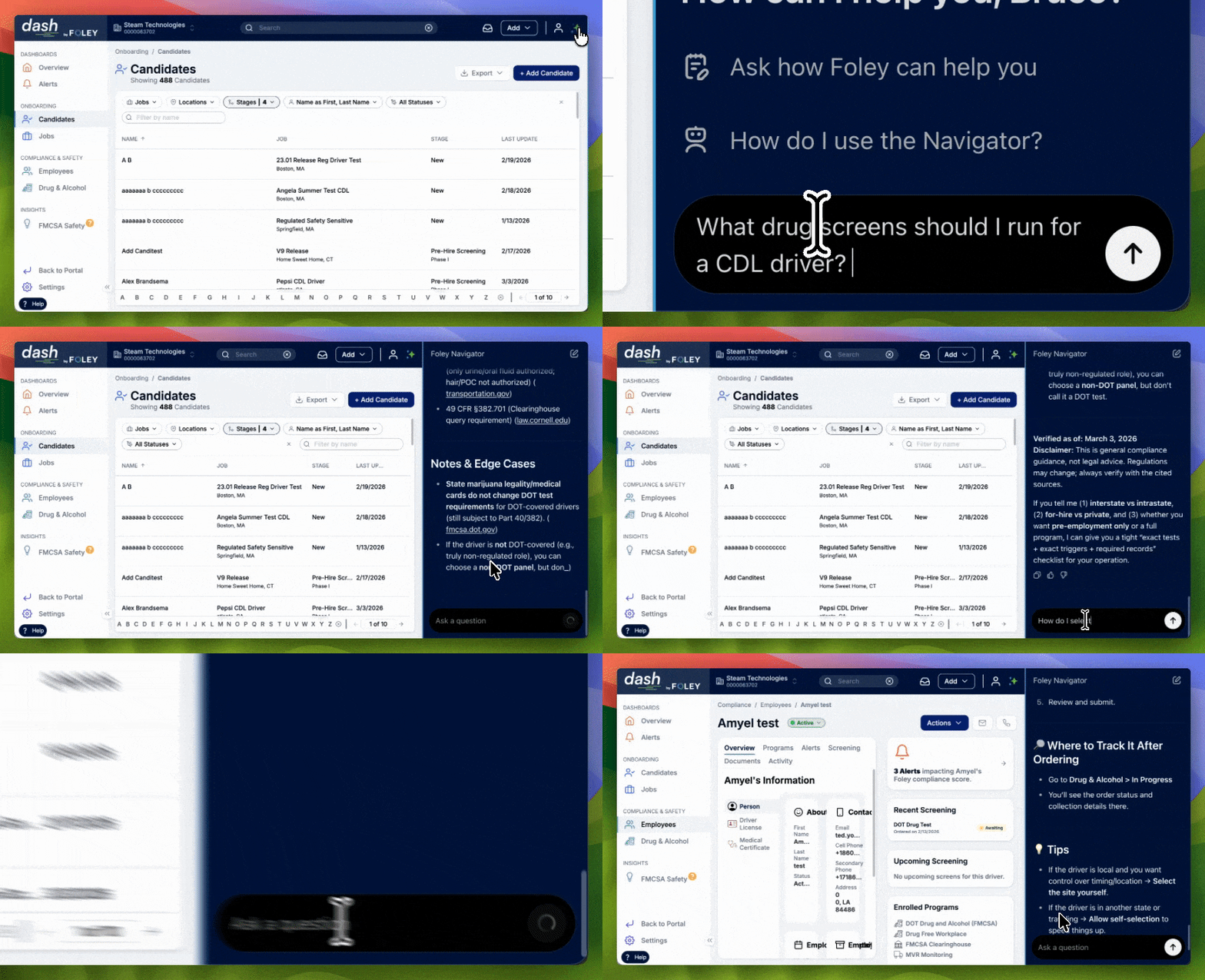
This is the obligation intrastate carriers miss most often. federal rule applies the federal rules to every person who operates a CMV requiring a CDL — and because most states have adopted the FMCSRs for intrastate operations under federal rule, intrastate CDL drivers in those states are subject to the same testing program as interstate drivers. Running only inside your state does not exempt you.
A compliant program is not a testing account. It is six moving parts, and Foley operates all of them in-house:
- A DOT random pool. Owner-operators and small fleets must join a consortium to be randomly selected in a statistically valid way. Foley runs its own consortium, so selections, notifications, and collection scheduling come from one place. Minimum annual random rates are set by FMCSA under federal rule. For 2026 they are 50 percent for controlled substances and 10 percent for alcohol. FMCSA publishes any change in the Federal Register, and it applies from 1 January of the following year.
- Pre-employment testing before the first safety-sensitive function, under federal rule.
- Post-accident, reasonable suspicion, return-to-duty and follow-up testing, with supervisor training under federal rule.
- MRO review of every result — a laboratory positive is not a violation until the Medical Review Officer verifies it under federal ruleSubpart G. Our MROs handle that review.
- Designated Employer Representative coverage. Someone has to take the call and pull the driver. Foley acts as DER support so that decision is never delayed.
- clearinghouse registration, pre-employment full queries, annual limited queries, and violation reporting under federal ruleSubpart G.
If you are standing this up for the first time, start with our dot drug test program overview, then enroll the drivers.
What Foley Files and Manages
| Service | What we do | Who it is for |
|---|---|---|
| USDOT number and MCS-150 | Initial registration, biennial updates, changes of address, fleet and mileage corrections | Interstate and intrastate |
| MC operating authority | Application, authority type selection, coordination with your insurer on BMC filings, monitoring to grant | Interstate for-hire |
| BOC-3 | Process agent designation in all required states | Interstate for-hire |
| UCR | Annual registration and fee calculation by fleet size | Interstate |
| Drug and alcohol program | Foley consortium enrollment, quarterly random selections, collection site network, MRO review, DER support, policy and supervisor training | Any CDL employer, including intrastate by state adoption |
| Clearinghouse | Registration, pre-employment full queries, annual limited queries, violation reporting | Any CDL employer |
| Driver qualification files | File build and audit-ready maintenance under federal rule, medical certificate tracking | All regulated carriers |
| Background screening and MVR monitoring | Pre-hire screening, annual MVR review, continuous license monitoring between reviews | All regulated carriers |
One vendor, one file, one renewal calendar. When an investigator asks for the random selection log and the DQ files in the same visit, they come from the same system.
Why Fleets Bring This to Foley
We are not a filing broker that hands you a number and disappears. Foley operates the programs the filings obligate you to run.
- We run our own consortium and act as a C/TPA. Selections, MRO review, and DER escalation are ours, not a subcontractor's — which is why a positive result gets a phone call, not an email in a queue.
- We file MC, USDOT, BOC-3, UCR and mcs-150 in-house, so classification questions get answered by the person doing the filing.
- We do the intrastate analysis first. Before we file anything, we confirm what your state actually requires and whether your freight is moving in interstate commerce under federal rule. Most of the cleanup work we see traces back to that one question being answered wrong at the start.
- Renewals are tracked, not remembered. Biennial MCS-150, annual UCR, quarterly randoms, annual MVR reviews and medical certificate expirations run on one calendar.
If you already have a number and are not certain it matches how you run, that is a 15-minute conversation. Bring your MCS-150 and a week of dispatch.
Intrastate CDL drivers still need a DOT random pool
Most states apply federal ruleto intrastate CDL drivers. Foley runs its own consortium — enrollment, quarterly selections, MRO review and DER support included.
- The MCS-150 biennial update applies to every USDOT holder, including carriers that only ever operate inside one state.
- Drivers self-certify interstate or intrastate status with their state licensing agency, and that choice decides which medical standard applies to them.
- IRP and IFTA generally start above 26,000 lbs GVWR or at three or more axles, and both renew annually.
- Meeting every federal requirement does not finish the job. States layer their own operating authority, state DOT numbers and cargo rules on top.
Frequently asked questions
Do I need an MC number for intrastate?
Generally no. Operating authority under the federal rulespplies to for-hire transport of regulated commodities or passengers in interstate commerce. If your freight starts and ends in one state and is not part of a larger interstate journey, federal authority does not apply. Check whether your state requires its own intrastate motor carrier authority or permit.
Do I need a DOT number for intrastate?
In most states, yes. The majority of states have adopted the Federal Motor Carrier Safety Regulations for intrastate operations under the federal rulesrequire intrastate carriers to obtain a USDOT number. Any intrastate carrier hauling a placardable quantity of hazardous materials needs one regardless of state.
Do you need a DOT number for intrastate operations in every state?
No — a minority of states do not require it for intrastate-only carriers. The exceptions are narrower than most operators assume, and the list changes. The requirement follows your state of domicile, and Foley confirms it for that state before you register.
Do you need a DOT number for intrastate hazmat hauling?
Yes. Any intrastate carrier transporting hazardous materials in a quantity requiring placarding must have a USDOT number under the federal rules. Depending on the material, a separate HM safety permit may also apply under the federal rulesSubpart E. The materials that trigger the permit are listed at federal rule
Can I have a USDOT number without an MC number?
Yes, and most carriers do. Private carriers hauling their own goods, exempt commodity haulers, and intrastate carriers all operate on a USDOT number alone. The USDOT number is a safety identifier. The MC number is permission to haul regulated freight for hire across state lines.
What happens if I cross a state line once with intrastate-only registration?
You are operating in interstate commerce for that trip, which means authority, insurance on file, and a USDOT number all had to be in place beforehand. Operating without required authority can result in an out-of-service order under federal rule and civil penalties under federal law 14901. Your insurer may also contest a claim.
Does hauling a container from a port in my own state count as interstate?
Usually yes. Interstate commerce at federal rule follows the journey of the freight, not the truck. If the load originated out of state or is continuing to an out-of-state destination, the movement is interstate even if you never leave your state.
Do intrastate carriers need a BOC-3 or UCR?
No to both, in the normal case. BOC-3 process agent designation under the federal rulesis tied to operating authority. UCR under the federal rulespplies to interstate carriers, brokers, freight forwarders and leasing companies. Intrastate-only operations are outside both.
Do intrastate CDL drivers need DOT drug and alcohol testing?
In most states, yes. federal rule applies the federal rules to anyone operating a CMV requiring a CDL, and states that adopted the FMCSRs for intrastate operations apply it to intrastate drivers. That means pre-employment testing, a random pool, MRO review, and Clearinghouse queries. Foley runs its own consortium for exactly this.
Do I still have to file an MCS-150 if I only run intrastate?
Yes, if you hold a USDOT number. The biennial update requirement at federal rule attaches to the number, not to the type of commerce. Miss the update and FMCSA deactivates the number, which can stop you at a shipper gate or a scale.
How long does it take to get operating authority?
The application itself takes minutes. The wait is the public protest period plus the time for your insurer to file the BMC-91 or BMC-91X and for the BOC-3 to post. A new authority is published and open to protest for 10 days before FMCSA grants it. Authority is not active until the protest period closes and both filings are on record.
Intrastate does not mean unregulated
Most states apply the FMCSRs to intrastate CDL drivers — including random drug and alcohol testing under the federal rules.