









Driver Qualification Files for Non-Domiciled CDL Drivers (FAS Citizens)

The FMCSA has opened a national pathway for a specific group of commercial drivers, and it creates a documentation question at hiring intake. Compliant driver qualification file management is how you answer that question. On May 14, 2026, the FMCSA granted every State Driver's Licensing Agency a five-year exemption to issue non-domiciled commercial driver's licenses to citizens of the Freely Associated States. If you hire CDL drivers, here is what the decision does and how to document a non-domiciled CDL driver correctly.
What the FMCSA decided
In a Federal Register notice published May 14, 2026, the FMCSA announced its decision to grant in part and deny in part an exemption application from the Hawaii Department of Transportation. The agency granted all State Driver's Licensing Agencies (SDLAs), (not only Hawaii,) a five-year exemption to issue a non-domiciled commercial driver's license (CDL) or non-domiciled commercial learner's permit (CLP) to citizens of the Freely Associated States who reside in the United States and hold a valid, unexpired passport from a Freely Associated State along with a Form I-94 or I-94A.
The Freely Associated States (FAS) are the Federated States of Micronesia, the Republic of the Marshall Islands, and the Republic of Palau. The FMCSA concluded that granting the exemption, subject to its terms and conditions, is "likely to achieve a level of safety equivalent to or greater than" the level that would exist without it.
Two limits matter. First, the FMCSA denied Hawaii's request to issue standard CDLs and CLPs to FAS citizens — the pathway is for the non-domiciled credential class, not the standard one. Second, this decision supersedes the earlier exemption granted to Oregon, which had allowed Oregon to issue standard credentials to FAS citizens. The effect is a single, consistent, national rule: non-domiciled credentials for FAS citizens, available through any SDLA, for five years.
What a non-domiciled CDL is and how it differs from a standard CDL
A non-domiciled CDL is a distinct credential class under the federal CDL standards in 49 CFR Part 383. It exists for drivers who are not domiciled in a state in the ordinary sense but who are authorized to be issued a commercial credential under defined conditions. The driving privileges a non-domiciled CDL conveys are the same as a standard CDL of the equivalent class and endorsements. What differs is the basis on which it is issued and how it is recorded.
For a carrier, the operational point is that the credential class is part of the record. A non-domiciled CDL is not a standard CDL, and your driver qualification file should reflect the actual credential the driver holds. Mislabeling it does not change the driver's privileges, but it does create an inconsistency that an auditor can flag.
Who this affects
FAS-citizen drivers are a small population, historically concentrated in Pacific-adjacent and port markets. The May 14 decision makes the non-domiciled pathway available nationally, so any carrier may now encounter a candidate who holds — or is eligible to obtain — a non-domiciled CDL on this basis. The people who feel the change first are recruiting and hiring staff, who have to verify eligibility documents they may not have seen before, and driver qualification file staff, who have to record the credential class correctly.
For most carriers, this will be an occasional situation rather than a routine one, and that is exactly why it is worth having the workflow written down before the first candidate arrives. A process that is exercised rarely is the kind that gets improvised under hiring pressure, which is how an eligibility document goes unverified or a credential class gets recorded incorrectly. A short, documented intake procedure for non-domiciled CDL drivers protects against that, and it costs almost nothing to prepare in advance. Carriers that hire across multiple states benefit most because the national consistency of the May 14 decision means the same procedure now works regardless of which SDLA issued the credential.
Recordkeeping errors that create audit exposure
- Recording the credential as a standard CDL. If the file, the MVR, and your driver management system disagree on the credential class, an auditor has a question you do not want to answer mid-audit. Record it as non-domiciled everywhere.
- Missing eligibility documents. The FAS passport and the Form I-94 or I-94A are the basis for the credential. If they are not retained and findable in the file, the file does not stand on its own.
- Treating non-domiciled status as a reason to shortcut Part 391. The Clearinghouse query, MVR, medical certification, and employment-history checks all apply. Skipping any of them is a violation.
- Letting eligibility documents expire without a re-check. The exemption rests on a valid, unexpired FAS passport. Build a reminder so an expired document does not sit unnoticed in an active driver's file.
Hiring intake: what to verify and document
A non-domiciled CDL driver still goes through the full driver qualification process. The credential basis adds a few intake checks; it does not remove any of the standard ones.
- Confirm the FAS passport is valid and unexpired. The exemption requires a valid, unexpired passport issued by a Freely Associated State. Verify it and record the verification.
- Confirm the Form I-94 or I-94A. The driver must have the corresponding admission record. Confirm it and keep documentation consistent with your work-authorization process.
- Confirm the credential is a non-domiciled CDL or CLP. Check that the SDLA issued the non-domiciled class, not a standard credential, and that it carries the correct class and endorsements for the role.
- Record the credential class correctly in the driver qualification file. Note that the credential is non-domiciled. Accuracy here is what keeps the file clean in an audit.
- Run the standard Part 391 checks that apply to every driver. Motor vehicle record, Clearinghouse query, medical certification, employment history, and the road test or its accepted equivalent all apply regardless of domicile. The non-domiciled basis does not waive any of them.
How non-domiciled status interacts with the rest of the driver qualification file
The driver qualification file requirements in 49 CFR Part 391 do not change because a driver holds a non-domiciled CDL. The Clearinghouse query, motor vehicle record review, medical examiner's certificate, and the rest of the file are required as they are for any CDL driver. What deserves attention is consistency: the credential class recorded in the file, on the MVR, and in your driver management system should all agree, and the eligibility documents (the FAS passport and the I-94 or I-94A) should be retained and easily accessible.
How Foley helps with driver file compliance
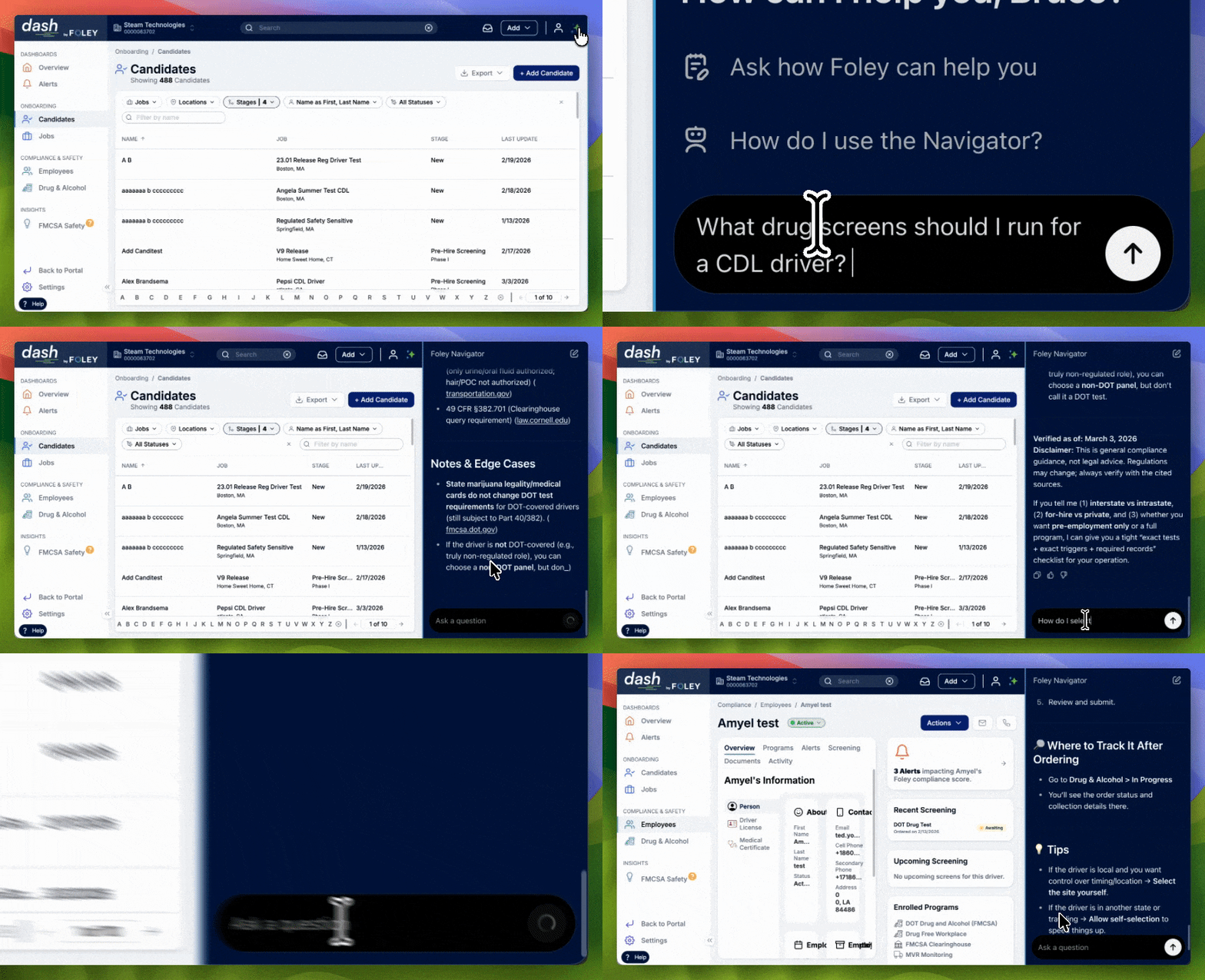
Foley manages driver qualification files, Clearinghouse queries, and motor vehicle record monitoring, and builds the hiring-intake workflow that keeps a file consistent from the first document to the audit. For a non-domiciled CDL driver, that means recording the credential class correctly and retaining the eligibility documents alongside the standard Part 391 checks. Foley can manage the driver qualification file so the credential basis is documented and audit-ready. See the FMCSA compliance hub.
Frequently asked questions
What is a non-domiciled CDL?
It is a distinct CDL class under 49 CFR Part 383 issued to drivers who are not domiciled in a state in the ordinary sense but are authorized to receive a commercial credential under defined conditions. The driving privileges match a standard CDL of the same class and endorsements.
Can any state issue a non-domiciled CDL to an FAS citizen now?
Yes. The May 14, 2026 decision granted all State Driver's Licensing Agencies a five-year exemption to issue non-domiciled CDLs and CLPs to qualifying FAS citizens.
What documents does the driver need?
A valid, unexpired passport issued by a Freely Associated State and a Form I-94 or I-94A.
Does a non-domiciled CDL driver still need a Clearinghouse query and an MVR?
Yes. The standard 49 CFR Part 391 driver qualification requirements, including aClearinghouse query, MVR, medical certification, and the rest, apply regardless of domicile.
How do I record this in the driver qualification file?
Note that the credential is a non-domiciled CDL. Keep the FAS passport and I-94/I-94A documentation in the file, and make sure the credential class is consistent across the file, the MVR, and your driver management system.
What changed from the earlier Oregon exemption?
The May 14 decision supersedes Oregon's exemption, which had allowed Oregon to issue standard credentials to FAS citizens. The national rule is now the non-domiciled class only.
Sources
Related Articles
A Review of Driver Qualification Files for Bus Drivers
Clutter Partners With Foley for Driver Hiring, Compliance Management
Truck Driver Recruiting: How to Hire Truck Drivers in 2026
.webp)