








DOT Drug Testing Consortium: Random Pool Enrollment for Carriers & Owner-Operators
A consortium handles the drug testing logistics so you don't have to. Your CDL drivers get pooled with drivers from other carriers into a single random testing program managed by an FMCSA-registered C/TPA. For owner-operators and small-to-mid-size fleets, it's the most cost-effective way to hit the 50% random drug testing and 10% alcohol testing minimums without building compliance infrastructure from scratch.
If you operate CMVs requiring a CDL, you need a compliant random testing program.
What a DOT Consortium Does
When you enroll, the C/TPA basically takes over the operational and regulatory side of your random testing program:
| Consortium Service | What It Covers |
|---|---|
| Random pool administration | Your drivers are added to a combined pool; selections are computer-generated using a scientifically valid method |
| Quarterly/monthly random draws | The C/TPA conducts draws throughout the year to meet the 50% drug / 10% alcohol annual minimums |
| Collection scheduling | When a driver is selected, the C/TPA coordinates specimen collection at a certified site |
| MRO review | All specimens are reviewed by a licensed Medical Review Officer |
| Clearinghouse reporting | Violations and RTD completions are reported to the FMCSA Drug & Alcohol Clearinghouse |
| MIS recordkeeping | Annual testing data is compiled and retained for 5 years per 49 CFR Part 382 |
| Audit support | Documentation is maintained in audit-ready format for FMCSA compliance reviews |
Bottom line: the consortium handles everything FMCSA requires for random testing. You enroll your drivers, respond when someone gets selected, and send them to test. That's basically it.
Who Should Join a Drug & Alcohol Consortium
Owner-Operators (1 Driver)
If you're an owner-operator with a CDL, you can't self-administer a random testing program. FMCSA requires selections to be unannounced and run by an independent party. So you must join a consortium. Not optional.
Small Carriers (2–25 Drivers)
Building an internal program at this size -- separate MRO contracts, collection site agreements, FMCSA Clearinghouse reporting, MIS tracking -- ends up being cost-prohibitive. A consortium spreads those costs across thousands of drivers.
Mid-Size Carriers (25–100 Drivers)
Even at this size, a lot of carriers choose consortium enrollment over running things internally. Quarterly draws, completion tracking, audit-ready records -- it adds up fast. Most compliance managers don't have the hours.
Large Carriers (100+ Drivers)
Large carriers typically work with a C/TPA in a third-party administration arrangement instead of a traditional consortium. The C/TPA manages the program for that carrier's driver pool specifically rather than combining them with other carriers. Foley supports both models.
“We see carriers of all sizes enroll in consortium programs, not because they can't administer their own, but because the cost of getting it wrong is too high. A missed random draw or a recordkeeping gap can result in $16,000 fines during a compliance review.”
FMCSA Random Testing Requirements the Consortium Must Meet
Your consortium must operate in full compliance with 49 CFR Part 382, Subpart D.
FMCSA Drug Testing Rates
| Test Type | Annual Rate | Authority |
|---|---|---|
| Random drug testing | 50% of average pool | §382.305(b)(1) |
| Random alcohol testing | 10% of average pool | §382.305(b)(2) |
Selection and Notification Rules
- Selections must use a scientifically valid random method (computer-generated)
- Every driver in the pool must have an equal probability of selection at every draw
- Notification has to be unannounced. The driver learns they've been selected only when told to report.
- Once notified, the driver proceeds to the collection site immediately -- no delays, no excuses
Alcohol Testing Timing
Random alcohol tests can only be conducted immediately before, during, or immediately after a driver performs a safety-sensitive function. Drug tests don't have this timing restriction. Alcohol tests do. And the timing rule trips up plenty of fleets that otherwise run clean programs.
Record Retention
| Record Type | Retention Period |
|---|---|
| Verified positive test results | 5 years |
| Alcohol tests ≥ 0.02 | 5 years |
| Negative and cancelled tests | 1 year |
| Random pool documentation and draw records | 5 years |
| MIS annual summary | 5 years |
Consortium Liability: Who FMCSA Holds Responsible
Here's the part that trips up a lot of carriers: delegating your testing program to a C/TPA does not delegate your liability. Under 49 CFR Part 382, the motor carrier is the regulated entity. FMCSA doesn't audit consortiums — they audit you. If your C/TPA missed a quarterly draw, failed to report a violation to the Clearinghouse, or let your random rate slip below 50%, the notice of violation shows up on your doorstep, not theirs.
Your C/TPA agreement should be specific about this. At minimum, it needs to spell out draw frequency, notification timelines, record retention obligations, Clearinghouse reporting deadlines, and what happens if the C/TPA fails to perform. A lot of carriers sign a one-page enrollment form and call it done. That's not a compliance agreement — it's a handshake with no teeth.
During an FMCSA compliance review, the auditor will ask for random pool documentation, draw records, test results, and MIS summaries going back five years. Your C/TPA should be able to produce all of that within 24-48 hours. If they can't, you've got the wrong C/TPA. Ask about audit support before you enroll, not after you get the audit letter.
One more thing: if a driver tests positive and your C/TPA botches the Clearinghouse reporting or the return-to-duty process, that's still your problem. The carrier is responsible for ensuring every step of the post-violation process gets completed correctly, documented properly, and reported on time.
Switching Consortiums Without a Compliance Gap
You can switch C/TPAs mid-year — there's no FMCSA rule against it. But the transition has to be seamless. Any gap in random pool coverage means your drivers weren't in a compliant testing program during that window, and that's a violation waiting to happen during an audit.
Before you cut over, get written documentation from both C/TPAs. The outgoing provider should confirm the date of last draw, which drivers were selected, completion status of any pending tests, and the year-to-date random testing rate. The incoming C/TPA needs all of that to pick up where the old one left off and ensure the annual 50%/10% minimums still get hit. Your testing program requirements don't pause because you're switching vendors.
Transfer your records, too. Five years of draw records, test results, MIS summaries — all of it needs to come with you. If your old C/TPA drags their feet, that's a problem you should've addressed in the original agreement. Smart carriers include a records-release clause upfront so there's no leverage game when you decide to leave.
How to Choose a C/TPA
Not all consortiums are equal. Quality varies widely.
1. FMCSA Registration
The C/TPA should be registered with FMCSA. Registration isn't technically "required" by regulation, but it shows the organization has formal standing as a service provider in the DOT testing framework.
2. Collection Site Network
How many SAMHSA-certified collection sites does the C/TPA offer? If your drivers operate across multiple states, a national network matters. A limited network means drivers waste hours traveling to distant sites -- or worse, miss the collection window entirely.
3. Clearinghouse Integration
Since January 2020, all violations and RTD completions must be reported to the FMCSA Drug & Alcohol Clearinghouse. Your C/TPA should handle this reporting as part of the consortium service, not as an add-on.
4. Turnaround Time
How quickly do results come back? Negative results should land within 24-48 hours. Non-negatives which require MRO review should be processed within 1-3 business days.
5. Audit Support
Will the C/TPA back you up during an FMCSA compliance review? The good ones keep all records in audit-ready format and can produce documentation on demand. Ask about this upfront. Plenty of fleets don't, and regret it when the auditor calls.
Consortium vs. In-House Program: Cost Comparison
| Cost Factor | Consortium | In-House |
|---|---|---|
| Annual enrollment fee | $50–$150/driver | N/A |
| Per-test collection + MRO | $40–$80/test | $40–$80/test |
| Random pool software | Included | $200–$500/month |
| Clearinghouse reporting | Included | Staff time or separate vendor |
| MIS reporting | Included | Staff time |
| Compliance officer time | Minimal | 5–15 hours/month |
| Audit risk (missed draws, gaps) | Low (C/TPA manages) | Higher (internal oversight) |
For fleets under 100 drivers, consortium enrollment is almost always cheaper than building and maintaining internal infrastructure.
What Happens When a Consortium Driver Tests Positive
The same post-violation process applies whether a driver is in a consortium or an in-house program:
- The employer gets notified immediately
- The driver comes off safety-sensitive functions -- no exceptions
- The violation goes into the Clearinghouse
- A qualified SAP evaluates the driver
- Treatment, return-to-duty test, then follow-up testing kicks in
Because the process is the same regardless of program type, your C/TPA coordinates the Clearinghouse reporting and can help with SAP referral and follow-up scheduling.
Foley's DOT Drug Testing Consortium
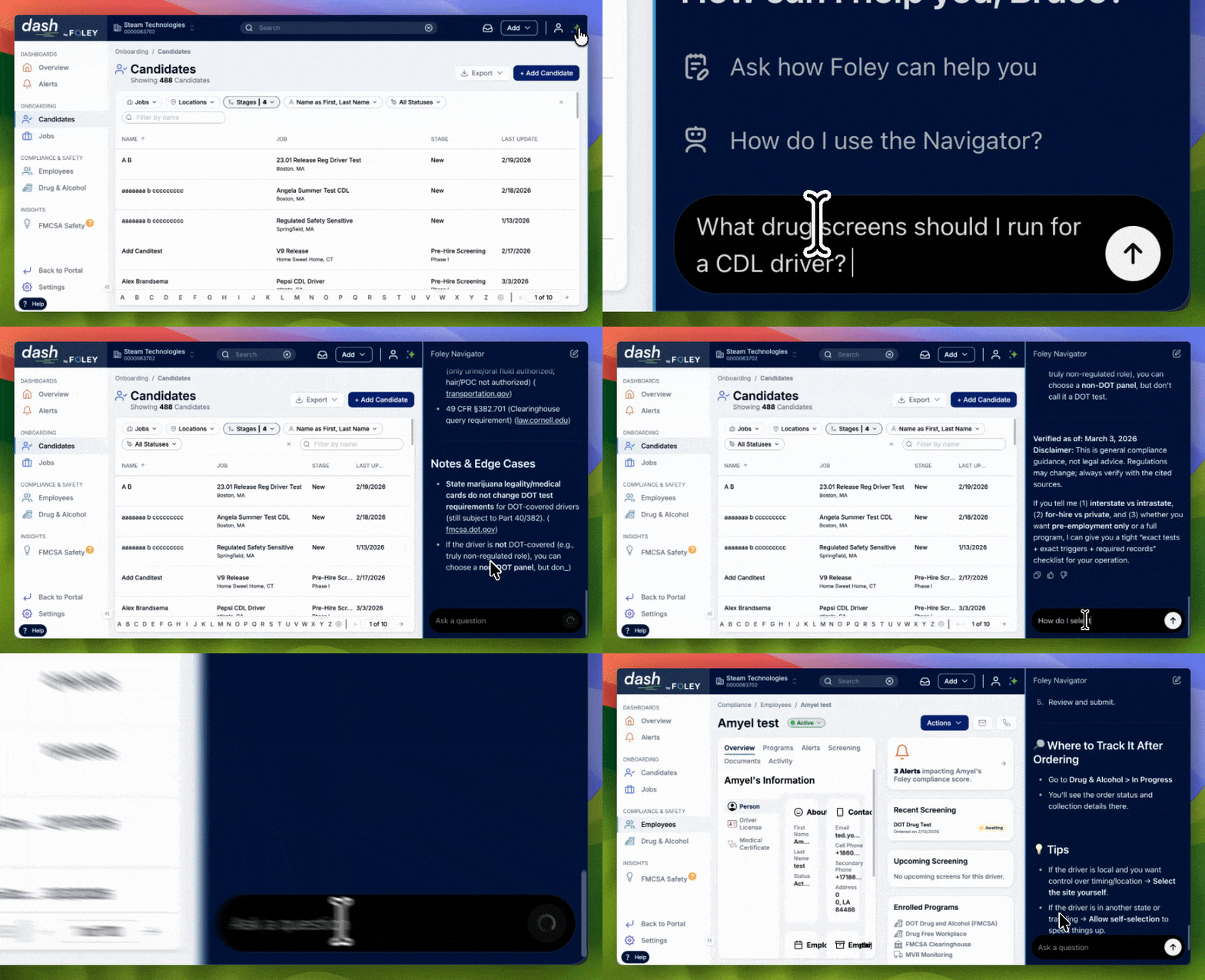
Foley has run FMCSA-compliant consortiums since 1992. Enrollment gets you into the random pool within 1-2 business days, with access to over 10,000 SAMHSA-certified collection sites, licensed MRO review, Clearinghouse reporting, MIS data retention for 5 years, and real-time compliance tracking through Foley's Dash platform. Send your driver roster and you're active in days. Request a demo to see how it works for your fleet.
Frequently asked questions
What is a DOT drug testing consortium?
A DOT drug testing consortium is a group of employers who combine their CDL drivers into a single random testing pool administered by a Consortium/Third-Party Administrator (C/TPA). The C/TPA manages all random selections, collection scheduling, MRO reviews, Clearinghouse reporting, and MIS recordkeeping on behalf of all consortium members. This is the standard compliance method for small carriers and owner-operators.
Who is required to join a DOT drug testing consortium?
Every CDL driver must be enrolled in a DOT-compliant random drug and alcohol testing program under 49 CFR §382.305. Owner-operators and carriers with fewer than 50 drivers use a consortium because a single-driver operation cannot administer its own random testing, and managing it internally is cost-prohibitive for small fleets.
How much does it cost to join a DOT drug testing consortium?
Consortium enrollment fees range from $50 to $150 per driver per year for random pool administration, MIS reporting, and program management, which can be set up quarterly or monthly. Specimen collection and MRO review fees are billed separately at $40 to $60 per test.
Can I use any collection site with a consortium?
Collection site access depends on the C/TPA operating the consortium. Foley's consortium provides access to over 10,000 SAMHSA-certified collection sites nationwide. Smaller consortiums may have limited site networks that restrict where drivers can test.
What is the difference between a consortium and a C/TPA?
A consortium is the pooled group of drivers from multiple employers. A C/TPA (Consortium/Third-Party Administrator) is the organization that manages the consortium, handling random selections, recordkeeping, and regulatory compliance. Foley is a C/TPA that operates consortiums for its carrier clients.
What happens if my consortium C/TPA misses a quarterly draw?
You're still on the hook. FMCSA audits the motor carrier, not the C/TPA. If a compliance review finds your random testing rate fell below 50% for drugs or 10% for alcohol because your C/TPA skipped a draw, the violation lands on your carrier record. That's why your C/TPA agreement should spell out draw frequency obligations and give you visibility into completion rates.
How does consortium random testing work for drivers in multiple states?
The consortium pool is national — it doesn't matter where the driver is domiciled or operating. When a driver gets selected, they report to any SAMHSA-certified collection site in the C/TPA's network. A C/TPA with a large national network (Foley uses 10,000+ sites) means your driver can test wherever they happen to be running that week.
Can I switch consortiums mid-year?
Yes. There's no regulatory prohibition on switching C/TPAs during the year. The catch: you can't have any gap in random pool coverage. Your new C/TPA needs to pick up where the old one left off, including credit for tests already completed that calendar year. Get written confirmation from both the outgoing and incoming C/TPA that the transition date is documented.
Who is liable if a consortium fails to meet the 50% random testing rate?
The motor carrier. Every time. FMCSA holds the employer — not the C/TPA — responsible for meeting random testing rates under 49 CFR §382.305. You can sue your C/TPA for breach of contract if they dropped the ball, but the FMCSA fine hits your operating authority. Penalties run up to $16,000 per violation.