









ELD Mandate Compliance Guide (2026 Updated)
Having a device in the truck doesn't make you ELD-compliant. The data behind it does.
Most CMV drivers who keep records of duty status (RODS) must use an FMCSA-registered electronic logging device. The mandate (49 CFR Part 395, Subpart B) has been in full enforcement since December 16, 2019, and the enforcement posture has only gotten stricter since then.
Who Must Use an ELD
The mandate covers CMV drivers required to keep RODS under 49 CFR Part 395:
- Vehicles with a GVWR or GCWR of 26,001 lbs or more
- Vehicles designed to transport 16 or more passengers (including the driver) for compensation
- Vehicles requiring hazmat placards
- Any driver in interstate commerce who doesn't qualify for a specific exemption
If your drivers keep paper logs today and don't fall under an exemption, they need an ELD. No wiggle room on this one.
ELD Technical Requirements
FMCSA doesn't approve specific devices. Manufacturers self-certify that their ELDs meet the technical specs in 49 CFR §395.20–§395.38. A compliant device must:
- Automatically record engine power status, vehicle motion, miles driven, and engine hours
- Synchronize with the vehicle's engine ECM. It can't rely solely on GPS or manual input for driving time.
- Record date, time, and location at each duty status change — accurate to within roughly 1 mile during on-duty driving
- Support data transfer to law enforcement via wireless web services or USB 2.0 at roadside
- Retain data for the current 24-hour period plus the previous 7 consecutive days (8 days total)
- Display records in a standardized graph-grid format
- Prevent tampering so original recorded data can't be altered
FMCSA Registered Device List
FMCSA maintains a public list of registered ELD devices. Over 900 are registered as of early 2026. But registration just means the manufacturer submitted a self-certification. That's it. FMCSA doesn't independently test, verify, or endorse any device.
Picking a registered ELD protects you from the "no ELD" violation, but it doesn't guarantee the thing actually works in the field. You're responsible for making sure the device operates properly in your vehicles. If it consistently fails to record data accurately, that's your compliance problem — not the manufacturer's.
| Registration Status | What It Means | Fleet Manager Action |
|---|---|---|
| Registered (on FMCSA list) | Manufacturer self-certified compliance | Verify device works in your vehicles |
| Revoked | FMCSA removed from list for non-compliance | Replace immediately, treated as no ELD |
| Not on list | Device does not meet the mandate | Cannot be used, violation if relied upon |
ELD Exemptions
Not every CMV driver needs an ELD. Several exemptions exist under 49 CFR §395.1:
- Short-haul (150 air-mile radius): Drivers who stay within 150 air miles, return within 14 hours, and don't exceed 11 hours driving. They use timecards instead of RODS, so the mandate doesn't apply. But exceed those limits more than 8 days in any 30-day period and the exemption disappears.
- Driveaway-towaway. Drivers delivering vehicles under their own power or being towed, where the vehicle itself is the commodity.
- Pre-2000 model year engines — CMVs with an engine manufactured before model year 2000. The older engines lack the ECM interface needed for ELD connectivity.
- Agricultural operations: Drivers hauling agricultural commodities or farm supplies within 150 air miles during state-defined planting and harvesting seasons.
- Non-CDL short-haul (100 air-mile radius). Non-CDL drivers operating within 100 air miles under §395.1(e)(2).
For a detailed breakdown of each exemption, see our guide on ELD exemptions.
“The most common ELD exemption mistake is fleets assuming all their local drivers qualify for short-haul. One driver who exceeds the 150-mile radius or the 14-hour window more than 8 times in 30 days loses the exemption, and retroactively needs ELD records for that entire period.”
ELD Malfunction Procedures
Malfunctions happen. When one does, there's a specific protocol under 49 CFR §395.34:
- Driver notes the malfunction on the device and starts paper RODS immediately
- Driver notifies the carrier within 24 hours
- Carrier has 8 calendar days from notification to repair, replace, or recalibrate the device
- If it's not corrected within 8 days? The driver can't operate the vehicle until the ELD works. Full stop.
During that 8-day window, the driver must carry paper logs and produce them at roadside. After day 8, operating without a functioning device is a violation, paper logs won't save you.
So keep spare ELD units on the shelf. Eight days sounds generous until a replacement is backordered and your driver is sitting at a truck stop on day 9.
ELD Violations and Enforcement
ELD violations fall under 49 CFR Part 395. Consequences hit fast:
| Violation | What Happens |
|---|---|
| Operating without a required ELD | Out-of-service order; driver cannot operate until corrected |
| ELD malfunction exceeding 8-day window | Out-of-service order |
| Failure to produce ELD records at inspection | Treated as "no RODS", out-of-service order |
| ELD tampering or circumvention | Out-of-service order; potential $16,000+ fine per violation |
| Using a non-registered ELD | Treated as operating without an ELD |
These violations hit your CSA score under the Hours-of-Service Compliance BASIC. The intervention threshold sits at the 65th percentile for general freight carriers — one of the lowest across all BASICs. Pretty much any carrier with a handful of violations ends up on FMCSA's radar.
For the full breakdown of fines and enforcement, see ELD Violations: Fines, Process, and Prevention.
Data Transfer During Roadside Inspections
A device that records correctly but can't transmit at roadside creates the same outcome as having no ELD at all. Test data transfer regularly.
At inspection, drivers must produce ELD records one of two ways:
- Wireless web services — the device transmits data electronically to the inspector's system
- Local transfer via USB 2.0. The driver hands over a USB with the data file.
If neither works, the driver must show a printout or display. No records at all means out of service — the violation inspectors write up most often.
Hours of Service and ELD Integration
The ELD mandate exists to enforce Hours of Service rules. The device automatically tracks driving time, on-duty time, and off-duty time. HOS violations that used to hide in paper logs now get captured in real time. That was the whole point.
This changed everything for enforcement. The overlap between ELD tracking and HOS rules kicks in across all the major limits:
- 11-hour driving limit — the device stops the clock when the engine is running and the vehicle is moving
- 14-hour on-duty window. It tracks when the window opens and won't let it pause (except for qualifying sleeper berth splits).
- 30-minute break requirement: the ELD records break periods and flags missing breaks
- 60/70-hour rolling limit — it calculates cumulative on-duty time across 7 or 8 consecutive days
For a complete breakdown, see our Hours of Service Rules guide and our article on the 11-hour and 14-hour rules.
Getting Your Fleet ELD-Compliant
Buying devices isn't compliance. A real ELD program covers device selection, installation verification on every vehicle, driver training on operation and the paper RODS fallback, a malfunction response plan with spare units, ongoing internal review of logs, malfunctions, and roadside inspection results, and record retention for the full 6 months required under 49 CFR §395.8(k). Skip any of those and you've got gaps an inspector will find.
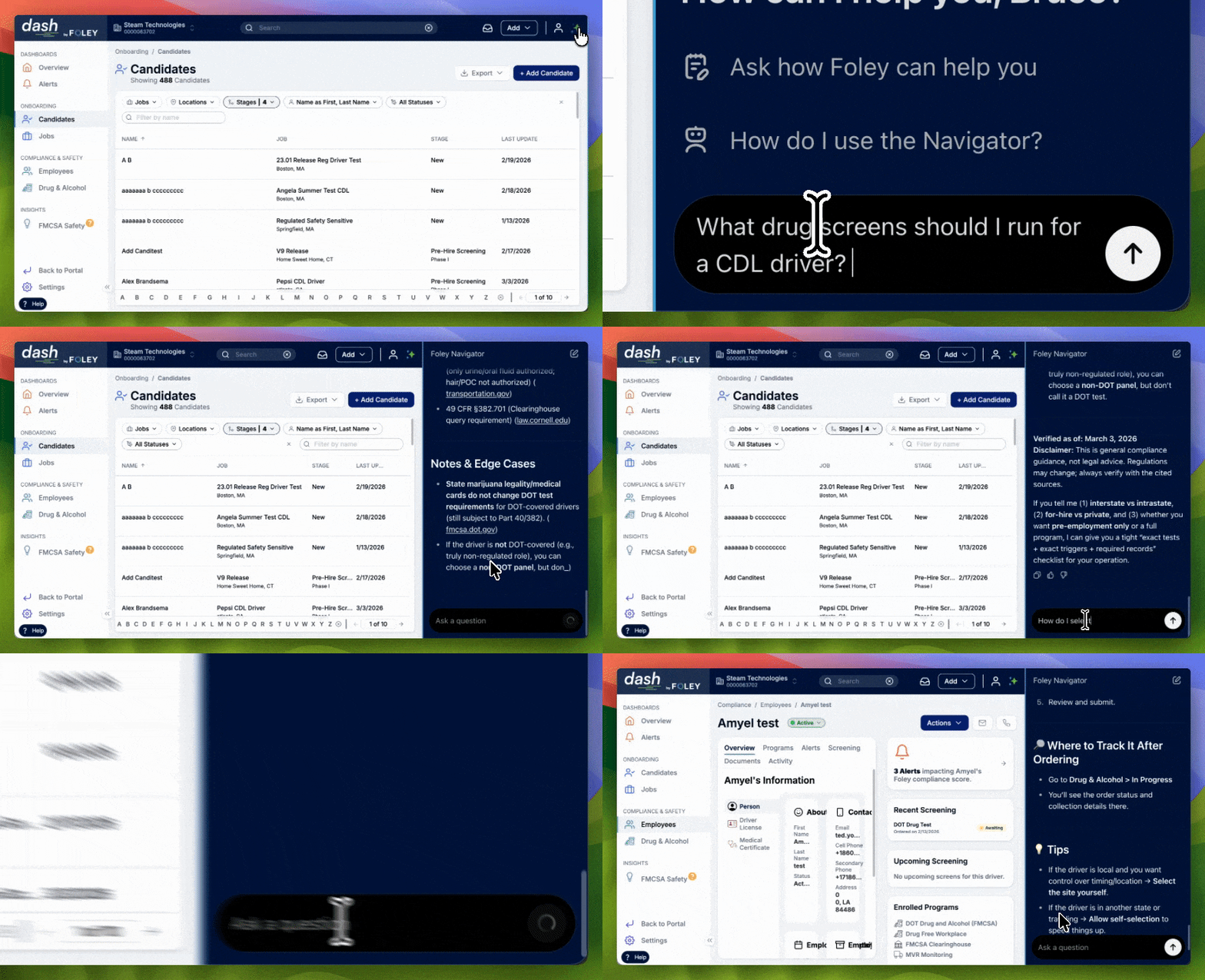
Paired with a reliable ELD system in place, Foley's Dash platform helps carriers manage the broader compliance picture around drive and fleet risk, including DOT drug testing, driver qualification files and management, alerts and CSA related visibility— all audit-ready in one platform. Request a demo to see how Dash compliments your ELD system.
Frequently asked questions
Who is required to use an ELD?
Most CMV drivers who are required to keep records of duty status (RODS) under 49 CFR Part 395 must use a registered ELD. This includes drivers of vehicles with a GVWR of 26,001+ lbs, vehicles transporting 16+ passengers for compensation, and vehicles requiring hazmat placards, unless they qualify for a specific exemption.
What happens if my ELD malfunctions on the road?
Drivers must note the malfunction and begin keeping paper RODS immediately. The carrier has 8 calendar days from the date the driver notifies them to repair, replace, or recalibrate the ELD. If the device is not corrected within 8 days, the driver cannot operate the vehicle.
How do I verify my ELD is FMCSA-registered?
FMCSA maintains a public list of registered ELD devices on its website. Registration means the manufacturer self-certified that the device meets the technical specifications in 49 CFR Part 395, Subpart B. FMCSA does not independently test or approve ELD devices.
Can a driver be placed out of service for ELD violations?
Yes. Drivers operating without a required ELD, with a device that has been malfunctioning for more than 8 days, or who cannot produce ELD records during a roadside inspection can be placed out of service, meaning the vehicle cannot move until the violation is corrected.
Do short-haul drivers need an ELD?
Drivers operating under the short-haul exemption (49 CFR §395.1(e)(1)) who operate within a 150 air-mile radius, return to their reporting location within 14 hours, and do not exceed 11 hours driving time are exempt from the ELD mandate. However, if a driver exceeds these limits more than 8 days in any 30-day period, the exemption is lost.