



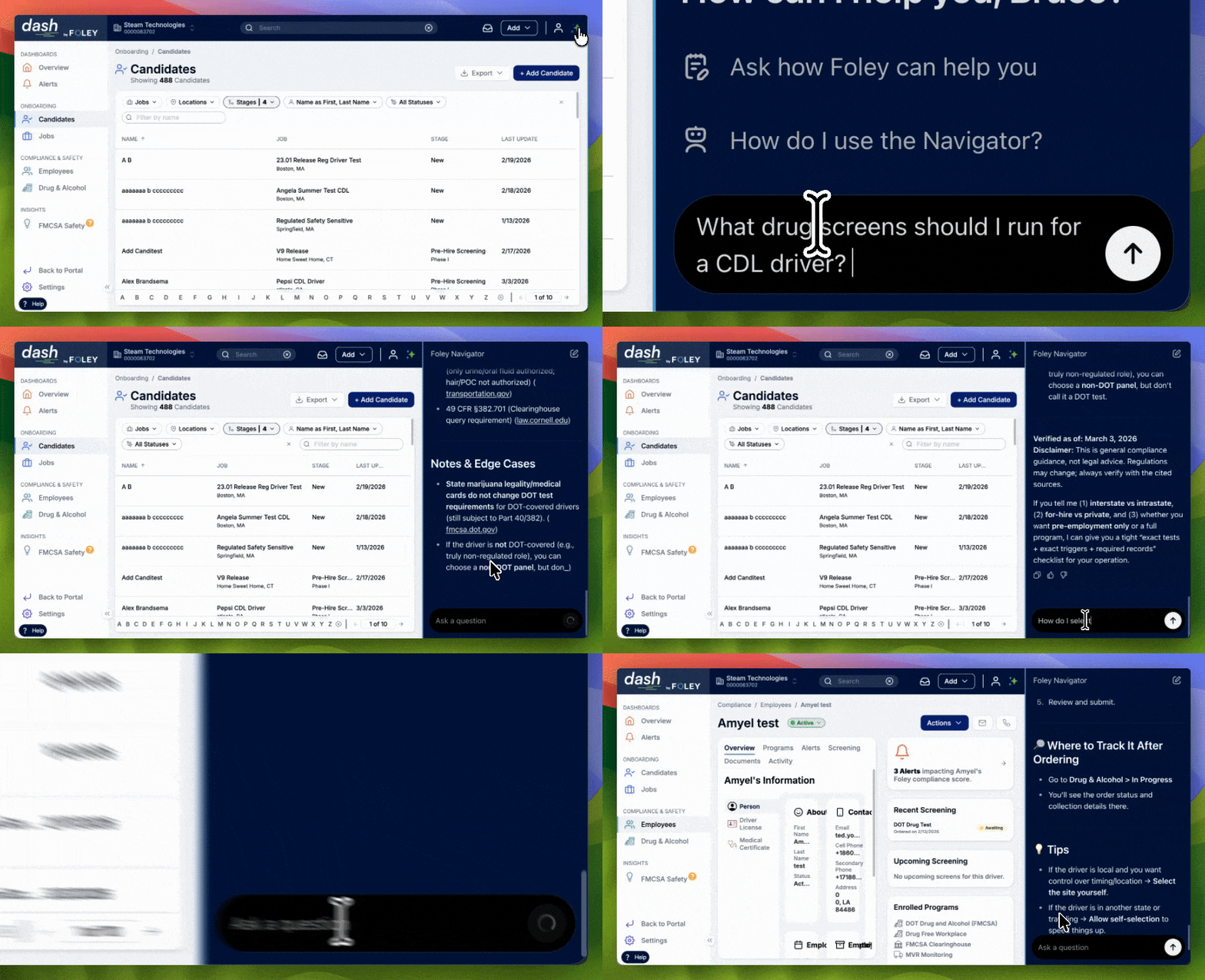





FMCSA Clearinghouse Compliance, Managed by Your C/TPA
Registration, driver consent, pre-employment and annual queries, violation reporting and return-to-duty — run for you by the consortium that operates the program, not software that reminds you to.
- Foley is your designated C/TPA inside the Clearinghouse
- Every query and report filed on schedule — records audit-ready
- Random pool run by Foley at the FMCSA minimum rates
Put Foley in the Clearinghouse for you
Tell us about your operation. A specialist confirms what you are missing and designates Foley as your C/TPA.
What the FMCSA Clearinghouse is — and what it means for you as an employer
The FMCSA Drug and Alcohol Clearinghouse is the federal database that records CDL drivers' drug and alcohol program violations. Under 49 CFR Part 382 Subpart G, every employer of CDL drivers must query it before hiring, query it again at least once a year for each driver, and report violations into it. A carrier cannot legally put a driver behind the wheel with an unresolved record in the Clearinghouse.
Foley is a consortium/third-party administrator (C/TPA) that operates its own DOT drug and alcohol testing program. That is the part that matters here: the Clearinghouse obligations sit on the employer, but the work — registration, consent, queries, reporting, return-to-duty tracking — can be done by your designated C/TPA. We do it for carriers of every size, as one accountable program rather than three vendors pointing at each other.
- Register your company and designate a C/TPA (382.711)
- Full pre-employment query before any safety-sensitive work (382.701(a))
- At least one query per driver every 12 months (382.701(b))
- Report violations, refusals and RTD results (382.705)
- Keep every driver in a random testing pool at the FMCSA minimum rates (382.305)
- A prohibited-status driver now loses the CDL itself (383.73)
Clearinghouse-II has been in force since 18 November 2024: a driver in prohibited status loses the CDL or CLP itself, not just the right to drive for you. The status is visible to the state licensing agency, and the downgrade follows automatically.
For calendar year 2026 the federal random testing minimums are unchanged — 50 percent of average driver positions for controlled substances and 10 percent for alcohol. Foley runs the queries, holds the consent records, and watches for a status change between your annual queries rather than at the next hiring cycle.
Who has to register and query
The rule reaches further than most new carriers expect. If you employ anyone who holds a CDL or CLP and operates a commercial motor vehicle that requires one, Part 382 applies to you — including a company of one.
Register as an employer, run pre-employment and annual queries on every driver, report violations, and maintain a random pool. You may do the work yourself or designate a C/TPA to do it for you.
You must register as an employer and designate a C/TPA — you cannot run your own queries or report on yourself (382.705(b)(6)). You must also belong to a random testing consortium.
Drivers themselves register only when they need to give electronic consent to a full query or want to review their own record. Medical review officers, substance abuse professionals and C/TPAs register to act in the program.
How Clearinghouse management works with Foley
That is the whole obligation, handled.
Enroll and Foley becomes your C/TPA the same day — registration, consent, queries, reporting.
Query types, timing and consent
Two query types, two consent types, and one 24-hour rule. This is where most carriers get tripped up, and it is the section our specialists get asked about most.
| Query | When it is required | Consent | What it returns |
|---|---|---|---|
| Full — pre-employment | Before the driver first performs safety-sensitive functions for you | Specific electronic consent, given by the driver in the Clearinghouse | The driver's full violation record, or confirmation that none exists |
| Limited — annual | At least once every 12 months for every employed driver | General written consent, kept on file by the employer | Whether or not a record exists — not the record itself |
| Full — follow-up | Within 24 hours of a limited query showing a record exists | Specific electronic consent | The full record; the driver is off safety-sensitive duty until it is resolved |
Full and limited queries are both drawn from the same FMCSA query plan, and purchased queries do not expire. FMCSA also sells an unlimited annual plan, which expires 12 months after purchase. FMCSA requires the employer to buy the query plan in its own Clearinghouse account — a C/TPA cannot buy a plan on your behalf. Once you designate Foley, we run the queries against your plan under 382.701 and tell you when the balance needs topping up.
Every query, on schedule, with the record in your file
Pre-employment full queries before dispatch, annual limited queries for the whole roster, and the 24-hour follow-up when a record is found — done by your designated C/TPA, not a reminder in your inbox.
Put Foley in the Clearinghouse for youReporting violations and refusals
Under 49 CFR 382.705, employers must report to the Clearinghouse: verified positive, adulterated or substituted drug test results; alcohol results of 0.04 or higher; refusals to test; actual-knowledge violations (for example a driver using on duty); negative return-to-duty results; and completion of a follow-up testing plan. The MRO reports verified results and refusals it determines; the SAP reports evaluation and eligibility dates.
Reports are due by the close of the third business day after you obtain the information (382.705). A late or missing report is a violation in its own right, separate from the underlying test result. As your C/TPA, Foley files these for you so the clock is never yours to watch.
The annual query plan and the random testing pool
Every driver, every 12 months — not "most of the roster, most years." Auditors ask for the query records alongside your random selection records, because the two obligations sit side by side in Part 382.
- Annual queries: one per driver per 12-month period; a limited query satisfies it unless a record is found (382.701(b)).
- Random testing: drivers must be in a pool tested at the FMCSA annual minimum rates — 50% for drugs and 10% for alcohol in calendar year 2026, unchanged since 2020. FMCSA publishes any change in the Federal Register and it applies from January 1 of the following year (382.305).
- Selection records: a documented, repeatable random selection schedule is exactly what a new-entrant safety audit under 49 CFR 385.321 asks to see.
Foley runs the random pool and the draws ourselves — we hold the pool, we do not broker it to another administrator. Enrolled drivers are named to a real consortium with documented selections at the required rates.
CDL downgrades: what changed under Clearinghouse-II
Since November 18, 2024, the Clearinghouse-II rule (49 CFR 383.73 and 384.235) requires state driver licensing agencies to downgrade the CDL or CLP of any driver in "prohibited" status, and to refuse to issue, renew, transfer or upgrade a commercial license while that status stands. The state must act within 60 days of being notified by the Clearinghouse. The downgrade is removed only after the driver completes the return-to-duty process and the Clearinghouse reflects it.
For an employer this changes the stakes of a violation: a driver with an unresolved record is no longer just ineligible for safety-sensitive work with you — they can lose the commercial privilege on their license altogether, and a carrier that keeps them driving is operating a downgraded CDL holder. It also changes the stakes of your reporting: an unreported violation leaves a prohibited driver licensed and hireable by the next carrier.
We report violations within the window so the record is accurate, track the return-to-duty steps so the downgrade lifts as soon as the driver is eligible, and flag any driver whose record would put their CDL at risk before you dispatch them.
A driver in prohibited status right now?
The return-to-duty sequence has to be done in order and reported correctly, or the downgrade stands. A specialist walks it with you on the call.
Return-to-duty and the SAP process
A verified positive, an alcohol result of 0.04 or higher, or a refusal puts the driver in "prohibited" status in the Clearinghouse. Getting back to safety-sensitive work follows 49 CFR Part 40 Subpart O: a substance abuse professional evaluation, completion of the prescribed education or treatment, a negative return-to-duty test under direct observation, and a follow-up testing plan of at least six tests in the first 12 months. Each step is recorded in the Clearinghouse by the SAP, the MRO or the employer.
Foley tracks the whole sequence, schedules the return-to-duty and follow-up tests, and reports completion so the record clears. The full walkthrough is in our Clearinghouse return-to-duty requirements guide.
Registering: your account, your Clearinghouse number, and who can act for you
Registration happens at clearinghouse.fmcsa.dot.gov. You create a Login.gov account (the Clearinghouse's identity provider, so identity verification is handled by Login.gov and you complete whatever steps it requires at sign-up), then register your company as an employer. Your USDOT number is your identifier in the system. There is no application to be approved; registration is immediate once identity is verified.
Authorized users and Clearinghouse Assistants
The person who registers becomes the employer's Clearinghouse Administrator. An Administrator can invite Clearinghouse Assistants — employees who can run queries and view results under the company's account — and can designate one or more C/TPAs to act for the company. Assistants act only within the employer that invited them; a C/TPA acts across every employer that designates it, which is how Foley runs queries and reports for carriers without needing a login at each one.
Common registration mistakes
- Registering as a driver instead of an employer. Owner-operators must register as an employer and designate a C/TPA; a driver-only account cannot run queries or report.
- Skipping the C/TPA designation. Designating Foley is a separate step after registration; until it is done we cannot act in your account.
- No general consent on file. Limited annual queries require the driver's general written consent before the query is run — collect it at hire.
- Letting the query plan lapse. Queries fail silently without a funded plan. Foley watches the balance and tells you before it runs out.
- Treating a limited-query "record found" as done. The full query must follow within 24 hours, with the driver's specific consent, or the driver comes off safety-sensitive duty.
Drivers: your record, your privacy, and cross-border operations
Drivers can register to view their own Clearinghouse record at no cost and must give specific electronic consent before an employer sees the full record. Only employers you have consented to, and their designated C/TPAs, can see it. Drivers licensed in Canada or Mexico who operate in the United States are subject to Part 382 and to Clearinghouse queries and reporting the same as U.S. CDL holders.
What Foley's Clearinghouse management includes
| Included | What it covers |
|---|---|
| Registration and designation | Employer registration walkthrough; Foley designated as your C/TPA |
| Consent management | General consent on file for every driver; specific consent requests handled when full queries are needed |
| Pre-employment full queries | Run before the driver's first safety-sensitive work, with the result in your file |
| Annual limited queries | Every driver, every 12 months, with the 24-hour follow-up full query when a record is found |
| Violation reporting | Positives, refusals, actual-knowledge violations and RTD results filed within the required window |
| Return-to-duty tracking | SAP referral, RTD test, follow-up testing plan and Clearinghouse close-out |
| Random testing consortium | A real pool, run by Foley, at the FMCSA minimum rates, with selection records |
| Audit-ready records | Query, consent, selection and result records organized the way an auditor requests them |
Clearinghouse management is included with Foley's DOT drug and alcohol testing program. For program details, use the form on this page or call us.
Penalties and audit exposure
Clearinghouse violations are cited under 49 CFR 382.507 and carry civil penalties under 49 U.S.C. 521(b). FMCSA adjusts the maximum penalty every year for inflation, so the figure that applies is the one in force on the date of the violation. In practice the larger cost is the one that shows up in an audit: a driver operating with an unresolved record, a missing annual query, or a random program that cannot produce selection records can each move a carrier toward a conditional or unsatisfactory safety rating.
Query records, consent forms and random selection records are on the auditor's list. If any of those are thin, a Foley specialist can tell you in one call what is missing and how fast it can be closed — (860) 633-2660.
Why carriers put Foley in the Clearinghouse for them
Most Clearinghouse "services" are software that reminds you to do the work. Foley operates the program: we are the C/TPA of record, we hold and run the random pool, results are verified by a certified medical review officer under Part 40 Subpart G before anything reaches you, and the same team handles your driver qualification files, driver background screening and MVR monitoring. One specialist to call. One set of records for the auditor.
- Consortium/Third-Party Administrator under 49 CFR Part 40 — the pool is ours, not brokered
- Nationwide collection-site network for pre-employment, random, post-accident and reasonable-suspicion collections
- Designated-employer-representative support so results are handled correctly on your side
Two ways to get this off your desk
Enroll online and Foley becomes your designated C/TPA the same day, or talk to a specialist first about what your program is missing.
- FMCSA added identity-verification requirements for new Clearinghouse users on 27 April 2026. Every new registered user is in scope except CDL and CLP drivers.
- Roughly 180,000 drivers currently sit in the Clearinghouse with a violation still to clear, and about 65,400 employers are touched by the downgrade rule.
- A limited query that comes back showing a record exists starts a 24-hour clock: you must escalate to a full query, and pull the driver if consent is refused.
- A limited-query consent form is only valid if it names the time range it covers. Blanket forms without one are the failure we see most often in an audit.
Carriers who already run this with Foley
Arbor Pro of Virginia
Runs and stores every annual and full Clearinghouse query on schedule, with the consent records held for the audit. Read the case study.
Torc Robotics
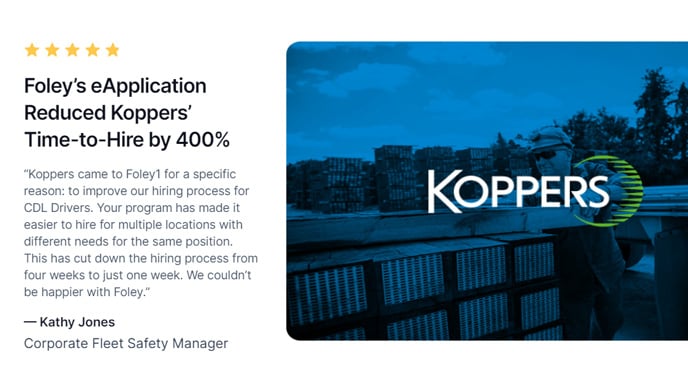
Saved close to half its compliance staff time compared with running driver files in a spreadsheet. Read the case study.
Frequently asked questions
Is there a Clearinghouse number or Clearinghouse application?
No. Your identifier in the Clearinghouse is your USDOT number, and there is no application to approve — you create a Login.gov account, verify your identity, and register your company as an employer. Owner-operators then designate a C/TPA. Foley walks you through both steps at enrollment.
Can the Clearinghouse cause a CDL to be downgraded?
Yes. Under Clearinghouse-II (effective November 18, 2024), state licensing agencies must downgrade the CDL or CLP of any driver in prohibited status and refuse to issue or renew one until the driver completes return-to-duty and the Clearinghouse reflects it 49 CFR 383.73, 384.235.
What is the FMCSA Clearinghouse?
The FMCSA Drug and Alcohol Clearinghouse is a federal database of CDL and CLP drivers' drug and alcohol program violations, established under 49 CFR Part 382 Subpart G. Employers must query it before hiring a driver and at least once a year for every driver they employ, and must report violations to it. It is run by FMCSA; Foley acts on your behalf inside it as your designated consortium/third-party administrator (C/TPA).
Who has to register in the Clearinghouse?
Every employer of CDL drivers subject to Part 382, every owner-operator (who must also designate a C/TPA), and the medical review officers, substance abuse professionals and C/TPAs that act in the program. Drivers register only when they need to give electronic consent to a full query or to view their own record.
What is the difference between a limited query and a full query?
A limited query tells you whether a record exists for the driver; it needs the driver's general written consent, which you keep on file. A full query returns the record itself and needs the driver's specific electronic consent inside the Clearinghouse. Pre-employment checks must be full queries. If a limited annual query shows a record exists, you must run a full query within 24 hours or remove the driver from safety-sensitive functions until you do (49 CFR 382.701).
How often do I have to run Clearinghouse queries?
A full query before a driver first performs safety-sensitive functions for you, and at least one query per driver in every 12-month period after that. The annual query may be limited. Foley runs both on schedule for every driver in your program.
What do I have to report to the Clearinghouse, and how fast?
Employers report verified positive, adulterated or substituted results, refusals to test, actual-knowledge violations, negative return-to-duty results and completion of follow-up testing plans, under 49 CFR 382.705. Reports are due by the close of the third business day after you learn of the violation 49 CFR 382.705. As your C/TPA, Foley files these reports for you.
How do I sign up for the Clearinghouse as an employer?
You register your company at clearinghouse.fmcsa.dot.gov using a Login.gov account, then designate your C/TPA so they can query and report on your behalf. Foley handles the registration walkthrough and the designation step for you at enrollment.
Does an owner-operator need the Clearinghouse?
Yes. An owner-operator is both employer and driver, so they must register as an employer, designate a C/TPA to run queries and report violations, and be enrolled in a random testing consortium under 49 CFR 382.305 and 382.705(b)(6).
What does Foley's Clearinghouse management include?
Employer registration and C/TPA designation, driver consent collection and tracking, pre-employment full queries, annual limited queries with automatic follow-up full queries, violation reporting, return-to-duty and follow-up test tracking, and audit-ready records — as part of Foley's DOT drug and alcohol testing consortium. Queries are billed against the query plan in your own Clearinghouse account: FMCSA requires the employer to purchase that plan, and a C/TPA cannot buy one on your behalf. Foley runs the queries against your plan and tells you when it needs topping up.
Let Foley run your Clearinghouse compliance
Registration, queries, reporting and return-to-duty — handled by the consortium that operates the program. Tell us what you run and get a straight answer on the call.