








DOT Compliance: Requirements, Audits & Managed Service
Foley runs the whole federal compliance program for your fleet — our own drug and alcohol consortium, your driver qualification files, Clearinghouse queries, MVR monitoring, and your UCR, MCS-150 and BOC-3 filings.
- We run our own DOT drug & alcohol consortium and act as your C/TPA
- DQ files, Clearinghouse queries and MVR monitoring, managed for you
- UCR, MCS-150 and BOC-3 filed by us — never brokered out
Find out what is missing before an investigator does
Send your driver count and current setup. You get the gaps in writing, hire us or not.
What DOT compliance actually requires
DOT compliance is the set of driver qualification, testing, recordkeeping, inspection and filing duties a motor carrier owes under the Federal Motor Carrier Safety Regulations. The FMCSR sit at 49 CFR Parts 350–399, and the drug and alcohol testing procedures they point to sit at 49 CFR Part 40. An FMCSR is one individual rule inside that body — when people search "DOT regulations," "DOT regs" or "DOT rules and regulations," this is what they mean.
These duties attach the day you begin operating a commercial motor vehicle as defined at 49 CFR 390.5. They do not begin when you are audited. Being DOT compliant means every record below exists, is current, and can be produced on demand.
- A driver qualification file per driver, with the contents listed at 49 CFR 391.51 — application, MVR, employment verifications, medical certificate, road test
- Pre-employment, random, post-accident, reasonable-suspicion, return-to-duty and follow-up testing under 49 CFR Part 382
- Full pre-employment and annual limited Clearinghouse queries under 49 CFR 382.701
- An annual review of each driver's MVR and driving record under 49 CFR 391.25
- Hours-of-service records and ELD data under 49 CFR 395.8 and 49 CFR 395.22
- Driver vehicle inspection reports (49 CFR 396.11), an annual inspection per vehicle (49 CFR 396.17), and a maintenance file per vehicle (49 CFR 396.3)
- Registration and filings: USDOT number, biennial MCS-150 update (49 CFR 390.19), process agent designation (49 CFR Part 366), UCR (49 CFR Part 367), insurance on file (49 CFR Part 387)
- An accident register under 49 CFR 390.15(b)
FMCSA is moving carrier registration onto Motus, the system announced in the Federal Register on 29 April 2026. Motus replaces the Unified Registration System, the registration side of MCMIS, and the legacy ICC Licensing and Insurance system. Phase I went live in December 2025 for supporting companies such as process agents and insurance filers; Phase II opened the system to motor carriers, brokers and freight forwarders through the second quarter of 2026.
No regulation changed and no new deadline was created. What changed is the front door: the next biennial update, USDOT-number change, operating-authority change or BOC-3 filing is where most carriers will meet it. Fleets with several affiliated entities should expect to re-validate logins and authorisations, because each entity keeps its own record. Foley files through whichever system is live on the day, so the transition is ours to manage, not yours. Read our Motus briefing.
The 2026 CVSA International Roadcheck ran 12–14 May 2026. The two focus areas were cargo securement and electronic logging device tampering and falsification. Inspectors reviewed records of duty status for driving while not logged in, disconnected or tampered devices, improper edits and unidentified driving time, ghost co-drivers, misuse of personal conveyance, and off-duty time recorded while working.
Those inspections are not a one-week event on your record. Every violation written that week is weighted and time-decayed into your BASIC percentiles for the next two years, which is why a single bad Roadcheck stop shows up in an intervention months later.
Who FMCSA regulates — and who wrongly assumes they are exempt
FMCSA regulates you if you operate a vehicle in interstate commerce that meets the commercial motor vehicle definition at 49 CFR 390.5: a gross vehicle weight rating or gross combination weight rating of 10,001 pounds or more, or a vehicle designed to carry 9 to 15 passengers for compensation, or 16 or more passengers, or one carrying hazardous materials in a placardable quantity. A CDL is not the trigger. Weight, passengers and hazmat are.
You cross state lines, or your freight does even if your truck does not. The full FMCSR apply, plus a USDOT number and, for for-hire carriers, operating authority under 49 CFR Part 365.
Most states adopt the FMCSR by reference for intrastate carriers, sometimes with a lower weight threshold, a different minimum age, or a state-specific medical waiver. Each state adopts its own version by statute or administrative code, so the intrastate standard that governs is the one in force in the state where the vehicle operates. Foley confirms the adopted parts for your operation.
Non-CDL drivers are the group most often missed. A driver in a 12,000-pound box truck crossing a state line is a regulated driver: qualified under 49 CFR 391.11, medically certified under 49 CFR 391.41–391.45, subject to hours of service under Part 395, and carried in your DQ file system.
- DOT requirements for non-CDL drivers: DQ file, MVR at hire and annually, medical examiner's certificate, road test or equivalent, HOS records
- Part 382 drug and alcohol testing applies only to drivers operating a CMV that requires a CDL — a non-CDL DOT driver is generally outside Part 382 but fully inside Parts 391, 395 and 396
- Many fleets still test non-CDL drivers under company authority; that is a non-DOT test and must be kept separate from the DOT program
"DOT certification": what it really means and how to get registered
There is no federal credential called a DOT certification for a carrier. When someone asks how to get DOT certified, they mean one of three different things, and the answer changes depending on which.
- Getting a USDOT number. You register with FMCSA and receive a DOT number. This identifies the carrier; it is not a safety approval. There is no federal fee for the USDOT number itself. For-hire interstate carriers also need operating authority (an MC number), which carries a $300 application fee per authority type under 49 CFR 360.3T and a 10-day protest window from publication before it is granted.
- The driver's medical certificate. A driver "gets DOT certified" by passing an exam with a certified medical examiner under 49 CFR 391.43. That is driver-side medical certification, not carrier compliance.
- Passing the new entrant safety audit. New carriers are audited under 49 CFR Part 385, Subpart D and, on passing, have their new entrant designation removed. This is the closest thing to being "certified" and it is the one most owners are actually worried about.
Registration also carries recurring filings that carriers routinely let lapse:
- The biennial MCS-150 update under 49 CFR 390.19 — due on a schedule keyed to your USDOT number, whether or not anything about your operation changed
- A BOC-3 process agent designation covering every state you operate in, under 49 CFR Part 366
- Annual UCR registration under 49 CFR Part 367 — see our UCR filing guide for the bracket structure. The UCR Board sets the fees each year by power-unit bracket, counted from the power units reported on your MCS-150; trailers are excluded
- Proof of financial responsibility on file under 49 CFR Part 387
Start with the gap review
Before you change vendors or buy software, find out which records are actually missing. We audit what you have against 49 CFR 391.51 and 382.701 and tell you straight.
How managed DOT compliance works with Foley
We do not hand you a checklist and a login. We take the obligations off your desk and run them, then hand you the records when an investigator asks.
The rules and the clock: what is due, when, and under which part
Almost every violation we see in an audit is a timing failure, not a knowledge failure. The record existed; it was late, expired, or never renewed.
| Obligation | Governing part | Timing |
|---|---|---|
| Pre-employment drug test | 49 CFR 382.301 | Negative result received before the driver first performs a safety-sensitive function |
| Pre-employment full Clearinghouse query | 49 CFR 382.701(a) | Before first performing a safety-sensitive function; requires the driver's specific consent |
| Limited Clearinghouse query | 49 CFR 382.701(b) | At least once every 12 months for every CDL driver |
| Random drug and alcohol testing | 49 CFR 382.305 | Spread reasonably through the year at the federal minimum rates. For 2026 the minimums are 50 percent for controlled substances and 10 percent for alcohol; FMCSA publishes any change in the Federal Register, effective the following 1 January |
| Post-accident testing | 49 CFR 382.303 | Alcohol within 8 hours; controlled substances within 32 hours |
| Safety performance history investigation | 49 CFR 391.23 | Within 30 days of the driver beginning work |
| Annual MVR and driving record review | 49 CFR 391.25 | Every 12 months, with a signed note of the review in the DQ file |
| Medical examiner's certificate | 49 CFR 391.45 | At least every 24 months; shorter if the examiner restricts it |
| Driver vehicle inspection report | 49 CFR 396.11 | Each day a defect is found or reported; retained 3 months |
| Annual vehicle inspection | 49 CFR 396.17 | Every 12 months per vehicle; report retained 14 months |
| Hours-of-service records / ELD data | 49 CFR 395.8 | Retained 6 months with supporting documents |
| Accident register | 49 CFR 390.15(b) | Maintained 3 years from the date of each accident |
| MCS-150 biennial update | 49 CFR 390.19 | Every 24 months on the schedule keyed to your USDOT number |
| UCR registration | 49 CFR Part 367 | Annually; registration must be completed before 1 January of the registration year |
Every date in that table, tracked for you
Annual limited queries, 391.25 reviews, medical certificate expirations, annual inspections, MCS-150 and UCR windows — scheduled and flagged before they lapse.
See how it worksDOT inspections: roadside levels, the annual inspection, and the form
Two different things get called a DOT inspection, and confusing them costs carriers points in the Vehicle Maintenance BASIC.
Roadside inspections
Roadside DOT inspections are conducted to standards set by the Commercial Vehicle Safety Alliance, not by a CFR part, and are graded in levels. Level I is the full driver-and-vehicle inspection including the under-vehicle portion. Level II is walk-around driver and vehicle. Level III is driver credentials only. Level V is a vehicle-only inspection performed without the driver present. The out-of-service criteria applied are CVSA's, and CVSA reissues them each year, so the edition in force on the date of the inspection is the one that governs.
Any vehicle placed out of service must be repaired before it returns to service, and the signed inspection report must be returned to the issuing agency under 49 CFR 396.9(d). Missing that return is a paperwork violation that appears on your record months later.
The annual inspection
Separately, every commercial motor vehicle you operate must pass a periodic inspection at least once every 12 months under 49 CFR 396.17, performed by a qualified inspector meeting 49 CFR 396.19. The DOT inspection form people search for is the report generated by that inspection — the minimum inspection standards are at 49 CFR Part 396, Appendix A. A passing roadside Level I inspection can substitute for the annual inspection if the report documents it.
- Keep the annual inspection report, or a copy, where the vehicle is housed or maintained
- Driver vehicle inspection reports under 49 CFR 396.11 are a separate daily obligation, not the annual inspection
- Every vehicle needs a maintenance file under 49 CFR 396.3(b) for as long as you control it, plus 6 months after
New entrant? The clock is already running
FMCSA audits new carriers early in their first period of operation under 49 CFR Part 385, Subpart D. Files built after the notice arrives are the ones that fail.
What happens in an audit, and what violations cost
There are two encounters. A new entrant safety audit under 49 CFR Part 385, Subpart D happens in your first period of operation and is largely a records exercise. A compliance review is deeper, is usually triggered by your CSA scores, a crash, or a complaint, and produces a safety rating of satisfactory, conditional or unsatisfactory under 49 CFR 385.3.
Investigators score against acute and critical violations listed in 49 CFR Part 385, Appendix B. Acute violations are so severe that a single instance requires immediate corrective action — using a driver who tested positive, or failing to implement a drug and alcohol testing program at all. Critical violations reflect breakdown in management controls and are measured as a pattern.
In the audits we sit in on, the failures cluster in four places: no pre-employment Clearinghouse query on file, a random testing program that never pulled a selection, DQ files missing the 391.23 employment verifications, and expired medical certificates still in the active driver roster. None of these are hard. All of them are automatic findings.
Civil penalties for FMCSR violations are set out in 49 CFR Part 386, Appendix B and are adjusted for inflation every year, so the amount that applies is the one in force on the date of the violation. Penalties are typically assessed per violation, and recordkeeping violations can be assessed per day or per driver. An unsatisfactory rating can lead to an order prohibiting operation. The practical exposure for most fleets is not one large fine — it is a conditional rating that your insurer and your shippers both see.
DOT recordable vs. DOT reportable accidents
People use "DOT recordable" and "DOT reportable" interchangeably. Federally, there is one definition that matters: the definition of accident at 49 CFR 390.5. If a crash meets it, it goes on your accident register and it counts against you in the Crash Indicator BASIC.
An occurrence involving a commercial motor vehicle on a public road that results in a fatality; or bodily injury to a person who immediately receives medical treatment away from the scene; or one or more vehicles being towed from the scene because of disabling damage. Record it under 49 CFR 390.15(b) and keep the register 3 years.
An occurrence involving only boarding and alighting from a stationary vehicle, only the loading or unloading of cargo, or the result of a cargo inspection. Fault is irrelevant either way — a crash you did not cause is still recordable if it meets the criteria.
What makes an accident DOT reportable in the testing sense is a different test, at 49 CFR 382.303. Post-accident testing is required when there is a fatality, or when the driver receives a citation and the crash caused an injury treated away from the scene or disabling damage requiring a tow. Alcohol testing must occur within 8 hours, controlled substance testing within 32 hours, and you must document why any test was not performed.
State crash reporting is separate again, with its own thresholds and its own form. A crash can be state-reportable and not DOT recordable, or the reverse. We track both against your register.
Fleet safety programs and "fleet safety certified"
There is no federal fleet safety certification. No agency issues a certificate that makes a fleet "fleet safety certified." What exists is a satisfactory safety rating under 49 CFR 385.3, clean CSA percentiles in FMCSA's Safety Measurement System, and third-party or insurer-run programs that issue their own credentials. If a vendor sells you a fleet safety certification, ask who issues it and what it is recognized by.
A fleet safety program is the internal system that produces those outcomes. The parts of it that are federally required, and therefore audited, are specific:
- A written drug and alcohol policy distributed to every covered driver, with signed receipt, under 49 CFR 382.601
- A designated employer representative under 49 CFR 382.107 who can be reached and can act on a positive result
- Reasonable suspicion training for every supervisor — at least 60 minutes on controlled substances and 60 minutes on alcohol, under 49 CFR 382.603
- Entry-level driver training from a registered provider for new CDL applicants and upgrades, under 49 CFR Part 380, Subpart F
- Instruction that drivers are informed of and comply with the FMCSR, under 49 CFR 390.3(e)(1)
- Hazmat employee training, including recurrent training, under 49 CFR 172.704 if applicable
DOT compliance training, in practice, means those required trainings plus the internal training that keeps them from being findings: how your DER handles a refusal, how dispatch handles an out-of-service order, how a hiring manager runs a full Clearinghouse query. We deliver these to your team, not as generic courseware, but against your own program documents.
What Foley does for each obligation
This is the obligation map, with the part that governs it and what we operate on your behalf.
| Obligation | Part | What Foley runs |
|---|---|---|
| Driver qualification files | 49 CFR 391 | We build and maintain the file, run the 391.23 investigations, track medical certificates and license expirations, and hold it audit-ready |
| Drug and alcohol testing | 49 CFR 382 / Part 40 | We are the consortium and the C/TPA — enrollment, random pool management and selections, collection site network, MRO review, refusal and positive handling |
| Return-to-duty process | 49 CFR 40, Subpart O | SAP referral coordination, RTD test scheduling, follow-up testing plan administration |
| Clearinghouse | 49 CFR 382.701–.705 | Full pre-employment and annual limited queries, consent management, employer violation reporting |
| MVR and driver monitoring | 49 CFR 391.25 | MVRs at hire and annually, plus continuous monitoring so a violation surfaces when it happens, not at the annual review |
| Background screening | 49 CFR 391.23 | Previous employer safety performance history, including the 3-year drug and alcohol history |
| Hours of service | 49 CFR 395 | Log auditing and exception reporting against your ELD data |
| Vehicle files | 49 CFR 396 | Annual inspection tracking, DVIR retention, maintenance file structure |
| Registration and filings | 49 CFR 366, 367, 390.19 | MCS-150 biennial updates, UCR, BOC-3 — prepared and submitted by us |
| Accident register | 49 CFR 390.15(b) | Register maintenance and the recordable/post-accident-testing determination on each crash |
| Audit response | 49 CFR 385 | Mock audit, document assembly, and direct support through the safety audit or compliance review |
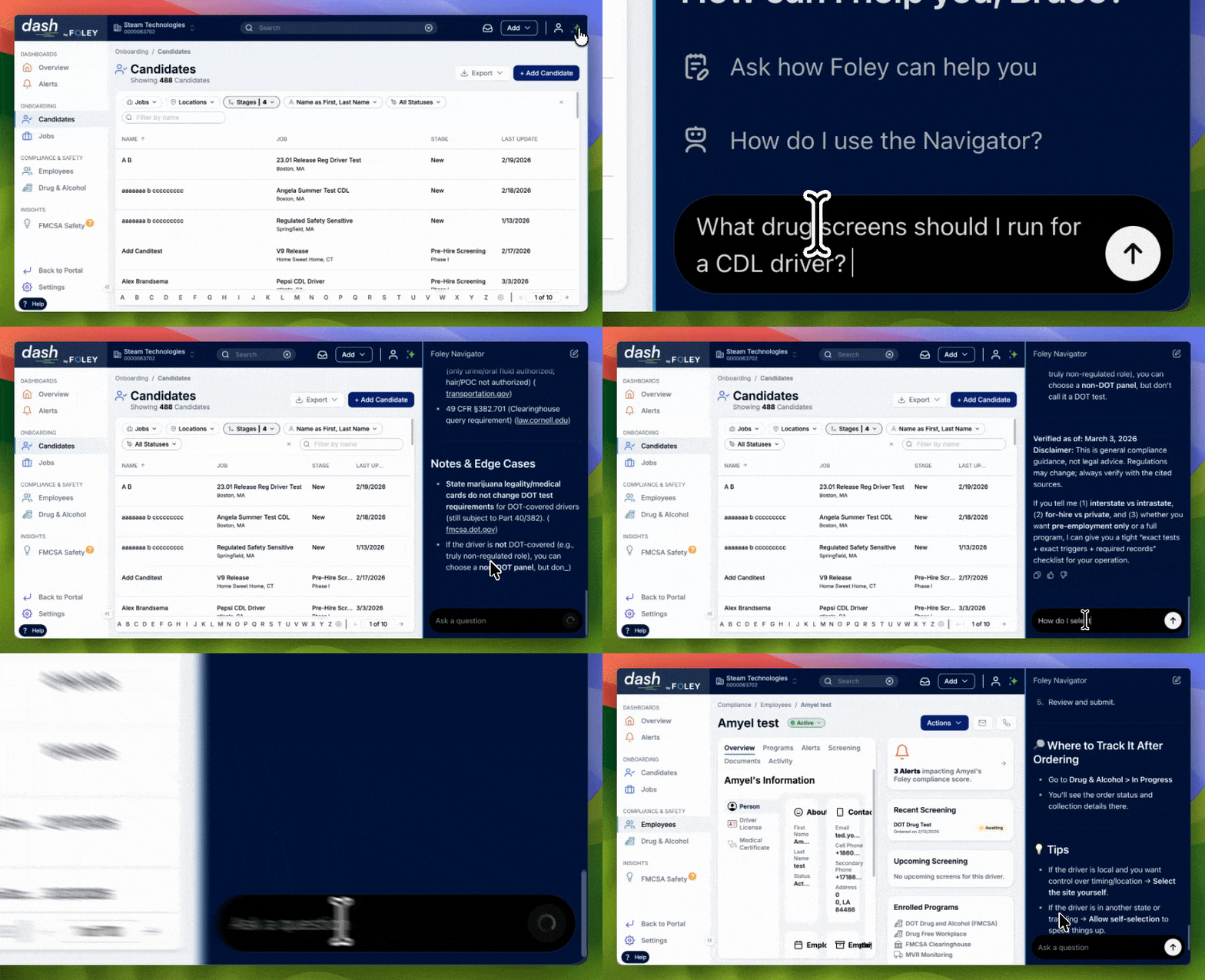
DOT compliance software: what the platform does
The software is where you see the program, not the program itself. That distinction matters, because most DOT compliance software sells you a place to store documents and leaves the actual work — the query, the collection, the MRO review, the filing — to you.
- One driver record per driver: DQ file contents, test history, Clearinghouse query results, MVR and monitoring alerts, medical certificate expiration
- A compliance calendar driven by the CFR timing — annual reviews, limited queries, medical certs, annual inspections, MCS-150 and UCR windows
- Random selection notices with driver name, test type and window, so your DER is not tracking a pool in a spreadsheet
- Document vault with the retention periods built in, so nothing gets purged before 49 CFR 382.401 or 49 CFR 391.51 allows
- An audit export that produces the file set an investigator asks for, in the order they ask for it
- Role-based access for owners, safety managers, dispatchers and the DER
If you already run a TMS or an ELD platform, we sit alongside it. We are not asking you to move your dispatch or your logs.
Who this is for: owner-operators, small fleets, and 100+ power units
The obligations do not scale down. One truck owes the same DQ file, the same random pool participation, the same MCS-150 update as fifty trucks. What changes is who has time to do it.
An owner-operator with a CDL must be in a consortium random pool — you cannot randomly select yourself. Simplified DOT compliance here means consortium enrollment, your own DQ file, the annual limited query, and your filings handled so you are not learning the FMCSA portal at midnight.
Big enough to be audited seriously, too small for a full-time safety director. This is where new entrant safety audits are failed. We become the safety department: files, testing, monitoring, filings, and someone who answers when a driver tests positive on a Friday.
You have a safety director and a CSA score to defend. We take the volume work — queries, MVR monitoring, file maintenance, random administration — and give your team exception reports and clean audit exports instead of data entry.
Across all three, the standard is the same: if an investigator walks in tomorrow, the records exist and we can produce them.
Pricing and engagement model
We price the program, not the paperwork. Three ways to engage:
- Consortium only. Random pool enrollment, C/TPA services, MRO review, collection site access. Use the contact form or call us for a quote.
- Managed compliance. The consortium plus DQ file management, Clearinghouse queries, MVR monitoring, background screening and the compliance calendar.
- Filings and project work. MCS-150 updates, UCR, BOC-3, new authority setup, DQ file remediation, and audit preparation. We quote our fee before the work starts, and any government fee is quoted separately and passed through at cost.
What we do not do: charge a percentage of a fine, bill per test on a surprise invoice, or quote a consortium rate that excludes MRO review. Government fees — UCR, operating authority — are passed through at cost. Ask for the total, in writing, before you sign anything, from us or from anyone else.
Why carriers choose Foley over a filing service or a broker
Most companies selling DOT compliance services are intermediaries. They enroll you in someone else's consortium, forward your BOC-3 to a process agent network, and hand your test to an unaffiliated C/TPA. When something goes wrong — a specimen is lost, an MRO cannot reach a driver, a filing is rejected — they are making the same phone call you would.
Foley operates the program. We run our own DOT drug and alcohol consortium and act as your C/TPA under 49 CFR Part 40. We support your DER directly. We run your Clearinghouse queries, maintain your DQ files, run background screening and continuous MVR monitoring, and submit your MCS-150, UCR registration and BOC-3 ourselves.
If you are comparing DOT compliance companies — and "DOT Compliance Group" is the name of one such competing provider, not a government body — the questions that separate them are short:
- Do you own the consortium, or resell one? Who is the C/TPA of record on my program?
- Is MRO review included, or billed per positive?
- Do you submit my filings, or forward them?
- Will you sit in my compliance review with me?
- Who answers at 4pm Friday when a driver refuses a test?
We work with carriers in every state, including intrastate-only fleets in Texas, California and Florida. States adopt the FMCSRs for intrastate carriers by reference and each one writes its own variations, so we confirm which version applies to your operation before we build the program. Whether you need a DOT number for the first time, a DOT drug test program that survives an audit, or help with your UCR filing, the engagement starts the same way: we look at what you have and tell you the truth about it.
Not sure whether you are even regulated?
If your vehicle is 10,001 pounds or more and crosses a state line, or your freight does, 49 CFR 390.5 applies to you. Tell us what you run and we will tell you what you owe.
- Offsite is the FMCSA default for both new entrant audits and compliance reviews, with electronic submission windows as short as 48 hours.
- In Foley's audit support work, driver qualification file failures have accounted for about 20 percent of critical and acute violations over five years.
- Roadside inspectors query the Clearinghouse during an inspection, so a prohibited driver surfaces at the roadside and not at your next annual query.
- Carriers cited or placed out of service during Roadcheck are prioritised for audits in the months that follow.
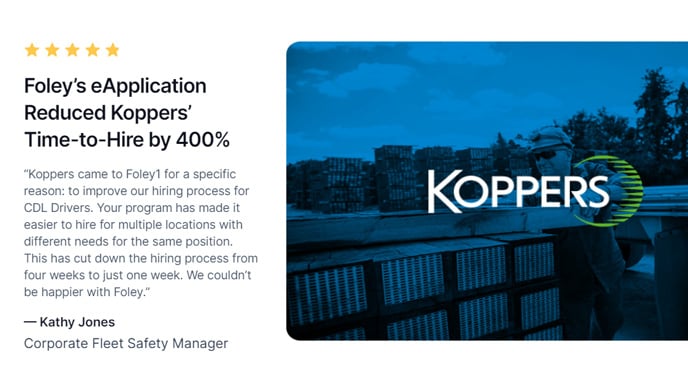
Carriers who already run this with Foley
Lindenmeyr Munroe
Lifted its compliance score from under 75 percent to around 95 percent, and now pulls MVRs in minutes instead of a day or two. Read the case study.
Torc Robotics
Saved close to half its compliance staff time compared with running driver files in a spreadsheet. Read the case study.
PKS Concrete Pumping
Made onboarding about 75 percent more efficient and gave back the hours a week that went into chasing paperwork. Read the case study.
Frequently asked questions
What is DOT compliance?
DOT compliance is meeting the Federal Motor Carrier Safety Regulations at 49 CFR Parts 350–399 and the testing procedures at 49 CFR Part 40. In practice it means a complete driver qualification file for every driver (49 CFR 391.51), an operating drug and alcohol testing program (49 CFR Part 382), Clearinghouse queries (49 CFR 382.701), hours-of-service records (49 CFR 395), vehicle inspection and maintenance records (49 CFR 396), and current registrations and filings.
What is FMCSA compliance?
The same thing, named for the agency. FMCSA — the Federal Motor Carrier Safety Administration — is the DOT agency that writes and enforces the FMCSR for motor carriers. "DOT compliance" and "FMCSA compliance" describe one obligation set; "DOT" is broader in that it also covers agencies like PHMSA for hazardous materials.
What is an FMCSR?
An FMCSR is a Federal Motor Carrier Safety Regulation — one rule within 49 CFR Parts 350–399. The parts that generate almost all enforcement activity are Part 382 (controlled substances and alcohol testing), Part 391 (driver qualification), Part 395 (hours of service) and Part 396 (inspection, repair and maintenance).
How do I get DOT certified?
There is no carrier "DOT certification." You register for a USDOT number with FMCSA, add operating authority if you are for-hire interstate, file a BOC-3 process agent designation (49 CFR Part 366), register for UCR (49 CFR Part 367), and put insurance on file (49 CFR Part 387). New carriers then pass a new entrant safety audit under 49 CFR Part 385, Subpart D. Separately, a driver "gets DOT certified" by passing a physical with a certified medical examiner under 49 CFR 391.43.
How much is DOT certification?
Registration costs depend on what you need. There is no federal fee to get a USDOT number and no federal fee to file the MCS-150 biennial update. Operating authority costs $300 per authority type under 49 CFR 360.3T. UCR fees are set each year by the UCR Board in brackets based on the power units reported on the MCS-150, and a BOC-3 filing carries a service fee from the process agent. Ask any provider for the total including pass-through fees before you pay.
What is FMCSA regulated?
You are FMCSA regulated if you operate a commercial motor vehicle in interstate commerce as defined at 49 CFR 390.5: 10,001 pounds or more GVWR or GCWR, or designed to carry 9–15 passengers for compensation or 16 or more passengers, or carrying placardable hazardous materials. A CDL is not required for you to be regulated.
What are the DOT requirements for non-CDL drivers?
A non-CDL driver operating a CMV under 49 CFR 390.5 still needs a driver qualification file (49 CFR 391.51), a medical examiner's certificate (49 CFR 391.41–391.45), an MVR at hire and annually (49 CFR 391.25), a safety performance history investigation (49 CFR 391.23), and hours-of-service compliance (49 CFR Part 395). Part 382 drug and alcohol testing applies to drivers operating vehicles that require a CDL, so most non-CDL DOT drivers fall outside it.
What is a DOT recordable accident?
An accident meeting the definition at 49 CFR 390.5: a fatality, a bodily injury requiring immediate medical treatment away from the scene, or disabling damage requiring a vehicle to be towed from the scene. Fault does not matter. Recordable accidents go on your accident register under 49 CFR 390.15(b), which you keep for three years.
What makes an accident DOT reportable?
For post-accident testing purposes, 49 CFR 382.303 controls: test after any fatality, and test when the driver is cited and the crash caused an injury treated away from the scene or disabling damage requiring a tow. Alcohol testing must happen within 8 hours and controlled substance testing within 32 hours, and you must document any test you could not perform. State crash reporting thresholds are separate and vary by state.
How do I get fleet safety certified?
No federal agency issues a fleet safety certification. What carriers can achieve is a satisfactory safety rating under 49 CFR 385.3 after a compliance review, and clean percentiles in FMCSA's Safety Measurement System. Some insurers and industry groups run their own recognition programs with their own criteria. If a vendor offers to make you "fleet safety certified," ask who issues the credential and who recognizes it.
What is DOT compliance training, and what does a company like DOT Compliance Group do?
DOT compliance training covers the instruction the FMCSR require: reasonable suspicion training for supervisors, at least 60 minutes on controlled substances and 60 minutes on alcohol (49 CFR 382.603); entry-level driver training from a registered provider (49 CFR Part 380, Subpart F); driver instruction on the FMCSR (49 CFR 390.3(e)(1)); and hazmat training where applicable (49 CFR 172.704). Third-party compliance companies — DOT Compliance Group is one competing provider, not a government office — handle some mix of testing, driver files and filings on a carrier's behalf. What varies is how much they operate themselves versus broker out.
Audited next month? We have sat in that room.
Mock audit against the acute and critical violations in 49 CFR Part 385, Appendix B, document assembly, and direct support through your safety audit or compliance review.