









Driver Qualification File (DQF) Requirements
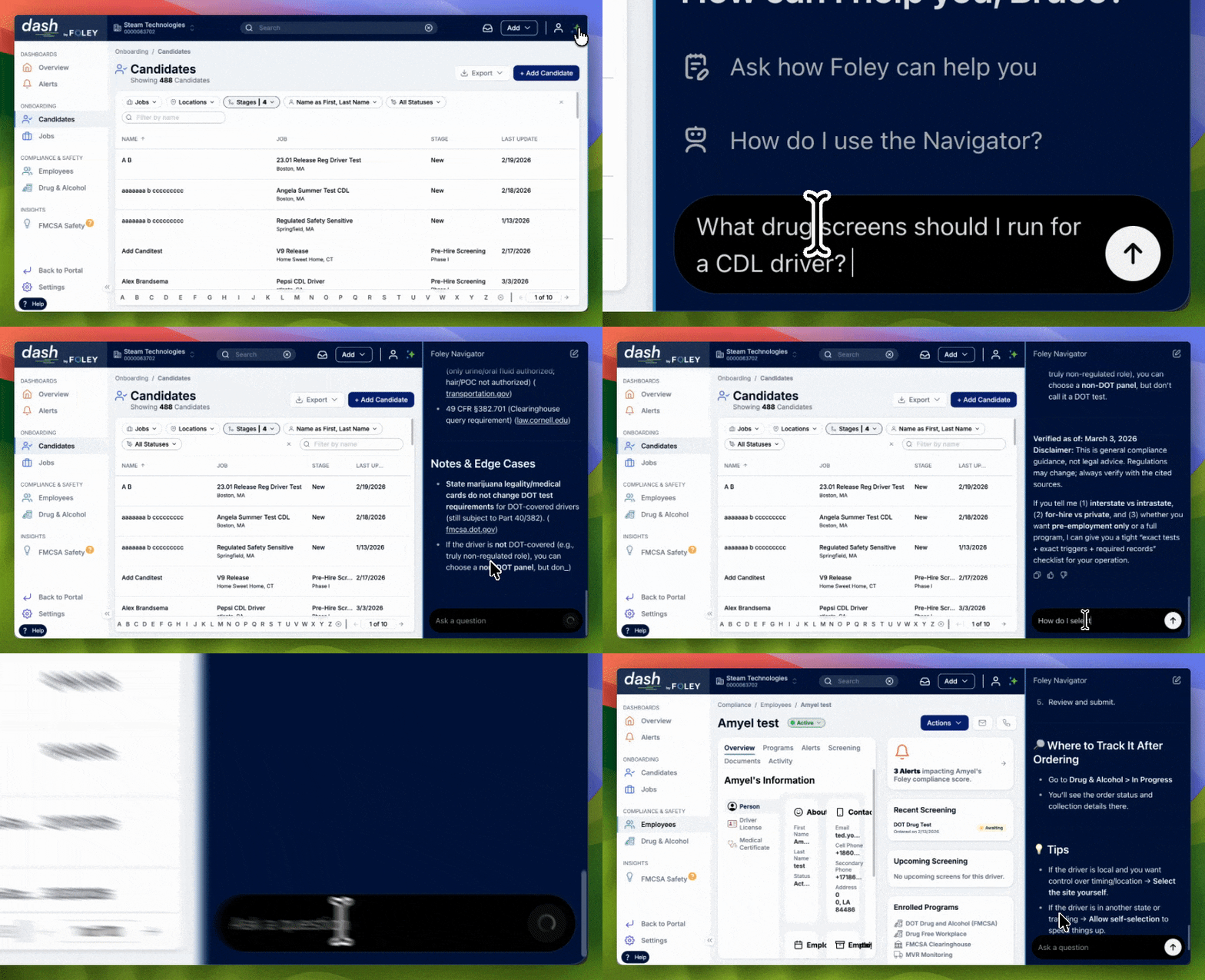
Foley builds, tracks and audits your driver qualification files — application through medical card and MVR — so every file is complete before an investigator asks for it.
- Full 49 CFR 391.51 file build, application to road test
- Med card, MVR and Clearinghouse tracked with expiry alerts
- Complete files produced on demand for an FMCSA audit
Find out what's missing before an investigator does
Send your driver count. We audit your files against 49 CFR 391.51 and send the gap list.
What Is a Driver Qualification File?
A driver qualification file is the record a motor carrier must keep for every driver who operates a commercial motor vehicle for it. Its contents are set by 49 CFR 391.51. It is not a personnel folder and it is not an HR file. It is the evidence that the driver was qualified under 49 CFR 391.11 on the day you first dispatched them, and that they stayed qualified every year after.
"DOT driver qualification file," "DQ file" and "driver qualification file FMCSA" all name the same file. There is no separate DOT version and no separate FMCSA version. One file, one rule.
You build it before the driver's first trip. You keep it current for as long as they drive for you, and for three years after they leave.
- Qualify the driver before you use them — 49 CFR 391.11
- Keep each item listed in 49 CFR 391.51(b)
- Review every driver's motor vehicle record at least once every 12 months — 49 CFR 391.25
- Store previous-employer safety history separately with controlled access — 49 CFR 391.53
- Retain the file for the length of employment plus three years — 49 CFR 391.51(i)
- Produce records for an investigator at your principal place of business — 49 CFR 390.29
Since the medical certification integration rule took effect, the motor vehicle record — not the paper card in the file — is the system of record for a CDL driver’s medical qualification. Certified medical examiners report each DOT physical to FMCSA, the result posts to the driving record, and the state licensing agency downgrades the CDL or CLP if the certificate expires and is not renewed inside the window on the disqualification notice.
The practical effect for an employer: you cannot put a CDL driver back on the road on the strength of a paper certificate alone. FMCSA’s temporary paper-certificate waiver ended on 10 January 2026. What counts is what the record says today, which is why a monitored MVR closes this gap and a filing-cabinet audit does not.
Who Has to Keep One
If a driver operates a vehicle that meets the commercial motor vehicle definition in 49 CFR 390.5, you keep a file. That includes non-CDL drivers in vehicles rated over 10,000 pounds. The CDL is not the trigger — the vehicle and the operation are.
Every driver, CDL and non-CDL, gets a complete file under 49 CFR 391.51. Scope is set by 49 CFR 391.1. Having an active DOT number is what puts you in front of an investigator.
Most states adopt Part 391 with variations — minimum age, medical waivers and grandfathered drivers are the common differences. Build to the federal file and document the state exception you rely on. The state exception is the part an investigator asks you to show in writing.
If you hold the operating authority and you drive, you are both the carrier and the driver. Same file, same annual review, same three-year retention. Auditors do not waive it for small fleets.
Multiple-employer drivers
49 CFR 391.63 lets a carrier using a driver already employed by another carrier rely on a reduced set of documents. The driver's primary employer still maintains the complete file. The reduced set only applies to a driver who, in any period of 7 consecutive days, is employed or used as a driver by more than one motor carrier — the definition of a multiple-employer driver in 49 CFR 390.5. A driver outside that definition needs the full file.
FMCSA Driver Qualification File Checklist (391.51)
Here is every item 49 CFR 391.51(b) requires, what it proves, and who produces it. This is the checklist we build against on every file we manage.
1. Driver's application for employment — 391.21
Signed and dated by the driver, complete, no blank fields. The carrier keeps the original. Field-by-field build is in the next section.
2. Motor vehicle record from each licensing state — 391.23(a)(1)
Order an MVR from every state where the driver held a license or permit during the preceding three years. Due within 30 days of the date employment begins. The carrier orders it; the driver signs the release.
3. Safety performance history from previous DOT-regulated employers — 391.23(c) and (d)
Written inquiry to every DOT-regulated employer the driver worked for in the three years before the application. Request within 30 days of hire. The prior employer has 30 days to respond. When nobody answers, your proof of the request is what saves the file. These responses live in the driver investigation history file under 49 CFR 391.53 — separate storage, controlled access, three-year retention.
4. Road test certificate or equivalent — 391.31 and 391.33
The carrier administers the road test and signs the certificate. The driver gets a copy; a copy goes in the file. Under 49 CFR 391.33 a valid CDL may be accepted in place of the road test, except for drivers operating double or triple trailers or tank vehicles.
5. Medical examiner's certificate — 391.43 and 391.45
The exam must be done by an examiner listed on the FMCSA National Registry. Certificates run 24 months maximum and are often issued for less. For CDL and CLP holders, the examiner transmits results to the state licensing agency and med-cert status appears on the CDLIS MVR, which is where the carrier verifies it. Verify med-cert status on the CDLIS MVR and keep dated proof of that check in the file. For non-CDL drivers, keep the certificate itself in the file.
6. Annual review of driving record — 391.25
Every 12 months: pull a fresh MVR, review it against the disqualifying offenses in 49 CFR 391.15, and sign a dated note that the review happened. Auditors look for the signed note, not just the MVR.
7. Drug and alcohol history — 382.701 and 391.23(e)
Run a full Clearinghouse query before the driver performs any safety-sensitive function, then a limited query at least once every 12 months. Test results themselves are retained in the drug and alcohol testing records under 49 CFR 382.401 — not in the DQF.
8. Certification of violations — 391.27
FMCSA has amended the driver's annual list of violations requirement. The record an auditor works from is the annual review of driving record under 49 CFR 391.25: the fresh MVR, the review against the disqualifying offenses, and a signed and dated note of the outcome. We build the file to the version of 391.27 in force on the date of the review.
It is rarely the medical card. It is the previous-employer inquiry with no response and no proof of the request, and the annual review note nobody signed.
Start with the audit, not the software
We inventory your existing driver files against 391.51(b) and hand you the gap list by driver before you commit to anything.
The Driver Application, Built to 391.21
The driver application is the one document you write yourself, and the one most often built wrong. 49 CFR 391.21 sets the required content. A truck driver application form that omits any of it is an incomplete file, even if the driver is perfectly qualified.
- Name, current address and addresses for the preceding three years
- Date of birth and date of application
- Every license or permit held in the preceding three years — issuing state, number, expiration
- Accidents in the preceding three years, with dates and consequences
- Traffic convictions and forfeitures in the preceding three years
- Any license denial, revocation or suspension, with reasons
- Nature and extent of driving experience, by equipment type
- Employment history for the preceding three years — and for CDL drivers, all DOT-regulated employment for the preceding 10 years
- Driver's signature and certification that the answers are true
Why applications fail review
- Gaps in the employment timeline with no explanation — auditors count months
- The 10-year CDL history collected as three years
- "None" left blank instead of written in
- No signature, or a signature with no date
- Free driver qualification file forms downloaded from a template site that predates a rule change
Our online driver application collects all of it, flags gaps before you review, and pushes the employment history straight into the 391.23 inquiries so the two never disagree.
DOT and Truck Driver Requirements to Be Qualified
Before the paperwork, the driver has to actually meet the standard. 49 CFR 391.11(b) lists the general qualifications, and this is what a driver-side "truck driver requirements" question really means.
- Age. At least 21 for interstate operation. Some states allow 18 to 20 intrastate.
- Language. Able to read and speak English well enough to converse, understand highway signs, respond to inquiries and make entries on reports.
- License. One valid license from one state only. Class A, B or C per 49 CFR 383.91, with the endorsements the operation requires — hazmat, tank, doubles/triples, passenger. A commercial learner's permit is a distinct credential under Part 383, not a substitute.
- Medical. Physically qualified under 49 CFR 391.41, examined by a National Registry examiner per 49 CFR 391.43, re-examined at least every 24 months per 49 CFR 391.45.
- Driving record. Not disqualified under 49 CFR 391.15 and clean enough to pass the carrier's own review under 391.25.
- Road test. Passed a road test under 49 CFR 391.31, or covered by the CDL equivalency in 391.33.
- Drug testing. A negative pre-employment DOT drug test under 49 CFR 382.301 and a clear full Clearinghouse query before the first safety-sensitive function.
Miss one of these and the file is not just incomplete — the driver is unqualified, and every mile they run is a violation.
Medical Card and MVR Tracking (What We Track, What We Don't)
Expirations are what break otherwise good files. A medical certificate lapses on a Tuesday and the driver runs unqualified until somebody notices in the next audit.
- Medical examiner's certificate expiration dates, tracked per driver with alerts ahead of the date
- National Registry verification that the examiner who signed was certified on the exam date
- CDL med-cert status as it appears on the CDLIS MVR, so a downgrade gets caught before dispatch does
- Continuous MVR monitoring and scheduled annual pulls for the 391.25 review
- Clearinghouse limited queries on an annual cycle, tracked to the driver
- License and endorsement expirations
We do not perform DOT physicals and we do not certify drivers. Your driver sees a certified medical examiner. We verify that examiner, capture the certificate, track the expiration, and tell you before it lapses.
How DQF Management Works With Foley
Deadlines and Retention at a Glance
| Record | Rule | When it is due | How long you keep it |
|---|---|---|---|
| Driver's application for employment | 391.21 | Before the driver is used | Employment plus 3 years |
| MVR from each licensing state, past 3 years | 391.23(a)(1) | Within 30 days of hire | May be purged 3 years after the record date — 391.51(d) |
| Previous-employer safety performance history | 391.23(c)–(d) | Request within 30 days of hire; employer responds within 30 days | 3 years, separate file — 391.53 |
| Road test certificate or CDL equivalency | 391.31 / 391.33 | Before first dispatch | Employment plus 3 years |
| Medical examiner's certificate | 391.43 / 391.45 | Before use; re-exam at least every 24 months | 3 years from date of issue |
| Annual MVR and signed review note | 391.25 | Every 12 months | 3 years |
| Clearinghouse full query / limited query | 382.701 | Pre-employment; then annually | 3 years — 382.401 |
| Pre-employment drug test result | 382.301 | Before first safety-sensitive function | Drug and alcohol file, not the DQF — 382.401 |
| The complete file after separation | 391.51(i) | — | 3 years after the driver leaves |
Records must be available at your principal place of business under 49 CFR 390.29. If yours live in a filing cabinet at a terminal three states away, that is a problem before the audit starts.
The FMCSA driver qualification file checklist
Every 391.51 item, its rule cite, its deadline and its retention period is on this page — the same checklist our advisors audit against. Tell us about your fleet and one of them will review your files against it.
Talk to a specialistThe Real Cost of Driver File Violations
Driver qualification findings do more damage than most carriers expect, because they compound. One missing medical certificate is a driver violation, a carrier recordkeeping violation, and — if that driver was in a crash — the first exhibit in a negligent qualification claim.
- Part 391 violations sit on the acute and critical lists used in the safety rating process and on the automatic-failure list for new entrant safety audits — see the appendices to 49 CFR Part 385
- Using a driver who is not qualified, or who has no file at all, is the finding that fails an audit outright rather than lowering a score
- Civil penalties are statutory, and FMCSA adjusts them for inflation every year, so the amount that applies is the one in force on the date of the violation
- Findings follow you into insurance renewals and shipper qualification reviews, where the cost is not a fine
The carrier is not careless. The carrier is busy. Files were correct at hire and drifted — a med card expired, an annual review slipped a quarter, a driver from 2019 never got a previous-employer inquiry. Every one of those is a separate finding, per driver.
New entrant in your first 12 months?
A safety audit is coming, and Part 391 findings are on the automatic-failure list. Get the files right before the letter arrives.
Audit-Ready: Producing the File on Demand
"Audit-ready" is not a feeling. It is an artifact: a complete, dated, indexed file for a named driver, handed over inside the window an investigator gives you.
What an FMCSA audit or new entrant safety audit asks for
- A driver roster for the review period, then complete files for a sample of those drivers
- Proof each driver was qualified before their first dispatch — not just qualified now
- The 391.25 annual reviews with signatures and dates for each year in the period
- Previous-employer inquiries with sent dates and responses, or documented non-responses
- Clearinghouse query records and pre-employment test results
- Supporting records such as the accident register under 49 CFR 390.15
Software that keeps fleet documentation audit-ready has to do one thing well: reconstruct any driver's file as of any date, on demand, with the evidence of when each item was obtained. That is what we produce — a per-driver packet and a fleet-level compliance report, exported and sent, while the investigator is still on the call. New entrants in the first 12 months should assume the audit is coming, and confirm their MCS-150 and registration data match the files.
What DQF Management Includes
| Item | Foley DQF management | Paper files in-house |
|---|---|---|
| Initial audit of existing files | Included, gap list by driver | You build the checklist yourself |
| 391.51(b) file build for new hires | Triggered from the online application | Manual, per hire |
| Previous-employer inquiries (391.23) | Sent, tracked, non-responses documented | Mailed and forgotten |
| MVRs and annual reviews (391.25) | Ordered on schedule, review note captured | Calendar reminder |
| Medical certificate tracking | Expiration alerts, Registry verification | Whoever notices first |
| Clearinghouse queries (382.701) | Pre-employment and annual, run for you | Self-managed in the FMCSA portal |
| Retention through 391.51(i) | Held for employment plus 3 years | Depends on the cabinet |
| Audit support | Named advisor, files produced on demand | You, at the table, alone |
Scope depends on your driver count and which services you add — MVR monitoring, background screening, consortium enrollment. Use the form on this page and a specialist will put terms in front of you.
Where DQFs Meet Drug and Alcohol Compliance
The two programs share the same drivers and the same audit. We run both in-house, which is why the dates line up.
- Foley-operated consortium/TPA. We run our own consortium under 49 CFR Part 382, Subpart C — random selections, scheduling, collection site network.
- C/TPA and DER support. Your designated employer representative gets a person to call when a result comes back non-negative, not a portal ticket.
- MRO review. Verification handled under 49 CFR Part 40 before anything reaches you.
- Clearinghouse. Registration, driver consent, and pre-employment and annual queries run for you under 49 CFR 382.701. Full detail on the Clearinghouse and DOT drug testing pages.
Random testing rates are set by FMCSA under 49 CFR 382.305. For 2026 the minimum annual rates are 50 percent for controlled substances and 10 percent for alcohol. FMCSA publishes any change in the Federal Register, and a new rate applies from January 1 of the following year, so build your selection schedule on the rate in force for that calendar year.
Why Fleets Hand Us the Files
We are not a document storage vendor. We operate the compliance programs the files are made of — the consortium, MRO review, DER support, background screening, MVR monitoring and the DQ files themselves. When your file is short a previous-employer response, it is our team chasing it.
- Real-time compliance status by driver and by fleet, not a quarterly report
- Alerts on expiring medical certificates, licenses and annual reviews
- Compliance reports generated for insurers, shippers and auditors
- A named compliance advisor who stays with your account
- An initial file audit before you commit to anything
Fleets that run registration work with us keep it under one advisor too — DOT number applications, the biennial MCS-150 update, BOC-3 filings and UCR registration. Different filings, same principle: the deadline is not the reminder.
Not sure whether your files would survive an audit?
Most carriers are fine at hire and short by year three — a lapsed med card, an unsigned annual review, an inquiry that was never answered. One call tells you which one you have.
- Both the driver qualification file and the safety performance history file have to be complete within 30 days of a new driver starting, not by the first audit.
- The file needs a motor vehicle report from every state that licensed the driver in the previous three years, not only the current one.
- The safety performance history file has to be access-restricted to the people involved in hiring, because of what it holds.
- In Foley's own survey, more than 40 percent of carriers did not feel ready for an offsite audit, where documentation is due in about 48 hours rather than two weeks.
Carriers who already run this with Foley
DNC Logistics
Cut the time spent managing driver files by at least half after moving paper files to monitored digital records. Read the case study.
Torc Robotics
Saved close to half its compliance staff time compared with running driver files in a spreadsheet. Read the case study.
AERO BridgeWorks
Went live in about two weeks and now runs driver files, MVRs and audit prep from one record instead of a filing cabinet. Read the case study.
Frequently asked questions
What is a driver qualification file?
It is the file a motor carrier must keep on every CMV driver, containing the items listed in 49 CFR 391.51(b) — application, MVRs, previous-employer safety history, road test certificate, medical certification and annual reviews. It proves the driver was qualified under 49 CFR 391.11 before you used them.
What is a DOT driver qualification file?
The same thing. "DOT driver qualification file," "DQ file" and "FMCSA driver qualification file" all refer to the file required by 49 CFR 391.51. There is no separate DOT format or DOT-issued file.
How to get a driver qualification file?
You build it — no agency issues one. Collect the 391.21 application, order MVRs from each licensing state, send 391.23 inquiries to prior DOT-regulated employers, complete the road test or apply the 391.33 CDL equivalency, capture the medical certification, and run the Clearinghouse query. Foley builds and maintains the file for you.
What goes in a driver qualification file?
Application for employment, MVR from every state the driver was licensed in over three years, previous-employer safety performance history, road test certificate or CDL equivalency, medical examiner's certification, and the annual MVR with a signed review note. Full item-by-item list is in the checklist section above.
How long must a driver qualification file be retained?
For as long as the driver is employed plus three years after they leave, under 49 CFR 391.51(i). Certain items — MVRs, annual review notes, inquiry responses — may be purged three years after the date of the record per 391.51(d), but the file itself stays.
Are free driver qualification file forms good enough?
Sometimes, and that is the risk. A free form is only compliant if it still matches the current text of 49 CFR 391.21 and 391.23. Template sites go stale after rule changes, and an application missing one required field makes the file incomplete.
Do non-CDL drivers need a driver qualification file?
Yes, if they operate a vehicle meeting the CMV definition in 49 CFR 390.5 — including vehicles rated over 10,000 pounds. Part 391 applies to the driver of a CMV, not only to CDL holders.
What are the DOT driver requirements to be qualified?
Under 49 CFR 391.11: at least 21 for interstate operation, able to read and speak English, one valid license from one state, physically qualified with a current medical certification, not disqualified under 391.15, and a passed road test or CDL equivalency under 391.33.
Does Foley issue medical cards or perform DOT physicals?
No. Your driver is examined by a certified medical examiner on the FMCSA National Registry. Foley verifies the examiner, records the certificate, tracks the expiration, monitors CDL med-cert status on the CDLIS MVR, and alerts you before it lapses.
What does driver qualification file management cost?
It depends on driver count and which services you add — MVR monitoring, Clearinghouse queries, consortium enrollment, background screening. A specialist sets the price for your operation, not this page. Request a quote and an initial file audit; the audit tells you how much remediation you are actually facing.
What does an FMCSA audit ask for from the DQF?
A driver roster, then complete files for sampled drivers: proof of qualification before first dispatch, annual reviews signed and dated for each year, previous-employer inquiries with sent dates and responses or documented non-responses, and Clearinghouse and pre-employment testing records.
Every driver. Every document. Every expiration date.
DQF management built on 49 CFR Part 391, run by the team that also operates your consortium and Clearinghouse queries.