








DOT Drug & Alcohol Testing Violations & Penalties
A single testing violation can put your operating authority at risk. Failing to run a compliant DOT drug and alcohol testing program risks lives on the road, and it carries a significant financial penalty on top.
Below: the violations that get cited most often, the citation behind each one, the maximum FMCSA can levy to companies like yours, and real amounts carriers have actually paid.
Maximum penalty per violation: $16,864 Maximum penalty for Clearinghouse violations: $5,833
FMCSA adjusts civil penalty ceilings annually for inflation, so treat these as the current maximum rather than a fixed number.
Most commonly cited drug testing violations
| Violation | CFR citation | Maximum fine |
|---|---|---|
| No random testing program | 382.305 | $16,864/day |
| Pre-employment test not conducted | 382.301 | $16,864/violation |
| No Clearinghouse pre-employment query | 382.701 | $5,833/violation |
| Missing or incomplete records | 382.401 | $16,864/violation |
| Allowing a positive-tested driver to drive | 382.205 | $16,864/violation |
| Random rate below the annual minimum | 382.305 | $16,864 |
| No supervisor training documentation | 382.603 | $16,864 |
What carriers have actually been fined
Maximum penalties describe the ceiling, not the norm. These are real enforcement actions, drawn from FMCSA records covering late 2021 to early 2022 — useful for calibrating what an ordinary violation costs an ordinary carrier.
| Violation | Code | Enforcement example |
|---|---|---|
| Failing to implement a drug/alcohol testing program | 382.115(a) | Hazmat carrier, Québec CA — $8,890, early 2022 |
| Using a driver before receiving a pre-employment result | 382.301(a) | Trucking company, Delran NJ — $8,140, early 2022 |
| Failing to conduct a post-accident test | 382.303 | Trucking company, Gary IN — $8,140, Oct 2021 |
| Random drug tests below the annual rate | 382.305(b)(2) | Asphalt paving contractor, Colorado Springs CO — $8,140, late 2021 |
| Safety-sensitive work with no follow-up testing program | 382.503 | Construction supply manufacturer, Fremont NE — $7,370, early 2022 |
| Using a driver who refused a test | 382.211 | Transportation company, Avondale AZ — $3,390, late 2021 |
| Using a driver with a .04 alcohol level | 382.201 | Structural components manufacturer, Edgeley ND — $11,720, late 2021 |
| Failing to implement a random testing program | 382.305 | Scaffolding rental company, Green Bay WI — $12,010, Oct 2021 |
| Random alcohol tests below the annual rate | 382.305(b)(1) | Refrigerated trucking and storage, Jessup MD — $6,030, late 2021 |
| Using a driver who tested positive | 382.215 | Trucking carrier, Fremont CA — $8,890, late 2021 |
| No pre-employment Clearinghouse query | 382.701(a) | Cargo and freight carrier, Elk Point SD — $2,190, late 2021 |
| No annual Clearinghouse query | 382.701(b)(1) | Trucking company, Laredo TX — $3,500, late 2021 |
| Using a driver with a positive result in the Clearinghouse | 382.701(d) | Carrier, Waterloo IA — $1,750, early 2022 |
How fines are calculated
Investigators do not simply apply the maximum. The amount reflects:
- How likely it was that the carrier knew about the problem
- The carrier's ability to pay
- The seriousness of the violation
Which is why a $16,864 ceiling produces real penalties between roughly $1,750 and $12,000 in the examples above.
What auditors actually look for
During a compliance review, FMCSA investigators will ask for:
- Your written drug and alcohol testing policy
- Random pool documentation and draw records
- Chain-of-custody forms for completed tests
- Clearinghouse query records — for current drivers and anyone hired recently. This is where most carriers come up short
- Supervisor reasonable-suspicion training certificates
- Records of any violations, plus the return-to-duty steps taken
Cannot produce the paperwork? That is a finding.
It does not matter whether the program ran perfectly. Without documentation, FMCSA treats it as though it did not exist. Plenty of carriers had a working program and could not prove it when it counted. Records missing equals program missing.
“The most common finding we see is carriers who have a program but can't produce the records to prove it. Documentation is everything in an FMCSA audit.”
Closing the gaps before FMCSA finds them
Carriers who come through compliance reviews clean are not necessarily bigger or better staffed. They have systems that catch problems before an auditor does.
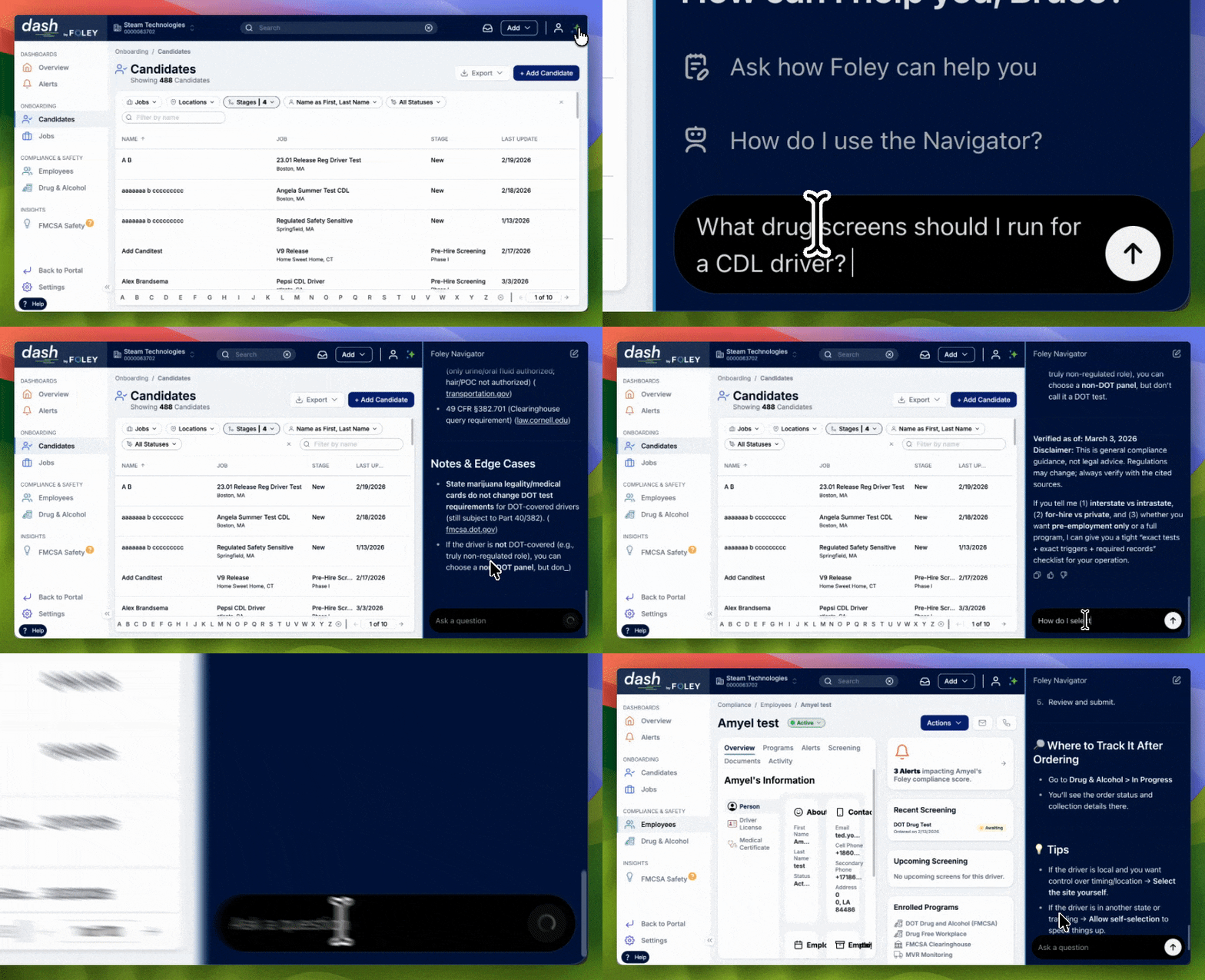
Foley's platform tracks every test, every random draw and every Clearinghouse query, flags anything missing or overdue, notifies you when a driver is due, and supplies current electronic Custody and Control Forms (eCCFs). The auditor arrives and the documentation is already there.
The fine is not for having a bad program. It is for not being able to prove you had a good one.
See how it works or call (860) 815-0764 for a software demo.
Frequently asked questions
What is the fine for not having a drug testing program? FMCSA can impose civil penalties up to $16,864 per violation per day for carriers operating without a required drug and alcohol testing program under 49 CFR Part 382. Failure to implement a testing program is also an acute violation that can immediately trigger an Unsatisfactory safety rating.
What triggers an FMCSA compliance review? Crashes, elevated CSA scores above intervention thresholds, complaints filed against the carrier, random selection, or the mandatory new entrant safety audit within 18 months of receiving operating authority. In FY2023 FMCSA conducted approximately 17,000 compliance reviews.
What happens if a driver tests positive and keeps driving? Allowing a driver who has tested positive to continue safety-sensitive functions violates 49 CFR 382.205. The carrier faces fines up to $16,864 per violation, and it is an acute violation that alone can result in a Conditional or Unsatisfactory safety rating.
What is the most commonly cited drug testing violation? Failure to implement a random testing program meeting the 50% drug and 10% alcohol annual minimums under 49 CFR 382.305 is among the most frequently cited. Missing Clearinghouse pre-employment queries under 49 CFR 382.701 are also cited at high rates, carrying fines up to $5,833 per occurrence.
Can an FMCSA drug testing violation shut down a carrier? Yes. An acute violation such as using a driver who tested positive for controlled substances (49 CFR 382.211) or failing to implement a drug testing program (49 CFR 382.115) can result in an Unsatisfactory safety rating. If not corrected, FMCSA issues an operations out-of-service order that stops all interstate operations.