









Driver Qualification File Requirements: Complete FMCSA Guide
An auditor walks in and asks for your driver files. Are they complete? Every motor carrier must maintain a driver qualification file (DQF) for each driver operating a commercial motor vehicle under its USDOT number. Ten documents per driver. That's the requirement under 49 CFR Section 391.51, from the initial employment application through annual reviews and medical certifications.
Incomplete files are the single most common critical violation in FMCSA compliance reviews. And it doesn't take much. Miss even one required document across enough driver files, and it can contribute to a rating downgrade during a compliance review. And when your safety rating drops from Satisfactory to Conditional, earning your way back can be a long process.
The 10 Required DQF Documents
Under 49 CFR Section 391.51, every DQF must contain the following:
| # | Document | CFR Citation | When Required |
|---|---|---|---|
| 1 | Employment application | 391.21 | Before hire |
| 2 | Motor vehicle record (MVR) from each licensing state (past 3 years) | 391.23(a)(1) | Before hire |
| 3 | Previous employer safety performance history inquiries | 391.23(d)-(e) | Within 30 days of hire |
| 4 | Road test certificate (or equivalent) | 391.31, 391.33 | Before operating a CMV |
| 5 | Medical examiner's certificate | 391.43, 391.45 | Before operating; renewed per examiner's determination (max 2 years) |
| 6 | Annual MVR review and notation | 391.25 | Every 12 months |
| 7 | Annual driver's certificate of violations | 391.27 | Every 12 months |
| 8 | Skill performance evaluation (SPE) certificate, if applicable | 391.49 | Before operating, if driver requires a waiver |
| 9 | Medical variance documentation, if applicable | 391.41(b) | Before operating, if driver holds a medical exemption |
| 10 | Entry-level driver training (ELDT) certificate, if applicable | 380.503, 380.513 | Before CDL issuance (drivers who obtained CDL on or after Feb. 7, 2022) |
What Each Document Requires
1. Employment Application (49 CFR §391.21)
The application must include:
- Driver's name, address, date of birth, and SSN
- All addresses for the past 3 years
- Employment history for the past 10 years (all employers, not just trucking)
- All CMV experience in the past 10 years
- A list of all motor vehicle accidents in the past 3 years
- All traffic violations and forfeitures in the past 12 months
- Whether the driver has been denied a license, or had one revoked or suspended
- A certification that all information is true and complete, signed by the driver
Watch out: Using a generic employment application that doesn't capture all FMCSA-required fields. The application has to specifically ask for every item listed in 391.21. Pretty much any standard job application template is going to miss something.
2. Motor Vehicle Record (49 CFR §391.23)
Before hiring a driver, you need to pull an MVR from every state that issued the driver a license in the past 3 years. Not just the CDL state. Every state. And it can't be older than 30 days at the time of hire.
3. Previous Employer Safety Performance History (49 CFR §391.23)
You need to contact every DOT-regulated employer the driver worked for in the past 3 years and request:
- Alcohol and drug testing records
- Accident history
- Whether the driver was subject to any FMCSA safety violations
Send these inquiries within 30 days of the driver's hire date and document all attempts to get responses, including from employers who don't respond. This trips up a lot of carriers. Because the 30-day clock starts at hire, not at orientation.
4. Road Test Certificate (49 CFR §391.31)
Every driver must pass a road test in the type of CMV they'll operate, administered by a qualified examiner. A valid CDL with the appropriate endorsements can serve as an equivalent under 49 CFR §391.33, which is the option most carriers go with.
5. Medical Examiner's Certificate (49 CFR §391.43)
Every CDL driver needs a current medical examiner's certificate from a provider on the National Registry of Certified Medical Examiners (NRCME). Certificates are valid for up to 2 years, though the examiner can issue a shorter period based on the driver's health conditions. The certificate must be on file in the DQF and match the driver's CDLIS (Commercial Driver's License Information System) record. The medical certificate is the document that shows up expired more than any other.
6. Annual MVR Review (49 CFR §391.25)
Carriers miss this one consistently. Every 12 months, you must:
- Obtain a current MVR for each driver
- Have a designated company representative review the MVR for disqualifying offenses
- Note the review in the DQF, including the reviewer's name, date of review, and any findings
7. Annual Driver's Certificate of Violations (49 CFR §391.27)
Each driver must submit a written list of all traffic law violations during the preceding 12 months, or certify that no violations occurred. This is a signed document from the driver, not an MVR. The missing signature gets caught on audit day.
“The DQF is where most carriers fail their compliance review. It is not because the requirements are complex, it is because there are 10 documents per driver, multiplied by every driver in your fleet, and any gap becomes a citable violation. The carriers that pass audits are the ones with a system that tracks every document and flags expirations automatically.”
DQF vs. Drug and Alcohol File
FMCSA requires the DQF and the drug and alcohol testing file to be maintained separately. Different regulatory bases. Different contents. Different retention periods.
| Attribute | Driver Qualification File | Drug & Alcohol File |
|---|---|---|
| Regulatory basis | 49 CFR Part 391 | 49 CFR Part 382 |
| Contents | Employment application, MVR, medical cert, road test, annual reviews | Test results, chain of custody forms, Clearinghouse queries, SAP records |
| Retention period | Employment + 3 years | Varies: positives = 5 years; negatives = 1 year |
| Audit factor | Factor 2: Driver | Factor 6: Controlled Substances & Alcohol |
| Access restrictions | Standard personnel file access | Confidential, restricted access per 49 CFR §382.401 |
You can pass the DQF review and fail the drug and alcohol review, or vice versa. Separate factors. Separate outcomes.
Retention Periods
| Record Type | Retention Period |
|---|---|
| Complete DQF (active driver) | Maintain throughout employment |
| Complete DQF (terminated driver) | 3 years after driver leaves |
| Previous employer safety performance inquiries | 3 years from date of hire |
| Drug test results (positive) | 5 years |
| Drug test results (negative) | 1 year |
| Alcohol test results (0.02 or greater) | 5 years |
| Clearinghouse query records | 3 years |
| Supervisor reasonable suspicion training | Duration of employment + 2 years |
Most Common DQF Audit Failures
Based on FMCSA compliance review data, these deficiencies result in violations most often:
| Violation | How It Happens | Impact |
|---|---|---|
| Expired medical certificate | Certificate expired and was not renewed; carrier failed to remove driver from safety-sensitive duty | Critical violation, can lead to Conditional rating |
| Missing annual MVR review | Review not completed within 12-month window, or review not documented | Critical violation |
| Incomplete employment application | Application does not include all 391.21 required fields (e.g., missing 10-year employment history) | Critical violation |
| Missing previous employer inquiries | Inquiries not sent within 30 days of hire, or no documentation of attempts | Critical violation |
| No annual certificate of violations | Driver did not submit the signed annual statement | Critical violation |
| Missing road test or CDL equivalent | No road test certificate and no documentation of CDL equivalency | Critical violation |
The math is simple. Critical violations trigger a rating downgrade when found in 10% or more of files reviewed. FMCSA reviews 20 driver files and 2 are missing annual MVR reviews? Conditional rating. Two files. That's all it takes.
Building a DQF Compliance System
Five components. Get these right and the system holds together:
- A standardized intake process. Use a 391.21-compliant application template, collect MVRs and medical certificates before the driver's first day, and send previous employer inquiries within the 30-day window.
- Automated expiration tracking. Medical certificates, annual MVR reviews, and violation certifications all have expiration dates. You need to actually track these per driver, not just hope someone remembers.
- Centralized file storage. Whether physical or digital, every file needs to be complete, organized, and accessible within minutes of an audit request.
- Regular self-audits. Review a sample of DQFs quarterly to catch gaps before FMCSA finds them.
- Clear owner-operator procedures. If drivers are leased onto your authority, their requirements are identical to company drivers. There's no reduced standard to fall back on.
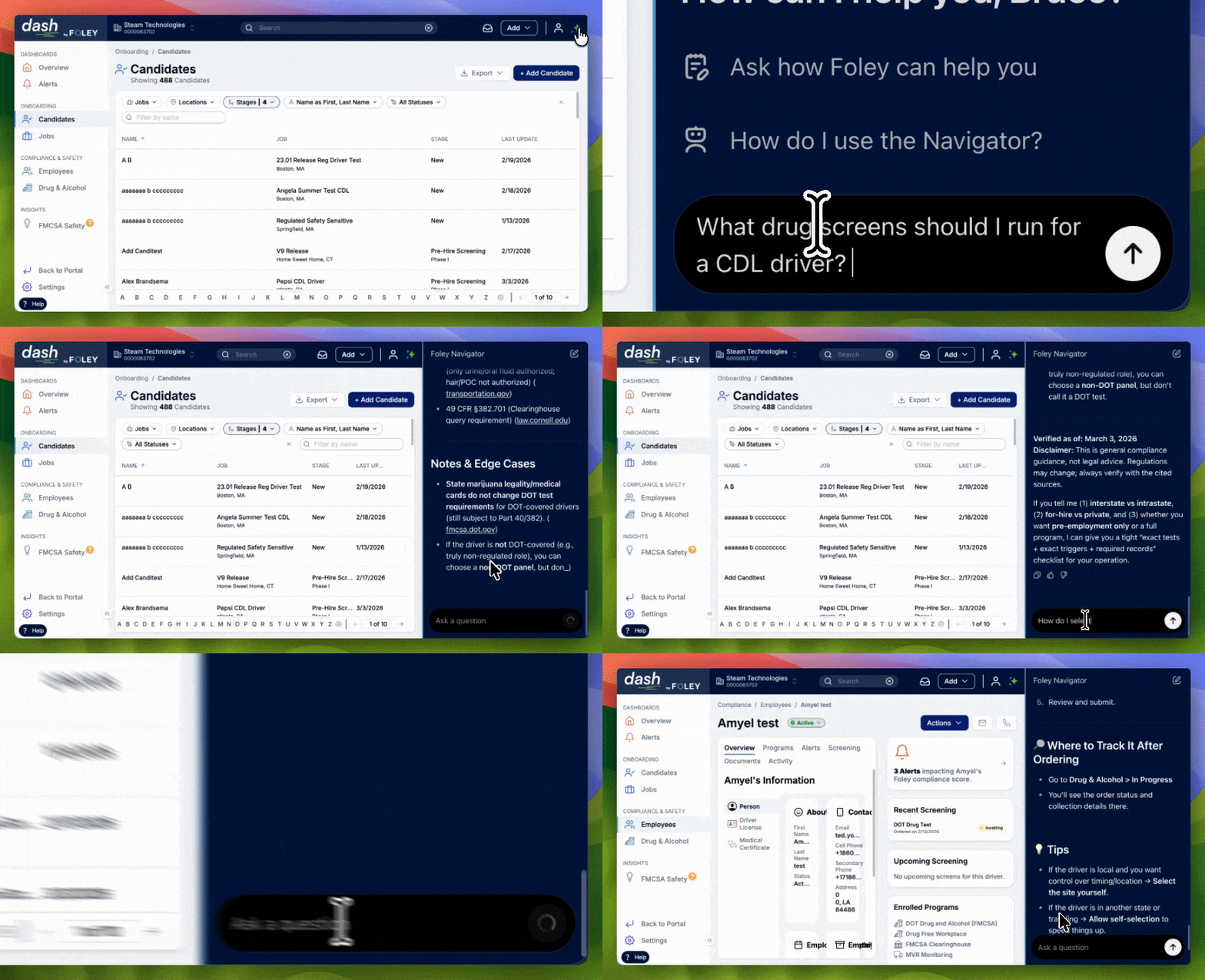
Foley manages DQFs for 45,000+ carriers through the Dash platform, which tracks every required document, flags upcoming expirations, automates MVR ordering, and keeps files audit-ready at all times. See how it works.
Related Compliance Requirements
A few related areas that tie back to DQF management:
- Drug and alcohol testing: Clearinghouse pre-employment queries must be completed before a driver begins safety-sensitive functions.
- CSA score monitoring. Your driver fitness BASIC percentile takes a direct hit from DQF violations found during inspections.
- DOT audit preparation: DQF completeness is one of six safety management factors evaluated in every compliance review.
- FMCSA compliance: DQF management is a core component of your overall regulatory program.
Frequently asked questions
What documents must be in a driver qualification file?
Under 49 CFR §391.51, a DQF must contain: the driver's employment application, motor vehicle record (MVR) from each state the driver held a license in the past 3 years, annual MVR review, annual driver's certificate of violations, medical examiner's certificate, road test certificate or equivalent, previous employer safety performance history inquiries, and any waiver or exemption documentation. Missing any required document is a citable violation during an FMCSA compliance review.
How long must you keep a driver qualification file?
You must maintain a DQF for the entire duration of a driver's employment plus 3 years after the driver leaves your company. Drug and alcohol testing records have separate retention periods under 49 CFR Part 382, positive tests and refusals must be kept for 5 years.
What is the difference between a DQF and a drug and alcohol file?
A driver qualification file (DQF) contains employment, licensing, medical, and driving history documents required under 49 CFR Part 391. A drug and alcohol (D&A) file contains testing records required under 49 CFR Part 382, pre-employment tests, random tests, Clearinghouse queries, and supervisor training records. FMCSA requires these to be maintained as separate files with different retention schedules.
What happens if a driver qualification file is incomplete during an audit?
Missing DQF documents are among the most common findings in FMCSA compliance reviews. They are classified as critical violations, if 10% or more of reviewed files are missing a required document, the carrier receives a Conditional safety rating. At 25% or more, the rating drops to Unsatisfactory.
Do owner-operators need a driver qualification file?
Yes. If an owner-operator is operating under your carrier's authority (leased on to your operation), you must maintain a complete DQF for that driver just as you would for a company driver. The regulatory requirement applies to every driver operating a CMV under your USDOT number, regardless of employment classification.