








DOT Drug Test Requirements, Procedures & Compliance
What does FMCSA actually require in a DOT drug testing program? More than most carriers realize. Who is covered, what tests you need, the oral fluid and Clearinghouse II rules, and where fleets most commonly fall out of compliance.
What are DOT drug and alcohol testing requirements?
DOT drug and alcohol testing requirements are federally mandated rules applying to employers of safety-sensitive employees under 49 CFR Part 40, which sets the testing procedures, and 49 CFR Part 382, which sets the requirements specifically for commercial motor vehicle drivers. They define when testing must occur, what is screened for, how tests are conducted, and how results are reported and recorded.
This is not a best-practice framework. It is a strict compliance standard enforced by FMCSA. If you employ CDL drivers operating commercial motor vehicles, you're required to have a fully compliant program: all required testing types, proper records, Clearinghouse queries, and trained supervisors. Missing any element creates a violation during an FMCSA review.
Who must comply
Beyond trucking: all DOT modes
Part 40 is not FMCSA-only. It governs drug and alcohol testing across every DOT mode, and each agency layers its own rules on top:
| Agency | Sector | Covered roles include |
|---|---|---|
| FMCSA | Motor carriers | CDL drivers performing safety-sensitive functions |
| FAA | Aviation | Pilots, flight attendants, air traffic controllers, maintenance technicians |
| FRA | Rail | Engineers, conductors |
| FTA | Transit | Transit vehicle operators |
| PHMSA | Pipeline | Emergency response personnel |
| USCG | Maritime | Merchant mariners |
A safety-sensitive position is any role where impairment could directly affect public safety. Part-time employees and contractors performing those functions are covered too. The rest of this page focuses on FMCSA, since that is where most carriers' obligations sit.
CDL drivers under 49 CFR Part 382
If you operate CMVs requiring a CDL you are subject to Part 382. No exceptions, and fleet size doesn't matter. A one-truck owner-operator has the same obligations as a 500-unit carrier.
Vehicle types that trigger the requirement
Vehicles with a GVWR of 26,001+ lbs, vehicles transporting 16+ passengers, or hazmat vehicles requiring a CDL.
The regulation covers anyone performing safety-sensitive functions — that includes driving, but also loading, vehicle inspection, and on-duty time at a carrier facility. Mechanics and dispatchers are not covered unless they hold a CDL and perform covered duties. Every CDL holder on your roster who could be called to drive is in the pool.
Owner-operators often miss this: you cannot self-administer a random testing program, because the selection has to come from a third party. Most single-truck operators join a DOT drug testing consortium, which places them in a random pool managed by a C/TPA.
The six required test types
Your program must include all six. Miss one and you have a citable gap.
- Pre-employment — before a driver's first safety-sensitive function
- Random — unannounced, spread through the year, at 50% drug / 10% alcohol annually
- Post-accident — after qualifying accidents involving fatalities, injuries, or citations
- Reasonable suspicion — when a trained supervisor observes specific signs
- Return-to-duty — after a violation, before the driver resumes safety-sensitive functions
- Follow-up — at least 6 tests in the 12 months following return-to-duty, at the SAP's discretion, and the SAP may extend follow-up testing for up to five years
All six are checked during a compliance review. Carriers sometimes assume they can skip reasonable suspicion because they have never had an incident; FMCSA still wants to see trained supervisors and a documented process.
Post-accident has the tightest deadlines of any test type: 32 hours for a drug specimen, 8 hours for alcohol. Not every accident qualifies — the trigger is a fatality, a bodily injury requiring transport for medical treatment, or a vehicle towed from the scene with a citation issued to the CMV driver. Missing the window requires documentation explaining why. Keep post-accident procedures written down and accessible to supervisors in the field, not in a binder at the office.
A positive result triggers immediate removal from safety-sensitive functions and starts the return-to-duty clock.
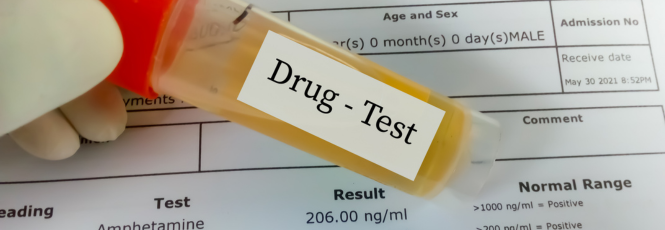
The DOT 5-panel drug test
A federally standardized 5-panel screen defined under Part 40, covering marijuana (THC), cocaine, opioids, phencyclidine (PCP), and amphetamines. The opioid category was expanded in 2018 beyond codeine and morphine to include hydrocodone, hydromorphone, oxycodone and oxymorphone. Amphetamines include methamphetamine and MDMA.
You cannot modify this panel. It does not matter that your state legalized marijuana or that you would like to add fentanyl screening. If you want broader screening for your own policy, run a separate non-DOT test — collected separately, documented separately, and never a substitute for the DOT test.
Each substance has an established cutoff level; concentrations below the threshold are reported negative. Detection windows vary — typically 24 to 72 hours for most substances, though marijuana can be detected for weeks in chronic users.
The test uses immunoassay screening with GC-MS confirmation, and a split specimen is collected every time so the driver can request a re-test of the B bottle. Your MRO handles all verified positives, and the driver gets a chance to provide a legitimate medical explanation before the result is final. Which means you cannot act on a preliminary screen — you wait for the MRO's verified result.
What changed in 2024-2025: oral fluid and Clearinghouse II
Oral fluid testing is now an authorized DOT collection method under updated Part 40. Employers may choose mouth swab collection instead of urine. The 5-panel is identical; only the collection changes — no bathroom, no direct-observation complications, harder to cheat. It is particularly useful for post-accident and reasonable suspicion testing in the field, where getting a driver to a collection site inside the window is a real problem.
Two practical caveats. Not every collection site offers it yet, so check with your consortium or C/TPA first. And SAMHSA still has to certify laboratories for oral fluid analysis; that process has been slower than expected, which limits how many facilities can actually process these tests. Before you commit to oral fluid collection as your primary method, confirm your lab is certified and your collection sites are equipped. Urine remains the default until the lab infrastructure catches up.
Clearinghouse II took effect November 18, 2024. State driver licensing agencies must now downgrade a driver's CDL when there is an unresolved drug or alcohol violation in the Clearinghouse. Previously a driver could carry a violation and keep their CDL because states were not required to act on Clearinghouse data. That loophole is closed. A driver who does not complete the return-to-duty process loses the license itself, not just the job.
State implementation timelines varied; some SDLAs needed IT changes to interface with the database. The federal requirement applies regardless of your state's readiness. Run the queries, report the violations, and do not assume a driver is clean because their CDL is still active in a slow-moving state.
Written policy requirements
Under §382.601 every carrier must maintain a written drug and alcohol policy, not a downloaded template, an actual policy reflecting your program. It must cover the circumstances under which each test type is required, the consequences of a positive test or refusal, and the driver's rights including the right to a split specimen test.
Every driver must receive a copy before performing any safety-sensitive function, and you need a signed acknowledgment on file for each. If your policy references a C/TPA, name them. If you use a consortium for random testing, say so.
The policy must include contact information for your DER and, where applicable, your SAP, and describe what happens after a violation — removal from safety-sensitive functions, SAP referral, and the return-to-duty requirements. Vague language about "disciplinary action" does not satisfy the regulation.
Update it when rules change. Oral fluid authorization is a policy update. Clearinghouse II is a policy update. A policy written in 2020 and untouched since is a compliance gap.
Reasonable suspicion: training and what counts
Under §382.603 you need at least one supervisor per shift who has completed the required training — 60 minutes on alcohol misuse indicators and 60 minutes on controlled substance indicators.
Observable indicators that can support reasonable suspicion:
- Physical — bloodshot eyes, dilated or constricted pupils, tremors, slurred speech, unsteady gait
- Behavioral — unusual aggression, paranoia, excessive fatigue, dramatic mood swings
- Performance — accidents, near-misses, unexplained absences, sharp changes in work quality, safety procedure violations
The determination must be documented in writing with factual descriptions rather than conclusions or diagnoses: date, time, location, witnesses present, and the specific behaviors observed. Vague notes like "seemed off" will not hold up. Then remove the employee from safety-sensitive duties and arrange immediate testing.
FMCSA Clearinghouse requirements
Under 49 CFR §382.701, since January 2020 every employer must:
- Query the Clearinghouse before hiring a new CDL driver
- Run annual limited queries on all current CDL drivers
- Report all violations — positive tests, refusals, actual knowledge, and return-to-duty completions
Two query types, not interchangeable. A full query requires the driver's electronic consent and returns detailed violation information; it is mandatory before any new hire performs safety-sensitive functions. A limited query needs no consent and only reveals whether a violation exists. Limited queries satisfy the annual check, but if one comes back showing a violation you must immediately follow up with a full query, and that driver cannot drive until it clears.
Drivers can access their own Clearinghouse records and designate employers to query on their behalf.
“The Clearinghouse has fundamentally changed the hiring landscape. Carriers who skip pre-employment queries are taking on enormous liability.”
DOT drug testing recordkeeping requirements
| Record type | Retention period |
|---|---|
| Verified positive tests | 5 years |
| Alcohol tests ≥ 0.02 | 5 years |
| Negative and cancelled tests | 1 year |
| Education and training records | Duration of employment + 2 years |
| Annual MIS summary | 5 years |
You're required to retain drug and alcohol testing records per these timelines. The retention period starts from the date of the test, not the date results came back. If you cannot produce records during an audit, FMCSA treats it as though the testing never happened.
Beyond results, retain records of the random selection process — the pool list, selection dates, notification-to-collection timeline. Gaps here are what auditors use to question whether your random program is genuinely random. FMCSA can request the annual MIS summary outside a formal review.
Owner-operators face identical requirements with less administrative infrastructure, which is another reason most join a consortium — the C/TPA handles retention, pool management and Clearinghouse reporting.
See the full recordkeeping guide for detail.
Where programs break down
The same gaps recur even in carriers who believe they are compliant:
- Missing pre-employment Clearinghouse queries. The single most common violation since 2020. The drug test was run but the full query was not — or a limited query was run where a full one was required.
- Outdated written policies. Still referencing the old opioid panel, or silent on the Clearinghouse. Auditors compare your policy against current regulation.
- Gaps in quarterly random draws. Batching tests into Q1 and Q4 and leaving Q2–Q3 empty is a red flag. Pull from the pool every quarter at minimum.
- No supervisor training documentation. Having trained supervisors is not enough; you need certificates, sign-in sheets or training records. If you cannot document it, it did not happen.
- Failing to report violations. Missing reports leave dangerous drivers invisible to other carriers running pre-employment queries.
- No designated employer representative. If the MRO cannot reach your DER, results sit in limbo. Some carriers still list someone who left two years ago.
- Incomplete driver education. Under §382.601 drivers must receive materials explaining requirements, consequences, and where to find substance abuse help. Handing over the policy is not the same thing — auditors check for both.
None of these are obscure. They are basic program management tasks that get dropped when nobody is watching the calendar. A DOT-compliant testing program with a qualified C/TPA handles most of this automatically — but the regulatory responsibility still sits with the carrier.
Penalties and enforcement
Civil penalties for program failures reach $16,864 per violation, and they stack. A missing Clearinghouse query on three drivers is three violations, not one. FMCSA adjusts the ceiling annually for inflation.
Beyond fines there is operational impact. A carrier rated Unsatisfactory after a compliance review must fix the deficiencies or face an out-of-service order. That means your trucks stop rolling. For smaller fleets, a single compliance review gone wrong can be an existential problem.
Drivers face consequences too. A positive test or refusal goes into the Clearinghouse and stays until the driver completes the full return-to-duty process: SAP evaluation, any recommended treatment, a return-to-duty test, and follow-up testing. Under Clearinghouse II an unresolved violation now triggers a CDL downgrade at the state level. The driver isn't just unemployable in safety-sensitive roles — they lose the license itself.
Building a program from scratch
If you're setting up a DOT drug testing program for the first time — maybe you just got your operating authority, or you're adding CDL drivers to a fleet that previously didn't have them — here's the sequence that matters:
- Appoint a DER who understands the role: receiving MRO results, ordering tests, managing the Clearinghouse account
- Select a C/TPA or build in-house. Most fleets under 100 drivers use a consortium
- Write your policy per §382.601, naming your C/TPA and reflecting current rules including oral fluid and Clearinghouse requirements
- Train your supervisors — 60 minutes alcohol, 60 minutes drugs. Document everything from training dates and content covered to attendee signatures.
- Set up Clearinghouse access — register as an employer, and build queries into the hiring workflow before the first driver starts
- Establish collection site relationships, confirm which offer oral fluid, and identify backups — you do not want to be scrambling after an accident with the clock running
Get all of this in place before your first driver performs a safety-sensitive function. FMCSA expects the program to exist from day one.
Compliance checklist
- A written DOT-compliant drug and alcohol policy
- Enrollment in a random testing consortium, if applicable
- Supervisor training for reasonable suspicion determinations
- Pre-employment testing procedures
- A system for random selections
- Clearinghouse query and reporting processes
- Proper recordkeeping and MIS reporting
Frequently asked questions
Who is required to have a DOT drug testing program? Every carrier operating CMVs with a GVWR of 26,001+ lbs, vehicles transporting 16+ passengers, or hazmat vehicles requiring a CDL must maintain a compliant program under 49 CFR Part 382. There are no exemptions based on fleet size.
What drugs does DOT testing cover? The 5-panel screens for marijuana, cocaine, opioids (codeine, morphine, hydrocodone, hydromorphone, oxycodone, oxymorphone), PCP, and amphetamines (methamphetamine and MDMA). The panel is set by federal regulation and cannot be modified by the employer.
How often must random drug tests be conducted? A minimum annual rate of 50% for drugs and 10% for alcohol, calculated against your average driver pool count under §382.305. Most C/TPAs spread tests across quarterly draws.
What are the six required types of DOT drug testing? Pre-employment, random, post-accident, reasonable suspicion, return-to-duty, and follow-up. Missing any category is a citable violation during a compliance review.
Can a carrier use a non-DOT drug test to satisfy FMCSA requirements? No. Only tests conducted under 49 CFR Part 40 procedures satisfy FMCSA requirements. Non-DOT workplace tests use different collection protocols, panels and chain-of-custody procedures.
What changed in DOT drug testing requirements for 2024-2025? Two things. Oral fluid testing is now permitted as an alternative collection method under updated Part 40. And Clearinghouse II took effect November 18, 2024, requiring state licensing agencies to downgrade CDLs for drivers with unresolved violations.
What is the DOT 5-panel drug test? A federally standardized screen under Part 40 covering marijuana, cocaine, opioids, PCP and amphetamines. Employers cannot add substances or substitute a broader workplace panel.
Do owner-operators need a DOT drug testing program? Yes. Owner-operators holding a CDL must be enrolled in a compliant random testing program. Because they cannot administer their own random selections, most join a consortium through a C/TPA. Operating without membership is a violation regardless of fleet size.
What is the post-accident drug testing window? 32 hours for drug testing, 8 hours for alcohol. Miss either window and FMCSA treats it as a refusal to test under §382.303 — the same consequences as a positive result.
Related Articles
DOT Drug and Alcohol Testing for Aviation: FAA''s Part 120 ICR Renewal and What Aviation Employers Should Know
DOT Drug & Alcohol Testing FAQs for Owner-Operators & Small Companies
What to Do When a Driver Needs a Post-Accident DOT Drug Screen & Alcohol Test
.webp)