








The DOT Return-to-Duty Process: What It Is and How to Automate Its Recordkeeping

When a driver fails a DOT drug or alcohol test, they cannot simply come back. They must complete the return-to-duty (RTD) process first, and the employer carries most of the documentation burden for it.
Two things to be clear about up front:
- A failed DOT test or a refusal goes onto the driver's FMCSA Clearinghouse record and stays there until the RTD process is complete and five years have passed from the violation date. Until RTD is complete the driver sits in "prohibited" status, which bars them from operating a CMV.
- Since November 18, 2024, Clearinghouse II adds another layer of enforcement. Drivers in prohibited status can no longer keep their commercial driving privileges. State Driver Licensing Agencies must remove or downgrade the CDL or CLP until RTD is successfully completed.
What is the DOT return-to-duty process?
A federally prescribed sequence under 49 CFR Part 40 that a safety-sensitive employee must complete after a drug or alcohol violation before returning to safety-sensitive work. It is not a disciplinary process and it is not optional — the steps, the order and the documentation are all set by regulation.
When the RTD process is triggered
Any of these starts the clock:
- A verified positive drug test
- An alcohol test at 0.04 or above
- A refusal to test, including a substituted or adulterated specimen
- Actual knowledge of prohibited use
The nine steps
Step 1: Immediate removal from safety-sensitive functions
The driver stops driving as soon as it is safe to do so — including mid-route in another state. There is no grace period and no "finish the load" allowance.
Step 2: Provide the SAP referral list
The employer must give the driver a list of DOT-qualified Substance Abuse Professionals. This is an employer obligation and it is one auditors check.
Step 3: Initial SAP evaluation
A face-to-face interview in which the SAP assesses the employee's situation and usage history, then determines what education or treatment is required.
Step 4: Driver completes the prescribed program
Education, treatment, or both, as prescribed. The driver arranges and pays for this in almost every case.
Step 5: SAP follow-up evaluation
With the same SAP. They determine whether the employee may take an RTD test and resume safety-sensitive functions, and they issue the follow-up testing schedule to the Designated Employer Representative.
Step 6: The return-to-duty test
Conducted only after the SAP confirms all requirements are met.
The RTD specimen collection must be directly observed by an individual of the same sex, for the entire process. This is not optional and not at the employer's discretion — a non-observed collection does not satisfy the return-to-duty requirement.
Step 7: Report return-to-duty completion to the Clearinghouse
The employer must report the negative return-to-duty result by the close of the third business day after receiving it. Miss this and the driver stays in prohibited status, unable to work for anyone.
Step 8: The driver returns to safety-sensitive functions
Once a negative result is received and reported.
Step 9: Follow-up testing
The SAP prescribes a minimum of six tests over 12 months, and may extend the schedule for up to five years. Every follow-up test is also directly observed.
Follow-up testing does not replace random testing
This one catches carriers regularly. A driver on a follow-up schedule stays in the regular random pool and must complete any random selections they receive in addition to their scheduled follow-up tests.
A random cannot substitute for a follow-up and a follow-up cannot substitute for a random — precisely because randoms are not collected under direct observation and follow-ups must be.
What the return-to-duty process costs
Nobody discusses the money until a driver is already in the middle of it.
| Cost item | Typical range | Who pays |
|---|---|---|
| SAP initial evaluation | $200–$400 | Driver |
| SAP follow-up evaluation | $200–$400 | Driver |
| Treatment / education program | $500–$10,000+ | Driver |
| Return-to-duty test | $50–$80 | Varies by employer policy |
| Follow-up tests (6–12 over 12 months) | $300–$960 | Employer |
| Lost wages during the process | $3,000–$20,000+ | Driver |
The driver bears most of the direct cost. Some carriers cover the RTD test itself because it runs through the employer's program, but that is a policy choice — there is no regulatory requirement either way. Follow-up testing is different: those tests happen through your program and the employer normally absorbs them.
Realistic timelines
It depends on the SAP's clinical determination and how quickly the driver moves. Two common scenarios:
Scenario 1: Education-only recommendation (best case)
| Phase | Typical timing |
|---|---|
| Removal from duty | Day 0 |
| SAP initial evaluation | Week 1–2 |
| Education program completion | Weeks 2–6 |
| SAP follow-up evaluation | Week 6–7 |
| RTD test (directly observed) | Within days of SAP clearance |
| Clearinghouse reporting + CDL restoration | 1–2 weeks after negative test |
| Back on the road | \~6–8 weeks |
Scenario 2: Outpatient treatment recommendation
| Phase | Typical timing |
|---|---|
| Removal from duty | Day 0 |
| SAP initial evaluation | Week 1–2 |
| Outpatient treatment | Weeks 2–12 |
| SAP follow-up evaluation | Week 12–13 |
| RTD test (directly observed) | Within days of SAP clearance |
| Clearinghouse reporting + CDL restoration | 1–2 weeks after negative test |
| Back on the road | \~3–4 months |
Inpatient treatment cases can stretch to six months or longer. And remember — about 15–20% of drivers need additional treatment after the SAP follow-up evaluation, which resets part of the clock.
The follow-up testing period starts after the driver returns to duty and runs for a minimum of 12 months, up to 60 months. During that period, the driver stays in your random testing pool and completes the SAP-prescribed follow-up tests on top of that. Those follow-up tests are unannounced — the driver doesn't get to schedule them.
There's no regulatory shortcut. The SAP controls the clinical timeline, and neither you nor the driver can speed it up. What you can control is how fast you handle the administrative steps: providing the SAP referral list promptly, scheduling the RTD test as soon as the SAP clears the driver, and reporting to the Clearinghouse the same week you get the negative result.
Employer obligations versus driver obligations
Fleet managers get tripped up on the split. Both parties have responsibilities, but FMCSA audits the employer.
| Obligation | Responsible party |
|---|---|
| Provide SAP referral list | Employer |
| Schedule and attend SAP evaluations | Driver |
| Complete prescribed treatment | Driver |
| Arrange and pay for the RTD test | Depends on employer policy |
| Conduct the RTD test through a compliant program | Employer |
| Report RTD completion to the Clearinghouse | Employer |
| Administer the follow-up testing schedule | Employer |
| Retain all RTD records for 5 years | Employer |
FMCSA will ask for RTD documentation whether or not the driver finished. If a driver disappears mid-process, your obligation is to keep records showing which steps were completed and that you referred them to a SAP.
Recordkeeping requirements
These apply even if a single employee goes through return-to-duty.
Maintain a written DOT-compliant drug and alcohol testing program that includes RTD and follow-up procedures — retained for the duration it was in force, plus five years after it is replaced or revised.
Keep for five years:
- Alcohol test results at 0.02 or above
- Verified positive drug test results
- Refusals, including substituted or adulterated results
- SAP reports
- All follow-up tests and follow-up test schedules
All records must sit in a secure location with controlled access — paper files locked, electronic records password-protected. Records must be legible and signatures authenticatable, because an auditor who cannot read or verify a record treats it as absent.
What the return-to-duty process costs
Nobody talks about the money until the driver's already in the middle of it. Here's what a typical RTD case actually costs:
| Cost Item | Typical Range | Who Pays |
|---|---|---|
| SAP initial evaluation | $200–$400 | Driver |
| SAP follow-up evaluation | $200–$400 | Driver |
| Treatment/education program | $500–$10,000+ | Driver |
| Return-to-duty test | $50–$80 | Varies by employer policy |
| Follow-up tests (6–12 over 12 months) | $300–$960 | Employer (required under your program) |
| Lost wages during process | $3,000–$20,000+ | Driver |
The driver bears most of the direct cost. SAP evaluations, treatment, and lost wages all come out of their pocket in almost every case. Some carriers cover the RTD test itself since it's conducted through the employer's DOT drug testing program, but that's a company policy decision — there's no regulatory requirement either way.
Follow-up testing is a different story. Those tests happen through your program, and the employer typically absorbs that cost. If you're using a drug testing consortium, follow-up tests are usually billed per test on top of your consortium membership.
For drivers, the total out-of-pocket ranges from about $1,500 for a straightforward education-only case to $15,000+ when inpatient treatment is involved. That doesn't count lost wages, which are often the biggest hit. A driver who's off the road for three months at $1,200/week loses $14,400 before they even factor in treatment costs.
Bottom line for fleet managers: the RTD process is expensive enough that drivers sometimes abandon it entirely. That's their right, but you still need to keep the records showing you referred them to a SAP and initiated the process — FMCSA checks for that whether the driver completed RTD or not.
Common return-to-duty failures
Failure to report to the Clearinghouse
The most damaging mistake in the process. If you do not report return-to-duty completion, your former driver cannot work for any other carrier — and when FMCSA audits you, the missing report is a citable violation.
Missing follow-up tests
Not optional, and not interchangeable with random testing. If the SAP prescribed 12 follow-up tests over 24 months, you conduct exactly that. Missing ones are easy for auditors to spot.
Incorrect test type
Alcohol violation means the return-to-duty test must be an alcohol test. Drug test refusal means it must be a drug test. Mismatched types invalidate the entire return-to-duty.
Non-observed collection
A newer failure mode worth naming: if the return-to-duty or a follow-up specimen was not collected under direct observation, the test does not count, and the driver's return was not valid.
Automating return-to-duty recordkeeping
Managing one case manually means tracking nine steps across four parties — SAP, MRO, collection site, Clearinghouse — under five-year retention. One case is manageable. Three at once and spreadsheets stop working.
Automated compliance platforms address this by:
- Tracking each case through a workflow. Every step has a status, a responsible party, and a deadline.
- Storing all documentation centrally -- SAP reports, test results, and Clearinghouse confirmations in one retrievable location.
- Building follow-up testing schedules from the SAP's prescription and sending alerts when tests are due.
- Flagging missing documentation. If a record is expected but hasn't arrived (say, a SAP follow-up evaluation after treatment completion), the system alerts your compliance manager.
- Enforcing retention periods so records stay for the required five years automatically.
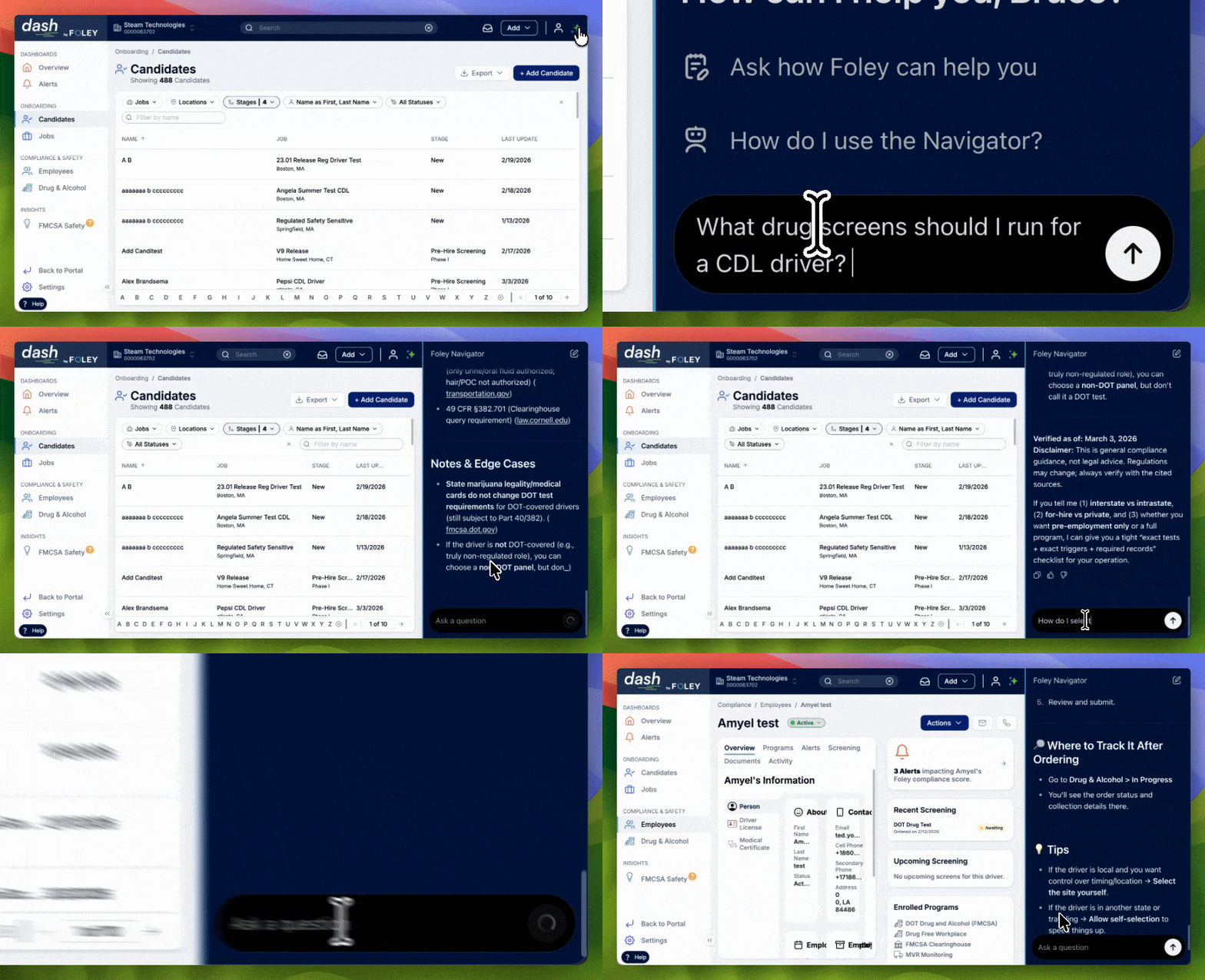
A third-party administrator, like Foley, can run the whole thing: SAP referral, test scheduling, direct-observation collection arrangements, Clearinghouse reporting and record retention, with the documentation filed into the driver qualification file automatically.
“A single RTD case generates 15 to 20 individual documents across multiple parties over 12 to 60 months. Tracking that in a spreadsheet works for one case. It breaks down at three. Automation is not a luxury for RTD management, it is how you avoid audit findings.” - Foley Compliance Team, FMCSA-Registered C/TPA
Frequently asked questions
What is the DOT return-to-duty process? The federally required sequence under 49 CFR Part 40 that a safety-sensitive employee must complete after a drug or alcohol violation: removal from duty, SAP evaluation, prescribed education or treatment, SAP follow-up evaluation, a directly observed return-to-duty test, Clearinghouse reporting, and a follow-up testing schedule of at least six tests over 12 months.
How long does the return-to-duty process take? Roughly 6–8 weeks where the SAP recommends education only, and 3–4 months for outpatient treatment. Inpatient recommendations run longer. The variables are the SAP's clinical determination and how quickly the driver completes each step.
Who pays for the return-to-duty process? The driver bears most of it — SAP evaluations, treatment, and lost wages. Employers typically absorb follow-up testing because it runs through their program. Who pays for the RTD test itself is a company policy decision with no regulatory requirement either way.
Is the return-to-duty test directly observed? Yes. The RTD test and every follow-up test must be collected under direct observation by an observer of the same sex. A collection that was not observed does not satisfy the requirement.
Do follow-up tests replace random testing? No. The driver remains in the random pool and must complete random selections in addition to follow-up tests. Neither can substitute for the other, because randoms are not directly observed.
How many follow-up tests are required? A minimum of six within the first 12 months after return to duty. The SAP may prescribe more and may extend the schedule for up to five years.
When must return-to-duty completion be reported to the Clearinghouse? By the close of the third business day after the employer receives the negative RTD result. Until it is reported the driver remains in prohibited status.
How long does a violation stay on the Clearinghouse record? Until the RTD process is complete and five years have passed from the date of the violation.
What happens if a driver never completes the return-to-duty process? They remain in prohibited status and cannot perform safety-sensitive functions for any employer. Under Clearinghouse II their state licensing agency must also remove or downgrade the CDL or CLP. The employer's obligation is to retain records showing which steps were completed and that a SAP referral was provided.
Related Articles
DOT Substance Abuse Professional (SAP) Program Guide for Fleet Managers
DOT Part 40 Drug and Alcohol Testing Rule 2026: Directly Observed Collections When Oral Fluid Is Unavailable
DOT Drug Test Requirements, Procedures & Compliance
.webp)