









Background Checks for CDL Drivers: MVR, PSP, Employment History, and FCRA Compliance
Hiring a driver without a proper background check is a liability nightmare waiting to happen. One missed MVR pull, one skipped Clearinghouse query, and you're exposed in an FMCSA audit and a plaintiff attorney's courtroom.
FMCSA requires three categories of pre-employment screening: motor vehicle records, previous employer safety history, and Clearinghouse queries. FCRA adds disclosure and consent requirements on top of all that. Foley helps carriers manage the pre-employment screening process so required steps are completed, documented, and easier to keep compliant.
What FMCSA Requires Before You Hire
Federal regulations mandate three screening categories for CDL drivers. Different rules, different timelines, different documentation. Three separate workflows to manage before a driver touches a CMV.
1. Motor Vehicle Record (MVR)
Under 49 CFR §391.23, you must pull an MVR from every state where the driver held a license or permit in the past three years. Not just the state they currently live in. Every state.
An MVR reveals: - License status (active, suspended, revoked) - Moving violations and traffic convictions - Accident history reported to the state DMV - Endorsements and restrictions on the license - DUI/DWI history
| MVR Requirement | Detail |
|---|---|
| When to pull | Before hiring + annually for all current drivers |
| States covered | Every state where the driver held a license in the past 3 years |
| What disqualifies | Varies by carrier policy, but suspended/revoked CDL is an automatic disqualifier |
| Retention | In the driver qualification file for duration of employment + 3 years |
2. Previous Employer Safety Performance History
Under 49 CFR §391.23(d) and (e), you must investigate every CDL driver's safety performance history for the previous three years of DOT-regulated employment. This covers:
- Accident history — all DOT-recordable accidents
- Drug and alcohol violations, including failed tests, refusals, or other violations
- Return-to-duty status: whether the driver completed an RTD process
- Whether follow-up testing obligations remain (rehabilitation status)
You have 30 days from the driver's start date to send inquiries to all previous DOT-regulated employers. Document every attempt, including non-responses. Because if a previous employer ghosts you, that's fine — FMCSA just wants to see you tried.
3. FMCSA Clearinghouse Full Query
Before a CDL driver performs any safety-sensitive function, you must run a full query in the FMCSA Drug & Alcohol Clearinghouse (49 CFR §382.701). The driver has to provide electronic consent.
A full query shows whether the driver has unresolved drug or alcohol violations, resolved violations with remaining follow-up testing obligations, or refusals to test.
Unresolved violation? You can't hire them. Not for any safety-sensitive duty. For details on hiring drivers with resolved violations, see our Clearinghouse CDL reinstatement guide.
Recommended (Not Required) Screening
Pre-Employment Screening Program (PSP) Report
FMCSA's PSP provides a driver's: - 5-year crash history from the FMCSA Motor Carrier Management Information System (MCMIS) - 3-year roadside inspection history including out-of-service violations
PSP reports aren't federally mandated, but they fill a gap MVRs can't. An MVR shows what the state DMV knows. A PSP report shows what FMCSA inspectors found on the road. Two completely different pictures. Carriers that only pull MVRs are flying half blind.
| Screening Type | What It Shows | Required? | Source |
|---|---|---|---|
| MVR | License status, violations, DUI history | Yes | State DMV |
| Previous employer investigation | Accident history, drug violations, RTD status | Yes | Prior employers |
| Clearinghouse full query | Unresolved/resolved drug & alcohol violations | Yes | FMCSA Clearinghouse |
| PSP report | 5-year crash + 3-year inspection history | No (recommended) | FMCSA MCMIS |
| Criminal background check | Criminal convictions | Varies by state and carrier policy | Third-party providers |
“An MVR tells you about the driver's license. A PSP report tells you about the driver's safety record on the road. Carriers that only pull MVRs are seeing half the picture. The 8% crash reduction among PSP users is not a coincidence, it is the result of better hiring decisions.”
Criminal Background Checks
FMCSA doesn't require criminal background checks for CDL drivers, except for hazmat endorsement holders (they go through a TSA security threat assessment). Many carriers run criminal checks anyway as part of company policy.
If you do run them, FCRA compliance applies. No exceptions.
FCRA Compliance: What Carriers Must Do
FCRA kicks in whenever you use a third-party consumer reporting agency to pull background information on a driver. That includes MVRs obtained through a third party, PSP reports, criminal background checks and employment verification reports.
Required Steps
- Written disclosure. Give the driver a clear, standalone written disclosure that you'll run a background check. It has to be standalone — not buried in your hiring packet. Carriers get tripped up on this constantly.
- Written authorization. Get the driver's written consent before you run anything.
- Pre-adverse action notice. If you plan to deny employment based on the report, send the driver a copy of the report and a summary of their FCRA rights first.
- Give the driver a reasonable window (typically 5 business days) to review and dispute the report before you make a final call. That's the waiting period.
- Adverse action notice. If you proceed with denial, send a final notice with the reporting agency's contact info, a statement that the agency didn't make the hiring decision, and the driver's right to dispute.
FCRA Violations Are Costly
| FCRA Violation Type | Potential Penalty |
|---|---|
| Willful noncompliance | $100 to $1,000 per violation + punitive damages + attorney fees |
| Negligent noncompliance | Actual damages + attorney fees |
| Class action exposure | Statutory damages multiplied across all affected applicants |
FCRA class actions against trucking companies have produced multi-million dollar settlements. The two most common failures: bundling the disclosure with other hiring documents instead of keeping it standalone, and skipping the pre-adverse action waiting period. Either of those gaps is a lawsuit waiting to be filed.
What Foley's Background Check Service Includes
Pre-Employment Package
For every new CDL hire, Foley handles:
- Multi-state MVR ordering — records from every state where the driver held a license in the past 3 years
- PSP report. 5-year crash history and 3-year inspection data from FMCSA.
- Previous employer investigations: inquiries to all DOT-regulated employers, with response tracking and non-response documentation
- Clearinghouse full query, conducted with driver consent before first safety-sensitive function
- FCRA-compliant disclosure and consent covering all notice requirements
Ongoing Monitoring
Screening doesn't stop at hire. For current drivers, Foley provides annual MVR reviews (required by 49 CFR §391.25) with automatic alerts for new violations or license status changes. Annual Clearinghouse limited queries get run for every active CDL driver. And if you want it, continuous MVR monitoring gives you real-time alerts when a driver's record changes between annual reviews.
Integration With DQF Management
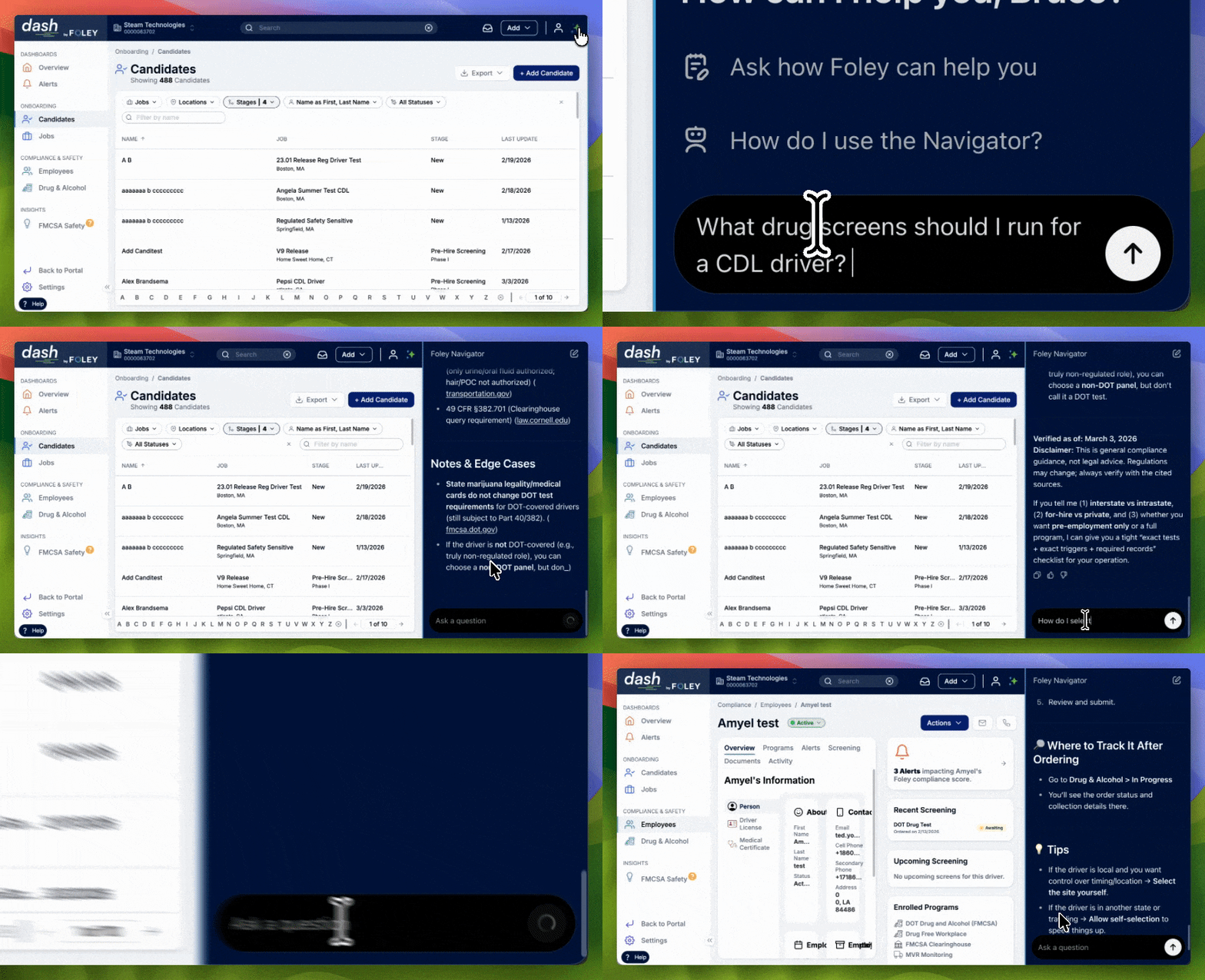
Every background check document feeds directly into the driver's qualification file in Foley's Dash platform. MVRs, PSP reports, employer responses, Clearinghouse queries — all automatically indexed, dated, and stored with the correct retention period.
The Cost of Skipping Screening Steps
Skip any step and you're exposed on three fronts. The fines are just the start.
Regulatory risk. Each missing screening step is a citable violation during an FMCSA compliance review, with fines up to $16,000 per violation. See DOT Drug Testing Violations & Penalties for fine schedules.
Liability risk is the bigger problem. If a driver you hired causes an accident and you didn't run the required screenings, plaintiff attorneys will use that negligent hiring as evidence. The missing PSP report or employer investigation becomes exhibit A — a gap which any attorney can exploit. Few carriers think about this until depositions start.
Then there's safety risk. Carriers using PSP reports see 8% fewer crashes and 17% fewer driver out-of-service violations. Screening works because it catches risk before it becomes an incident.
“Negligent hiring is the single largest liability exposure in trucking litigation. When a plaintiff attorney can show that a carrier did not pull an MVR, did not check the Clearinghouse, or did not investigate previous employers, the case is effectively decided before it starts.”
Get Started With Foley
Whether you're hiring your first CDL driver or onboarding 50 at once, Foley helps carriers complete, document, and store key screening steps from day one — including MVR pulls, PSP reports, employer investigations, Clearinghouse queries, and FCRA-related notices through Foley's Dash platform alongside DQF management and drug testing.
Frequently asked questions
What background checks are required before hiring a CDL driver?
FMCSA requires carriers to obtain the driver's motor vehicle record (MVR) from every state where they held a license in the past 3 years, investigate previous employer safety performance history for the past 3 years, and run a full query in the FMCSA Drug & Alcohol Clearinghouse. PSP reports from FMCSA's Pre-Employment Screening Program are not mandatory but are strongly recommended.
What is a PSP report and is it required?
A Pre-Employment Screening Program (PSP) report shows a driver's 5-year crash history and 3-year roadside inspection history from FMCSA records. It is not federally mandated, but it gives carriers visibility into a driver's safety record that MVRs alone do not provide. Carriers using PSP reports have shown 8% fewer crashes and 17% fewer out-of-service violations.
What does FCRA compliance require for driver background checks?
The Fair Credit Reporting Act (FCRA) requires carriers to provide written disclosure to the driver that a background check will be conducted, obtain written authorization before running the check, follow adverse action procedures if a hiring decision is based on the report, and provide a copy of the report if the driver requests it.
How far back do previous employer investigations go?
Carriers must investigate the driver's safety performance history with all DOT-regulated employers from the past 3 years. This includes accident history, drug and alcohol violations, and whether the driver was subject to any Return-to-Duty requirements. The inquiry must be sent within 30 days of hire.
What happens if a previous employer does not respond to a safety performance history inquiry?
The carrier must document all attempts to obtain the information, including dates, methods of contact, and the previous employer's identity. FMCSA requires a good-faith effort. If no response is received after documented attempts, the carrier should note the non-response in the driver's file. Failure to make the attempt is the violation, not the previous employer's silence.