








DOT Drug Test & Alcohol Testing Program
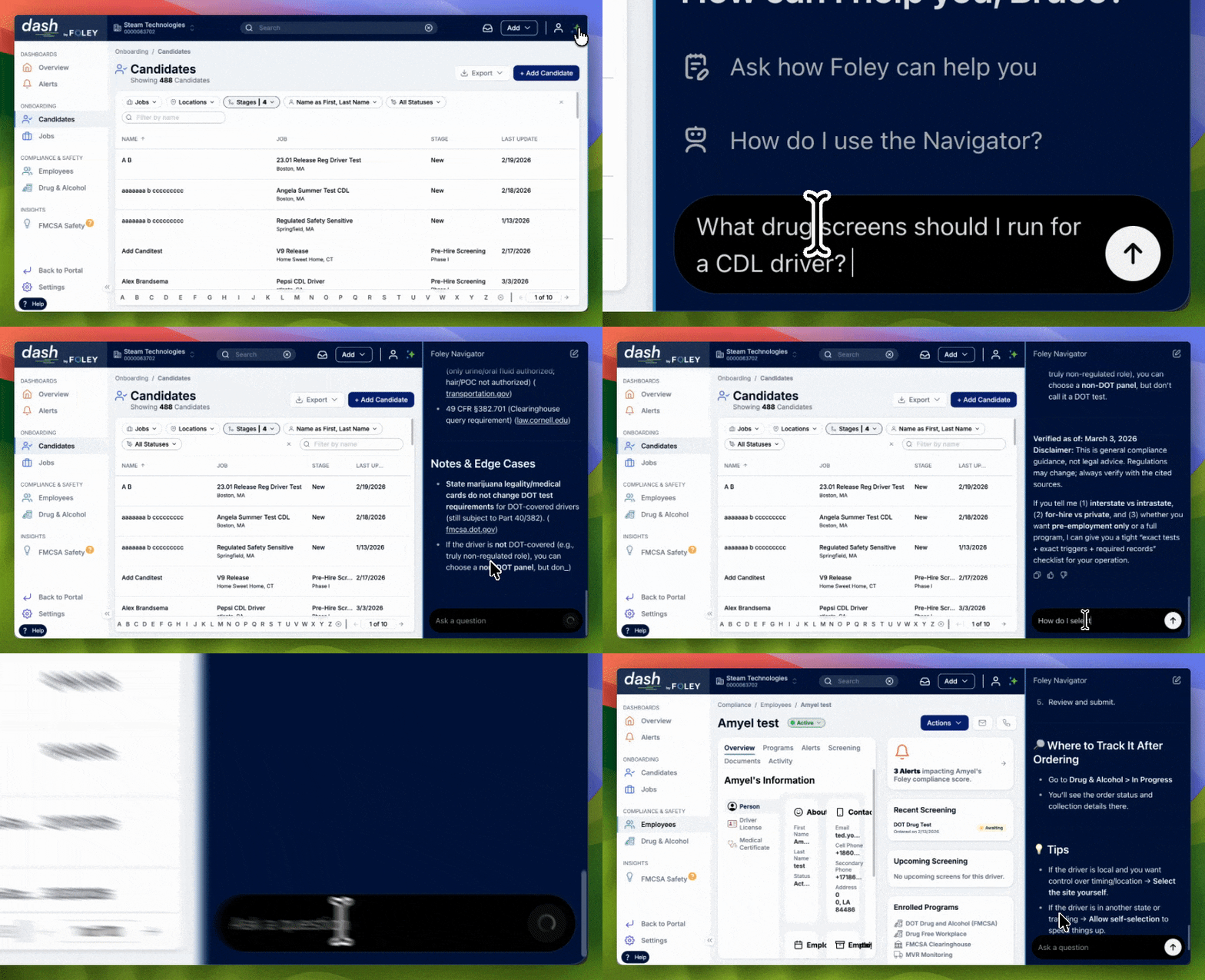
We run your DOT drug and alcohol testing program end to end — enrollment, random pool, collections, MRO review, and Clearinghouse queries.
- 10,000+ collection sites nationwide
- FMCSA-registered C/TPA — we run our own consortium
- Random pool and Clearinghouse queries included
Get your DOT drug and alcohol testing program set up
Send your driver count and where you run. We enroll you and schedule the tests.
What Is a DOT Drug Test?
A DOT drug test is a federally regulated urine collection that screens a safety-sensitive employee for five drug classes, using the collection, chain-of-custody, laboratory, and physician-review procedures in 49 CFR Part 40. For CDL drivers, who gets tested and when is set separately, in 49 CFR Part 382.
It is not a normal pre-hire screen. A DOT drug screen has a fixed panel, fixed cutoff levels, an HHS-certified laboratory, a Medical Review Officer, and a federal Chain of Custody and Control Form — none of it the employer's choice. Change one step and it is no longer a DOT test, which means on audit the test did not happen.
DOT alcohol testing runs on a parallel track: a screening test and, if needed, a confirmation test on an evidential breath testing device, given by a trained BAT or STT under 49 CFR Part 40, Subpart J. So yes, DOT tests for alcohol — but never in the urine specimen.
With one CDL driver, including yourself, you are the employer under 49 CFR 382.103, and you owe the whole program — not just the pre-employment test.
- Written policy and driver education materials — 49 CFR 382.601
- Verified negative pre-employment drug test before the first safety-sensitive function — 49 CFR 382.301
- Random drug and alcohol testing at the current federal minimum rates — 49 CFR 382.305
- Post-accident testing when the thresholds are met — 49 CFR 382.303
- Reasonable suspicion testing by a supervisor with documented training — 49 CFR 382.307, 49 CFR 382.603
- Return-to-duty and follow-up testing after any violation — 49 CFR 382.309, 49 CFR 382.311
- Clearinghouse queries and violation reporting — 49 CFR Part 382, Subpart G
- A designated employer representative and retained records — 49 CFR 382.401
Clearinghouse-II has been in force since 18 November 2024: a driver in prohibited status loses the CDL or CLP itself, not just the right to drive for you. The status is visible to the state licensing agency, and the downgrade follows automatically.
For calendar year 2026 the federal random testing minimums are unchanged — 50 percent of average driver positions for controlled substances and 10 percent for alcohol. Foley runs the queries, holds the consent records, and watches for a status change between your annual queries rather than at the next hiring cycle.
Who Must Be in a DOT Drug and Alcohol Testing Program
49 CFR Part 382 covers every driver who operates a commercial motor vehicle requiring a CDL, interstate or intrastate. Under 49 CFR 382.107 that means a gross vehicle or combination weight rating of 26,001 pounds or more, a vehicle designed to transport 16 or more passengers including the driver, or any size vehicle carrying placarded hazardous materials. There is no small-carrier exemption — only the administration scales with fleet size.
You test before first dispatch, keep every covered driver in a random pool, train supervisors on reasonable suspicion, and hold the records. Most fleets hand the administration to a C/TPA and keep only the DER decisions — pulling a driver, authorizing a test, accepting an MRO verification.
You cannot select yourself at random. Under 49 CFR 382.305 a single-driver employer must be in a random selection pool of two or more covered employees, administered by a consortium or third-party administrator. Same six test types, same records, same audit exposure.
Most states adopt Part 382 by reference for intrastate CDL operations, so the panel and the rates do not change — the inspector does. California enforces the federal testing program for intrastate carriers through CHP terminal inspections. Each state adopts Part 382 through its own vehicle or motor carrier code, so the adopting citation is set at the state level. We identify the one that governs your operation.
The program sits on top of an active carrier registration. If your dot number is inactive or your mcs-150 is stale, fix that first — an investigator will open with it.
Programs and Pricing: Pick the One That Matches Your Fleet
Three programs, all administered by Foley as your C/TPA, all covering the six required test types, the random pool, MRO review, and Clearinghouse queries. What differs is how much of the day-to-day we take off your desk.
| Program | Built for | What's included |
|---|---|---|
| Owner-Operator Consortium Enrollment | Single-driver carriers; you are your own employee | Foley random pool placement, pre-employment test, post-accident and reasonable suspicion testing on call, MRO review, Clearinghouse full and limited queries, enrollment certificate for your file |
| Small Fleet (2–25 drivers) | Growing fleets with no full-time compliance person | Plus quarterly random selections with rate documentation, DER support by phone, supervisor reasonable-suspicion training, written policy, and driver education materials |
| Enterprise / Managed Program | Multi-terminal operations, or contract-driven safety requirements | Plus a named program manager, SAP and return-to-duty case management, follow-up test scheduling, audit-ready records package, and coordination with mvr monitoring and DQ files |
Collection, lab, and MRO fees are the same at any program size — the panel is federally fixed. Administration is what changes. Ask for the line-item quote; we show which costs are pass-through and which are ours.
Want us to run this instead?
Same six steps, handled by our team. You keep the DER decisions; we keep the pool, the collections, the queries, and the audit file.
How Foley Sets Up and Runs Your Program
Enrollment takes minutes. This is what we do after that, in order.
The Six DOT Tests and When Each One Is Required
Six triggers. Miss one and it is an audit finding, not a paperwork problem.
| Test | Trigger | Timing | Citation |
|---|---|---|---|
| Pre-employment | Before a new driver's first safety-sensitive function; also to re-enter the pool after more than 30 consecutive days out of a random program | Verified negative required before dispatch | 49 CFR 382.301 |
| Random — drugs and alcohol | Scientifically valid, unannounced selection from the full pool of covered drivers | Spread reasonably through the year; driver proceeds to the site immediately on notification | 49 CFR 382.305 |
| Post-accident | Fatality, or a citation to the driver for a moving violation plus injury treated away from the scene or a tow-away | Alcohol within 8 hours; drugs within 32 hours | 49 CFR 382.303 |
| Reasonable suspicion | A trained supervisor observes specific, contemporaneous, articulable appearance, behavior, speech, or body odor | Alcohol test within 8 hours of the observation; document the observation in writing | 49 CFR 382.307 |
| Return-to-duty | After any violation, once a Substance Abuse Professional releases the driver | Directly observed collection before returning to safety-sensitive duty | 49 CFR 382.309, 49 CFR 40.305 |
| Follow-up | On the schedule the SAP sets — the employer cannot shorten it | Minimum 6 tests in the first 12 months; the plan may run up to 60 months | 49 CFR 382.311, 49 CFR 40.307 |
Alcohol testing is required for random, post-accident, reasonable suspicion, return-to-duty, and follow-up — not pre-employment, where it is permitted and rarely used.
Not sure which of the six you are actually running?
Send us your driver count and last year's selection records. We will tell you where the gaps are before an investigator does.
Request a program reviewWhat the DOT 5-Panel Tests For, What "W/TS" Means, and Urine vs. Oral Fluid
The DOT drug test panel is five classes, set federally. You cannot add a drug or drop one; a six- or ten-panel is a separate non-DOT test on a separate form.
- Marijuana — screened and confirmed on the THC metabolite, not the parent drug
- Cocaine — confirmed on benzoylecgonine
- Opioids — the class was expanded effective January 1, 2018 to add four semi-synthetic opioids alongside the three original analytes; every analyte and its cutoff is listed on our DOT 5-panel reference
- Amphetamines — amphetamine and methamphetamine, plus MDMA and MDA
- Phencyclidine (PCP)
The 2018 expansion is what fleets still miss. Before it, a driver on one of the added prescription opioids produced a negative because the panel never looked for it. Now the lab looks, the MRO verifies the prescription, and the result comes back negative with a safety concern flagged to you where applicable under 49 CFR 40.327 — a different conversation with your driver than a clean negative. Screening and confirmatory cutoff levels are fixed in 49 CFR 40.85; below cutoff is a negative, not a small positive.
"DOT drug panel w/ TS"
TS is the temperature screen. The collector reads the specimen temperature within four minutes of the collection and records it on the CCF; an out-of-range reading under 49 CFR 40.65 triggers a new collection under direct observation. Not an extra drug — the validity check that makes the specimen defensible.
Urine or oral fluid? What Part 40 allows right now
Urine is still the specimen for DOT testing in practice. DOT amended 49 CFR Part 40 in 2023 to authorize oral fluid collection as an alternative, with the same five classes and its own cutoff levels — but it cannot be used until HHS certifies at least two laboratories for oral fluid testing, including one split-specimen lab.
Why it matters when it goes live: the collector observes the collection, which removes most substitution and adulteration attempts; the detection window is shorter and weighted toward recent use, which suits post-accident and reasonable suspicion testing; and it resolves shy bladder, where a driver cannot provide 45 mL and the process moves to the medical evaluation in 49 CFR 40.193. Two constraints: the employer chooses the specimen type per test and must document that choice in the written policy before the collection, and certain collections must still be directly observed regardless of specimen type — 49 CFR 40.67. Our position: do not rewrite your policy on an anticipated rule. We update client policies once the lab certifications are in place, and we tell you when.
A pre-employment test cannot be backdated
A driver cannot perform a safety-sensitive function until you have a verified negative and a clean Clearinghouse full query (49 CFR 382.301, 382.701). If someone is dispatched Monday, the collection happens now.
Random Testing Rates and How the Pool Actually Works
Random testing is where most carriers fail an audit, and almost never because someone refused a test. The year ended under rate, or the selection could not be shown to be random.
The FMCSA Administrator sets the minimum annual percentage rates for controlled substances and for alcohol each year under 49 CFR 382.305 and publishes them in the Federal Register. For calendar year 2026 the minimums are 50 percent for controlled substances and 10 percent for alcohol, unchanged since 2020. The drug rate can only fall to 25 percent if the industry positive rate stays below 1 percent for two consecutive years. Any change is published in the Federal Register and applies from January 1 of the following year.
Beyond the number, 49 CFR 382.305 requires that the selection be scientifically valid, that every covered driver have an equal chance in every draw, that selections be unannounced and spread reasonably through the year, and that the driver proceed to the collection site immediately upon notification. Quarterly draws are the practical standard because they make the spread provable.
What we do as your consortium
Foley holds the pool: we run the draws, timestamp the selection list, notify your DER, route the driver to the nearest of 10,000+ collection sites, chase the lab result, and keep the rate math so you can show the percentage you hit, not just the tests you ran. A mid-year driver count change changes the denominator, and we recalculate rather than discover it in December. Single-driver carriers get the same through consortium enrollment — the only compliant way to run random testing when you are the only covered employee.
Post-Accident Testing: The Thresholds, in Order
Not every crash triggers a test. 49 CFR 382.303 gives you a decision sequence, and the wrong answer costs you either an audit finding or a wrongly tested driver.
- Fatality. Test for drugs and alcohol. No citation required, no other condition.
- Bodily injury with immediate medical treatment away from the scene. Test only if the driver receives a citation for a moving violation arising from the accident.
- Disabling damage to any motor vehicle requiring tow-away. Test only if the driver receives a citation for a moving violation arising from the accident.
Timing is strict. Alcohol: test as soon as practicable; if it has not been administered within two hours, document why and keep trying, and stop attempting at eight hours. Drugs: keep attempting up to 32 hours, then document why no test occurred. The driver must remain readily available — leaving without notifying you can be treated as a refusal under 49 CFR 382.303(d).
The failure we see most is waiting on the citation; officers sometimes issue days later. If a citation is plausible, collect inside the window — an unnecessary test is a small cost, a missed window cannot be fixed. Nothing in Part 382 stops you from testing when the threshold is not met, provided your policy authorizes it and the test is clearly identified as non-DOT where required.
Violations, the SAP Process, and Follow-Up Testing
A positive drug result, an alcohol concentration of 0.04 or greater, or a refusal removes the driver from all safety-sensitive functions immediately under 49 CFR 382.501 — before the end of that shift, not after your next safety meeting. An alcohol result of 0.02 to 0.039 is not a violation, but the driver is off safety-sensitive duty for at least 24 hours under 49 CFR 382.505. Both numbers belong in your policy in plain language.
Refusals are violations with the same consequences. The full list is in 49 CFR 40.191 — failing to appear within a reasonable time, leaving the collection site, refusing a directly observed collection, and a verified adulterated or substituted result.
The return path is fixed. You give the driver a list of Substance Abuse Professionals under 49 CFR 40.287. The SAP evaluates, prescribes education or treatment, re-evaluates, and only then releases the driver for a return-to-duty test — a directly observed collection under 49 CFR 40.305. After a verified negative, the SAP writes a follow-up plan: at least six unannounced tests in the first 12 months of safety-sensitive duty, extendable to 60 months.
Follow-up tests are separate from random, and a driver on a follow-up plan stays in the random pool. We schedule both, because carriers running this manually tend to substitute one for the other.
Clearinghouse Queries and Reporting (Part 382, Subpart G)
The Drug and Alcohol clearinghouse added query and reporting duties that sit alongside testing, not inside it — and they are checked separately on audit.
- Full query before hire. Every new CDL driver, with the driver's specific electronic consent in the Clearinghouse — 49 CFR 382.701(a). No consent, no query, no dispatch.
- Limited query annually. Once every 12 months for every current CDL driver, with a general written consent you retain — 49 CFR 382.701(b). If it shows information exists, you have 24 hours to run a full query before the driver performs another safety-sensitive function.
- Employer reporting. The MRO reports positives; you report refusals, actual knowledge, and negative return-to-duty and follow-up completions by close of the third business day — 49 CFR 382.705.
- Queries do not replace prior-employer inquiries for pre-Clearinghouse periods, or the three-year safety performance history in 49 CFR 391.23.
Since 18 November 2024, a prohibited status flows to state licensing agencies, which must downgrade the CDL or CLP until the return-to-duty process is complete — 49 CFR 383.73 and 49 CFR 384.235. That turns a testing violation into a licensing problem.
We run queries in-house as your C/TPA, chase driver consent, and pair query cycles with mvr monitoring so a suspended license and a prohibited status do not surface six months apart.
DOT vs. Non-DOT Testing, and What "Safety-Sensitive" Means
A non-DOT drug test is any employer-directed test not performed under 49 CFR Part 40. There is no federal CCF, no mandated MRO step unless you build one in, and no federal test-type triggers. State and local law governs instead — notice requirements, medical cannabis protections, and off-duty use statutes vary considerably, so a national non-DOT program needs a state-by-state review.
Five drug classes, federal cutoffs, HHS-certified lab, MRO verification, federal CCF, split specimen, six mandatory triggers. Results feed the Clearinghouse. Your only real choices are the vendor and the specimen type Part 40 permits.
Any panel — 5, 10, 12, expanded opiates, synthetic cannabinoids. Urine, oral fluid, or hair. Frequency and triggers set by your policy. No Clearinghouse reporting. Nothing here satisfies a Part 382 obligation, and nothing in Part 382 constrains it.
Keep them separate. Under 49 CFR 40.13 you cannot use a DOT collection, form, or result for a non-DOT purpose, or combine a DOT and non-DOT specimen in one collection: separate authorization, separate CCF or requisition, separate result path. "DOT-lookalike" non-DOT programs that mirror the 5-panel for non-CDL staff are fine, as long as the paperwork never mixes.
What counts as a safety-sensitive position
For FMCSA, safety-sensitive function is defined in 49 CFR 382.107 by reference to on-duty time in 49 CFR 395.2: driving, waiting to be dispatched, inspecting or servicing the vehicle, at the driving controls, in the sleeper berth, loading or unloading, supervising loading, attending a loaded vehicle, giving or receiving receipts, and repairing or attending a disabled vehicle. Any of it makes the driver covered.
Other DOT modes — FAA, FRA, FTA, PHMSA, and the Coast Guard — define safety-sensitive differently for their own employees. Outside DOT the term has no federal definition; it means whatever your written policy says, which is why that definition must be specific and applied consistently. Warehouse, shop, and dispatch staff belong in a non-DOT testing policy, not your DOT program.
Penalties, Audits, and What an Investigator Asks For
Several Part 382 violations are classified as acute in the safety fitness standard in 49 CFR Part 385 — one instance is severe enough to affect your rating: using a driver who has tested positive, failing to implement a random testing program, and failing to test after a qualifying accident. For new entrants, the drug and alcohol program is an automatic-failure item on the safety audit under 49 CFR Part 385, Subpart D.
Civil penalties for controlled substances and alcohol violations are assessed under 49 U.S.C. 521(b) and adjusted every year for inflation, so the figure that applies is the one in force on the date of the violation. Drivers face disqualification, and a prohibited Clearinghouse status can cost the CDL itself. The indirect cost is usually larger: an unsatisfactory rating, insurance non-renewal, and shipper contracts that require a satisfactory rating as a condition of hauling.
The audit request list
- Written policy with signed driver receipts — 49 CFR 382.601
- DER designation and contact records
- Supervisor reasonable-suspicion training certificates, 60 minutes on alcohol and 60 on controlled substances — 49 CFR 382.603
- Random selection lists by period, with the rate calculation and pool size used
- CCFs, lab results, and MRO verifications for the retention periods in 49 CFR 382.401
- Clearinghouse query records and consent documentation
- SAP referrals, return-to-duty results, and follow-up test plans
- Consortium enrollment documentation, if you use a C/TPA
If you cannot produce a document, the finding is written as if the activity never happened. We keep this package current for the programs we run.
Why Fleets Move Their Testing Program to Foley
We are not a broker sitting between you and a lab. Foley is an FMCSA-registered C/TPA that operates its own consortium — the pool, the selections, the rate math, and the records are ours to answer for.
- Our own random pool. We hold it, draw from it, and document the spread and rate. Owner-operators enroll into the same pool our fleet clients use.
- 10,000+ collection sites nationwide. A driver in a strange city at 9 p.m. after a tow-away gets an address and an authorization, not a callback tomorrow.
- MRO review and DER support in-house. You talk to someone who has worked the 49 CFR Part 40, Subpart G process hundreds of times, including the prescription conversations.
- Clearinghouse queries managed for you. Full queries before hire, annual limited queries on a calendar we hold, consent chasing included.
- The rest of the driver file in one place. Driver qualification files, background screening, mvr monitoring, and dot certification expiration tracking sit next to the testing record, so a lapsed medical card does not surface during an audit.
- The registrations underneath all of it. dot number applications, the biennial mcs-150 update, boc-3 process agent filings, annual ucr registration, and the unified carrier licence filing itself.
One program, one file, one number to call when a driver has an accident.
Owner-operator? You need a consortium, not a single test
You cannot randomly select yourself. Enrollment in a pool of two or more covered employees is what 49 CFR 382.305 requires — and enrollment documentation is what a safety audit asks for.
- An instant test never returns a positive. The only two results are negative and nonnegative, meaning something is present and the specimen goes to the lab anyway.
- Instant results come back on the spot; lab results average two to three days. Only the lab result is defensible if the driver contests it.
- A lab panel can be customised to screen for specific substances. An instant device cannot, so a non-DOT panel has to run through the lab.
- Every positive and every refusal, across all five DOT test types, has to reach the Clearinghouse. That reporting is the part fleets outsource to us first.
Carriers who already run this with Foley
Elberta Logistics International
Onboards drivers paperlessly, with MVRs, drug screens and background checks ordered automatically. Read the case study.
PKS Concrete Pumping
Made onboarding about 75 percent more efficient and gave back the hours a week that went into chasing paperwork. Read the case study.
Frequently asked questions
How far back does a DOT drug test go?
Two different things get called "how far back." The specimen has a detection window: a DOT urine test detects recent use, generally measured in days, with the window set by the drug, the dose, and the individual's metabolism rather than by a fixed period. The records lookback is separate and longer: a Clearinghouse full query under 49 CFR 382.701 returns violations recorded since January 2020, prior-employer drug and alcohol testing records go back three years under 49 CFR 40.25, and safety performance history covers three years under 49 CFR 391.23. A driver with a clean specimen can still fail the query.
What drugs are tested for in a DOT drug screen?
Five classes, fixed by 49 CFR Part 40: marijuana (THC metabolite), cocaine, opioids, amphetamines, and PCP. An employer cannot add or remove a substance. The analytes inside each class, and the initial and confirmatory cutoff concentrations set by 49 CFR 40.85, are listed in full on our DOT 5-panel reference.
What is a non-DOT drug test?
Any drug test not conducted under 49 CFR Part 40. The employer picks the panel, specimen type, cutoffs, and triggers, and state law governs notice and medical cannabis issues rather than federal rules. Non-DOT tests use their own forms and result path, and under 49 CFR 40.13 you cannot combine a DOT and non-DOT collection or reuse a DOT result for a non-DOT purpose. A non-DOT test never satisfies a Part 382 obligation.
What is a safety-sensitive position?
For CDL drivers, 49 CFR 382.107 ties it to the on-duty time definition in 49 CFR 395.2: driving, waiting to be dispatched, inspecting or servicing the vehicle, time at the controls or in the sleeper berth, loading and unloading or supervising it, attending a loaded vehicle, handling receipts, and repairing or attending a disabled vehicle. Other DOT modes define it separately for their employees. Outside DOT there is no federal definition — it means whatever your written policy defines, so that definition has to be specific and applied consistently.
What is a C/TPA?
A consortium/third-party administrator — the service agent role defined in 49 CFR 40.3 that performs testing program tasks for employers: managing random pools and selections, arranging collections, coordinating MRO review, handling Clearinghouse queries, and keeping records. A C/TPA cannot make employer decisions for you; removing a driver from duty, or receiving a verified positive as the employer, stays with your DER. Foley is an FMCSA-registered C/TPA and operates its own consortium.
What is a DOT consortium?
A random testing pool that combines covered drivers from multiple employers so selections can be run at the required rate. It is the only compliant way for an owner-operator to meet 49 CFR 382.305, because a single-driver employer cannot randomly select from a pool of one — the rule requires two or more covered employees. Consortium enrollment also produces the documentation an investigator asks for during a safety audit.
How much does a DOT drug test cost?
Three pieces: the collection fee at the site, the laboratory fee, and program administration (pool management, MRO access, Clearinghouse queries, records). The first two are largely fixed because the panel and procedures are federal; the third depends on program size. Program administration is quoted per operation by a specialist, not by a web page. Use the form or call and ask for a line-item quote so you can see which costs are pass-through.
Does DOT test for alcohol?
Yes, on a separate track from drugs. DOT alcohol testing uses a breath screening test and, if the result is 0.02 or higher, a confirmation test on an evidential breath testing device, administered by a trained BAT or STT under 49 CFR Part 40, Subpart J. A confirmed 0.04 or greater is a violation under 49 CFR 382.201. A result of 0.02 to 0.039 is not a violation but removes the driver from safety-sensitive duty for at least 24 hours under 49 CFR 382.505. Alcohol testing is required for random, post-accident, reasonable suspicion, return-to-duty, and follow-up — not pre-employment.
What type of drug test does DOT use?
A urine test analyzed by an HHS-certified laboratory, with an immunoassay screen, a confirmatory GC/MS or LC/MS-MS test on any non-negative, a split specimen held for the driver's optional retest, and Medical Review Officer verification. DOT amended 49 CFR Part 40 in 2023 to authorize oral fluid collection as an alternative, but it cannot be used until HHS certifies at least two laboratories for it. Hair testing is not authorized for DOT purposes.
What are the DOT drug testing requirements for an employer?
Written policy and driver education under 49 CFR 382.601; a verified negative pre-employment test under 382.301; random drug and alcohol testing at the current federal minimum rates under 382.305; post-accident testing under 382.303; reasonable suspicion testing by a supervisor with the 120 minutes of training required by 382.603; return-to-duty and follow-up testing under 382.309 and 382.311; Clearinghouse queries and reporting under Part 382, Subpart G; a designated employer representative; and retained records under 382.401. Fleet size does not change the list.
Is the DOT drug test part of the DOT physical?
No — separate requirements under separate rules. The DOT physical is a medical examination under 49 CFR Part 391, Subpart E, performed by a certified medical examiner. The drug test is a Part 40 collection ordered by the employer. Some clinics do both in one visit, which creates the impression they are one process — but a passed physical is not a negative drug test, and neither substitutes for the other in your driver file.
We run the pool, not a vendor
Foley operates its own FMCSA-registered consortium: our selections, our rate documentation, our MRO review, our Clearinghouse queries.