









DOT Hazmat Registration & Compliance | PHMSA Filing
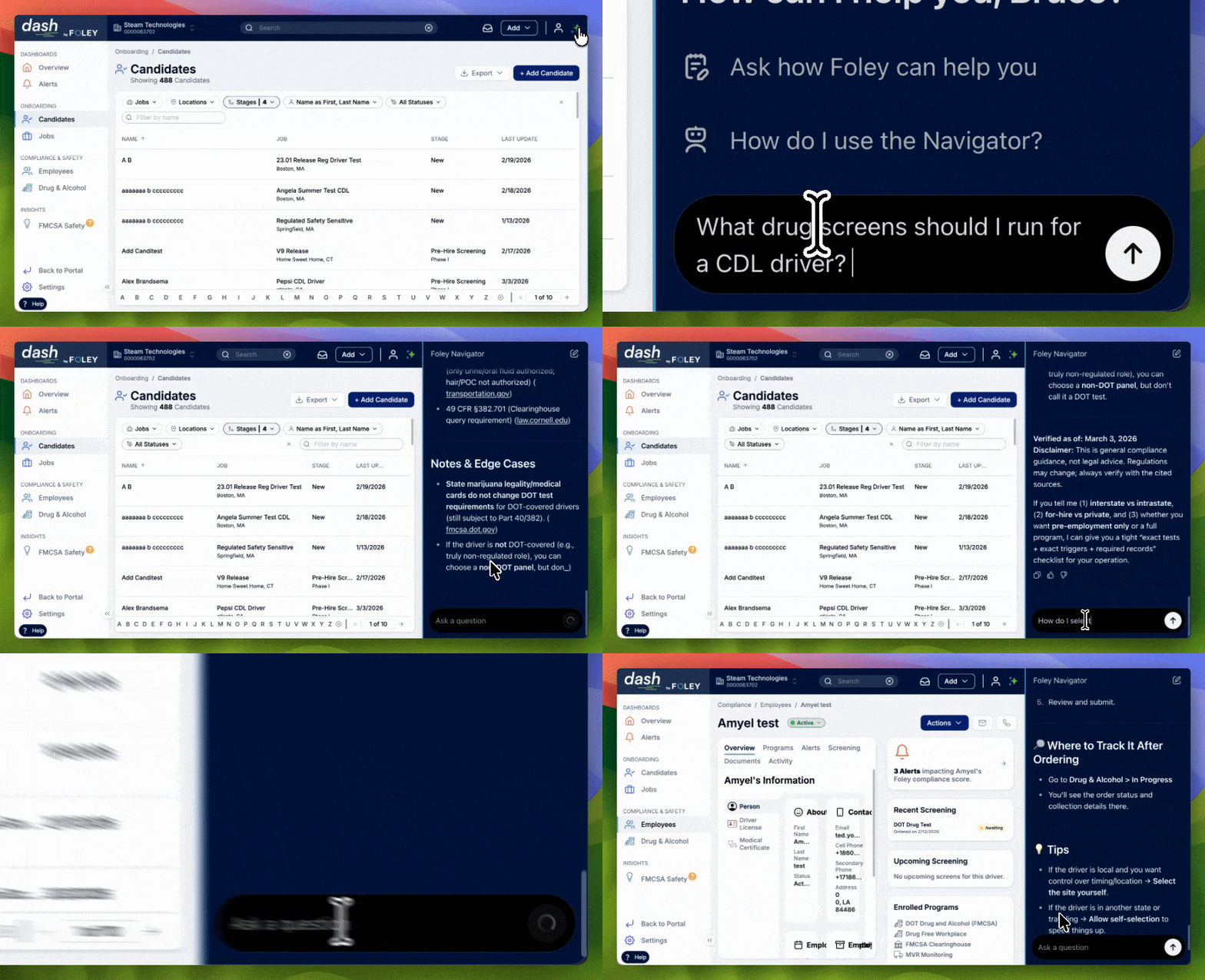
Foley files your PHMSA hazmat registration, documents 172.704 training for every hazmat employee, and writes the security plan — on the same account that runs your DQ files and testing program.
- PHMSA registration filed for you on Form DOT F 5800.2
- 172.704 training records built, dated, and tracked
- Security plans written to 49 CFR 172.802 and reviewed yearly
Register with PHMSA and build the file behind it
Tell us what you haul. We scope the registration, the training records and the security plan.
DOT Hazmat Registration, Training and Security Plans: What You Actually Owe
DOT hazmat registration is a filing with the Pipeline and Hazardous Materials Safety Administration. If your company offers or transports certain hazardous materials in commerce, you register, pay the fee, and get a Certificate of Registration. The rule is 49 CFR Part 107, Subpart G. The form is DOT F 5800.2.
Registration is one of four separate obligations. It is not training, not a security plan, and not the driver's hazmat endorsement. Most placarded motor carriers owe all four, and each lives under a different part of the CFR. A vendor that sells you a training certificate has covered one of the four.
- Registration with PHMSA, each registration year — 49 CFR 107.601
- Hazmat employee training in six subject areas, recurrent every three years — 49 CFR 172.704
- Security plan in writing, if you handle the triggering materials — 49 CFR 172.800
- Driver hazmat endorsement on the CDL, with a TSA threat assessment — 49 CFR 383.93
FMCSA is moving carrier registration onto Motus, the system announced in the Federal Register on 29 April 2026. Motus replaces the Unified Registration System, the registration side of MCMIS, and the legacy ICC Licensing and Insurance system. Phase I went live in December 2025 for supporting companies such as process agents and insurance filers; Phase II opened the system to motor carriers, brokers and freight forwarders through the second quarter of 2026.
No regulation changed and no new deadline was created. What changed is the front door: the next biennial update, USDOT-number change, operating-authority change or BOC-3 filing is where most carriers will meet it. Fleets with several affiliated entities should expect to re-validate logins and authorisations, because each entity keeps its own record. Foley files through whichever system is live on the day, so the transition is ours to manage, not yours. Read our Motus briefing.
PHMSA or FMCSA: Which Agency Governs Which Piece
Carriers search for "FMCSA hazmat" and land on registration pages, then get confused about who they are dealing with. Here is the split.
PHMSA issues the Hazardous Materials Regulations at 49 CFR Parts 171–180 — classification, packaging, shipping papers, marking, labeling, placarding, training, and security plans. PHMSA also administers the registration program under 49 CFR Part 107, Subpart G, issues the Certificate of Registration, and collects the incident reports behind its public hazmat data and statistics.
FMCSA inspects and investigates motor carriers against those same HMR requirements, adds the highway-specific rules at 49 CFR Part 397 for routing, attendance, and parking, and owns the CDL hazmat endorsement at 49 CFR 383.93. Hazmat violations land in your safety record and drive investigation priority.
You file with PHMSA, and FMCSA is who shows up. Both reference the same regulations, so a gap in your registration file becomes an FMCSA finding.
Do I Have to Register? The 107.601 Triggers
You must register if you offer for transportation or transport in commerce any of the following, per 49 CFR 107.601. One trigger is enough.
- A highway route controlled quantity of Class 7 radioactive material
- More than 25 kg (55 lb) of Division 1.1, 1.2, or 1.3 explosive material in a motor vehicle, rail car, or freight container
- More than one liter per package of a material poisonous by inhalation in Hazard Zone A
- A hazardous material in bulk packaging with capacity of 3,500 gallons or more for liquids or gases, or more than 468 cubic feet for solids
- A shipment in other than bulk packaging of 5,000 lb gross weight of one class of hazardous material for which placarding is required
- Any quantity of hazardous material that requires placarding under 49 CFR Part 172, Subpart F
- A select agent or toxin regulated under 42 CFR Part 73
The last one catches most fleets. Exceptions are narrow and listed at 49 CFR 107.606 — farmers moving material incident to their own farming operation, government agencies, and individual hazmat employees among them. Verify your commodity and quantity against 107.601 before you conclude you are exempt.
We file it, you keep hauling
Give us your commodity list and DOT number. We confirm the 107.601 trigger, file Form DOT F 5800.2, and send back the certificate plus your in-cab copy.
How Registration Works With Foley
Registration Fees, Payment, and Terms
PHMSA charges a registration fee plus a processing fee, per registration year, set at 49 CFR 107.612. Small business status follows SBA size standards. Foley's filing service is separate from the PHMSA fees below.
| Registrant | Registration fee | Processing fee | Total per registration year |
|---|---|---|---|
| Small business or not-for-profit | Reduced rate, set by PHMSA | Flat fee, same for every registrant | Registration fee plus the processing fee |
| All other registrants | Standard rate, set by PHMSA | Flat fee, same for every registrant | Registration fee plus the processing fee |
| Multi-year filing | Up to three registration years may be filed at once under 49 CFR 107.616. The per-year fee applies to each year covered. | ||
| Payment and submission changes | PHMSA sets how the registration statement and fee are submitted. Use the method PHMSA's registration system accepts on the day you file, and check it again at each renewal. | ||
PHMSA adjusts these amounts by rulemaking, so confirm the schedule before you budget a multi-year filing. The government fee is not refundable once the statement is processed.
File all three registration years at once
Multi-year filing under 49 CFR 107.616 is the cleanest way to avoid a lapse between DOT investigations. One filing, one renewal date to track.
Start my hazmat registrationRegistration Year, Renewal, and the Records You Keep
The registration year runs July 1 through June 30 under 49 CFR 107.616. It is not tied to your filing date, so a registration bought in May covers a short first year unless you file forward. That is the renewal mistake we see most.
- Renewal: file a new registration statement for each registration year you operate. There is no automatic rollover from PHMSA.
- Retention: keep a copy of the registration statement and the Certificate of Registration for three years from the date of issuance, at your principal place of business — 49 CFR 107.620(a).
- In the truck: a motor carrier must carry a copy of the current Certificate of Registration, or another document bearing the registration number, on board each truck and truck tractor — 49 CFR 107.620(b).
- Changes: a change in company name, address, or ownership means the registration information no longer matches your MCS-150. Fix both.
A lapsed registration is silent
PHMSA does not call you when your registration year ends. You find out when an investigator asks for the certificate covering a shipment you already ran.
Hazmat Employee Training Under 49 CFR 172.704
Every hazmat employee must be trained, tested, and certified by the employer. This is what people mean by DOT hazmat certification. There is no federal license and no government-issued card — the employer certifies, and the employer keeps the record. 49 CFR 172.704 requires six components:
- General awareness/familiarization — recognize and identify hazardous materials
- Function-specific — the requirements that apply to the job the person actually does
- Safety — emergency response, measures to protect from hazards, accident avoidance
- Security awareness — security risks of hazmat transport and how to recognize them
- In-depth security — required only if you must have a security plan under 172.800
- Driver training — for drivers, the additional requirements at 49 CFR 177.816
Timing: a new hazmat employee may perform functions before completing training only under the direct supervision of a trained employee, and training must be completed within 90 days of employment or of a change in job function. Recurrent training is required at least once every three years — that is your certification renewal cycle.
Delivery is built around a fleet, not a classroom. General awareness, safety, and security awareness run online and self-paced, so a driver can finish between loads on a phone. Function-specific and in-depth security content runs live, in person or by web session, because it has to match the job the person does.
The record is where carriers fail. 49 CFR 172.704(d) requires the employee's name, the most recent training completion date, a description or copy of the training materials, the name and address of the trainer, and the employer's certification that the employee was trained and tested. Keep it for as long as the employee is a hazmat employee and 90 days after. Foley builds that record, dates it, stores it with the driver's file, and flags the three-year expiration before it hits.
Hazmat Certification Is Not the CDL Hazmat Endorsement
You train and certify. It covers drivers, dock workers, packers, shippers, and anyone who prepares hazmat for transport. No test at the DMV, no card in the wallet — a signed training record in your file. Recurrent every three years. Applies to the company.
The driver takes a state knowledge test under 49 CFR 383.93 and 49 CFR 383.121, and passes a TSA security threat assessment under 49 CFR Part 1572. It sits on the CDL and follows the driver, not the company.
A driver with an H endorsement is not a trained hazmat employee under 172.704. You need both, documented separately. Endorsement status shows up on the driver's MVR, which is where we verify it during onboarding and on the annual review.
Security Plans Under 49 CFR 172.800–172.804
If you offer or transport the materials listed at 49 CFR 172.800(b) — the same family of placarded quantities, select agents, explosives, poison-inhalation-hazard materials, and highway route controlled radioactive shipments that drive registration — you must develop and adhere to a written security plan. Verify your exact commodity list against 172.800(b) and against 107.601 separately, because each section carries its own list.
49 CFR 172.802 sets the required content. The plan must include a risk assessment and address three areas at minimum:
- Personnel security — confirming information provided by applicants for positions involving access to hazardous materials, consistent with applicable law
- Unauthorized access — measures to deter unauthorized access to hazmat at facilities and during transport
- En route security — measures addressing security risks during transportation, including shipments stopped in transit
The plan must be in writing, retained and available to employees who need it, and reviewed at least annually and revised as circumstances change. Employees must be trained on it — that is the in-depth security training component of 172.704, and 49 CFR 172.804 addresses how the plan relates to other federal security requirements. Foley writes the plan against your operation, not a template with your name dropped in, and runs the annual review so the revision date is current when someone asks.
Penalties, Incident Reporting, and Audit Exposure
Civil penalties for hazardous materials violations are authorized by 49 U.S.C. 5123 and adjusted for inflation each year. The statute sets a higher maximum where the violation results in death, serious illness, severe injury, or substantial property destruction, and a minimum penalty for training violations. The amount that applies is the one in force on the date of the violation, and Foley confirms the current figure for your operation. Enforcement procedures are at 49 CFR Part 107, Subpart D.
What actually happens in the field: an investigator asks for the Certificate of Registration for the period covering a specific shipment, then for the training records of every hazmat employee involved, then for the security plan and its last review date. Three requests. Most carriers we onboard can answer one of them.
Reporting is part of the exposure. A release, fire, or death in transit requires an immediate telephone report to the National Response Center under 49 CFR 171.15, then a written report on Form DOT F 5800.1 within 30 days under 49 CFR 171.16. Those filings feed PHMSA's public incident data, which is what an investigator, an insurer, and opposing counsel pull when they want your history. A missed 5800.1 is a separate violation from whatever caused the incident.
Hazmat violations also weigh into FMCSA's Hazardous Materials Compliance BASIC, which raises your investigation likelihood independent of any fine.
What's Included
| Service | What Foley does | Governing cite |
|---|---|---|
| PHMSA registration | Prepare and e-file Form DOT F 5800.2, pay the government fee, deliver the Certificate of Registration and your in-cab copy | 49 CFR 107.601, 107.620 |
| Registration renewal | Track the registration year, file forward, default to the three-year term | 49 CFR 107.616 |
| Hazmat employee training | Online and instructor-led delivery in all applicable components, testing, employer certification, dated records with three-year expiration tracking, group rates for crews | 49 CFR 172.704, 177.816 |
| Security plan | Written plan with risk assessment, personnel security, unauthorized access, en route security; annual review and revision | 49 CFR 172.800–172.804 |
| Driver qualification files | DQ file build and maintenance, with the hazmat certificate and training records stored alongside | 49 CFR Part 391 |
| Drug and alcohol program | Foley-operated consortium and C/TPA, random pool, MRO review, DER support, Clearinghouse queries | 49 CFR Part 382, Part 40 |
| Carrier filings | MCS-150 biennial update, UCR, BOC-3 process agent designation | 49 CFR 390.19, Part 367, Part 366 |
Why Carriers Run Hazmat Through Foley
Foley operates the programs a hazmat carrier already needs, so the hazmat pieces land in the same file as everything else an investigator will ask for.
- Placarded drivers hold CDLs, so they are subject to 49 CFR Part 382. Foley runs its own consortium and C/TPA — the DOT drug test random pool your hazmat drivers sit in is ours, with our MRO review and DER support behind it.
- We run Clearinghouse queries and MVR monitoring on the same drivers, so an endorsement downgrade or a positive result does not sit unnoticed on a placarded route.
- We file the MCS-150, your UCR registration and unified carrier licence renewals, and your BOC-3 — so the legal name and address on your hazmat registration match every other federal record you hold.
- New authority? The DOT number application, registration, and training records get built in the right order instead of backfilled after the first inspection.
One account, one renewal calendar, one place to pull the file. See the full compliance program.
Ground, Air, Ocean, and Hazardous Waste
This page covers domestic highway transport under the HMR. Two adjacent areas come up constantly.
Other modes. 49 CFR 171.22 through 171.25 authorize use of the ICAO Technical Instructions and the IMDG Code for air and vessel shipments, with US variations. If you tender freight to an air carrier or an ocean terminal, your function-specific training under 172.704 has to cover the standard you actually ship under. In practice that means an IATA/ICAO dangerous goods course for air shippers and an International Maritime Dangerous Goods course for anyone offering freight for vessel transport, each on its own recurrence cycle rather than the 172.704 three-year clock.
Hazardous waste. A hazardous waste is a hazardous material under 49 CFR 171.8, so the HMR applies to transporting it, on top of EPA's manifest and generator requirements at 40 CFR Part 262. Hauling waste does not exempt you from registration if you meet a 107.601 trigger.
Foley's hazmat scope is registration, employee training records, and security plans for domestic ground operations. If you ship by air or vessel, or you need RCRA coursework, ask us what is covered before you assume it is included.
Need registration, training, and a security plan together?
Carriers hauling placarded loads usually owe all three. Talk to a compliance specialist and we will scope the whole obligation in one call instead of selling you pieces of it.
- A hazmat transporter needs a USDOT number regardless of vehicle size. The usual weight thresholds do not apply.
- The hazmat endorsement runs five years and does not renew automatically: the driver retests and re-clears the security threat assessment.
- Hazmat obligations attach to the driver hauling placarded loads and to the carrier they drive for, separately.
- Hazmat violations sit in their own penalty tier, which can reach seizure, criminal charges and driver disqualification.
Carriers who already run this with Foley
Elberta Logistics International
Onboards drivers paperlessly, with MVRs, drug screens and background checks ordered automatically. Read the case study.
Frequently asked questions
Who must register with PHMSA for hazmat?
Any person who offers for transportation or transports in commerce a material listed at 49 CFR 107.601. The full trigger list is above; the one that catches most fleets is any quantity requiring a placard under 49 CFR Part 172, Subpart F. Narrow exceptions — farmers moving material incident to their own farming operation, government agencies, and individual hazmat employees among them — are listed at 49 CFR 107.606.
How much does DOT hazmat registration cost, and how do I pay?
PHMSA charges a registration fee plus a processing fee for each registration year under 49 CFR 107.612. Small businesses and not-for-profits pay a reduced registration fee; all other registrants pay the standard rate. PHMSA sets both amounts in 107.612, so the fee that applies is the one in force for the registration year you are filing. The statement and fee go through PHMSA's electronic registration system, using the payment methods PHMSA accepts in that system.
When does DOT hazmat registration expire, and how does renewal work?
Registration is issued by the registration year PHMSA sets, not from your filing date. There is no automatic renewal — you file a new registration statement for each year you operate. Filing up to three registration years at once under 49 CFR 107.616 is the practical way to avoid a lapse.
What is the difference between PHMSA registration and a hazmat endorsement?
Registration is a company filing under 49 CFR Part 107 Subpart G. The endorsement sits on an individual driver's CDL under 49 CFR 383.93 and requires a state knowledge test plus a TSA security threat assessment under 49 CFR Part 1572. A registered company still needs endorsed drivers, and an endorsed driver does not register the company.
What are the DOT hazmat certification requirements?
Under 49 CFR 172.704 the employer must train, test, and certify every hazmat employee in general awareness/familiarization, function-specific, safety, and security awareness training, plus in-depth security training if a security plan is required and driver training under 49 CFR 177.816 for drivers. The employer keeps the record — there is no government-issued hazmat card.
Is hazmat employee training available online, and are there group rates?
Yes. General awareness, safety, and security awareness run online and self-paced, so drivers and dock staff finish between loads instead of losing a day to a public classroom course. Function-specific and in-depth security training runs live, in person or by web session. Online delivery does not change the record requirement.
How often is DOT hazmat certification renewal required?
Recurrent training is required at least once every three years under 49 CFR 172.704(c). New hazmat employees must complete training within 90 days of hire or of a change in job function, and until then may work only under the direct supervision of a trained employee. New job duties trigger new function-specific training regardless of where you are in the cycle.
Do I need a hazmat security plan?
You need one if you offer or transport any material listed at 49 CFR 172.800(b). The plan must be in writing, include a risk assessment, and address personnel security, unauthorized access, and en route security per 49 CFR 172.802. It must be reviewed at least annually and revised as circumstances change, and employees must receive in-depth security training on it.
Is FMCSA hazmat the same thing as PHMSA hazmat registration?
No. PHMSA writes the Hazardous Materials Regulations at 49 CFR Parts 171–180, administers the registration program, and collects the incident reports behind its hazmat data. FMCSA enforces those regulations against motor carriers, adds highway-specific requirements at 49 CFR Part 397, and controls the CDL hazmat endorsement. You file with PHMSA; FMCSA inspects and investigates you.
Do I have to carry the hazmat registration certificate in the truck?
Yes. Under 49 CFR 107.620(b) a motor carrier must carry a copy of its current Certificate of Registration, or another document bearing the registration number, on board each truck and truck tractor used to transport materials requiring registration. You must also retain the registration statement and certificate for three years at your principal place of business under 107.620(a).
Are hazmat drivers subject to DOT drug and alcohol testing?
Yes, if they operate a vehicle requiring a CDL — which includes any vehicle transporting hazardous materials in quantities requiring placards. Those drivers fall under 49 CFR Part 382, meaning pre-employment testing, random selection, post-accident, reasonable suspicion, and Clearinghouse queries. Foley operates its own consortium and C/TPA, so the same account covers hazmat registration and the random pool.
If you placard, you register.
Any quantity requiring a placard under 49 CFR Part 172 Subpart F triggers registration under 107.601 — no minimum weight, no grace period.