








You Don't Have to Be a Trucking Company to Need DOT Compliance

How privately owned companies, like landscaping businesses, movers, junk haulers, and waste management fleets, unknowingly step into federal compliance territory, and what to do about it to avoid violations and fines.
You started your business, you recruited a team, bought some trucks, and worked hard to earn a solid reputation. One thing that never crossed your mind? Federal compliance regulations.
Here's what most small fleet owners don't find out until it's too late: the FMCSA doesn't care how small your company is or if you’re not a traditional trucking company. If your vehicles cross certain weight thresholds or operate across state lines, you are legally required to comply with Federal Motor Carrier Safety Administration (FMCSA) regulations. The same rules govern large commercial trucking operations. And the fines, out-of-service orders, and audit consequences for non-compliance can be devastating for a company of your size.
What Is the FMCSA, and Why Should You Care?
The Federal Motor Carrier Safety Administration is the federal agency within the U.S. Department of Transportation responsible for regulating commercial motor vehicles (CMVs) on public roads. Their mission is to reduce crashes, injuries, and fatalities involving large trucks and buses, and their authority extends far beyond the trucking companies you picture hauling freight cross-country.
If your business operates vehicles that meet the federal definition of a CMV, you are subject to FMCSA regulations.
Does Your Business Operate Commercial Vehicles?
A vehicle qualifies as a commercial motor vehicle under federal rules if it meets any one of the following criteria:
-
Has a Gross Vehicle Weight Rating (GVWR) or Gross Combination Weight Rating (GCWR) of 10,001 pounds or more
-
Is designed to transport 16 or more passengers (including the driver)
-
Transports hazardous materials in quantities requiring placarding
-
A completed employment application
-
A copy of the driver's commercial driver's license (CDL), if applicable
-
Motor Vehicle Record (MVR) pulled at hire and annually thereafter
-
Annual review of driving record
-
Medical examiner's certificate (DOT physical)
-
Prior employer safety performance history (verifications)
-
Pre-employment testing before a driver operates a CMV
-
Random testing - you must enroll drivers in a random testing pool at FMCSA-mandated rates (currently 50% for drugs, 10% for alcohol annually)
-
Post-accident testing following certain crashes
-
Reasonable suspicion testing when supervisors observe signs of impairment
-
Return-to-duty testing following a violation
-
Register with the Clearinghouse
-
Run a pre-employment query on every CDL driver before hire
-
Run annual queries on all current CDL drivers
-
Report any violations to the Clearinghouse
-
Civil penalties for violations can range from hundreds to tens of thousands of dollars per infraction
-
Out-of-service orders can put your drivers and vehicles off the road immediately — stopping your revenue cold
-
Unsatisfactory safety ratings are public record and can damage your ability to win contracts, especially with commercial or government clients
-
Liability exposure skyrockets if a driver with an undisclosed violation causes an accident while driving your vehicle
-
Audit follow-up — once the FMCSA flags your operation, you're on their radar
Think about your fleet for a moment. A standard box truck, a heavy-duty pickup towing a loaded equipment trailer, a garbage truck — these almost always exceed the 10,001-pound threshold. In fact, many service contractors hit this limit without ever realizing it: an F-250 with a loaded equipment trailer frequently exceeds the GVWR cutoff.
If you operate even one vehicle that qualifies as a CMV and it crosses state lines for business, federal FMCSA compliance requirements apply to you.
What FMCSA Compliance Actually Requires
Here's a breakdown of the key compliance obligations that apply to small fleets operating CMVs:
1. USDOT Number Registration
Any motor carrier operating CMVs in interstate commerce must register with the FMCSA and obtain a USDOT number. This number must be displayed on your vehicles. Operating without one can result in significant fines and being placed out of service (meaning you cannot operate said vehicle until the issue is resolved).
2. Driver Qualification Files (DQFs)
For every driver operating a CMV, you're required to maintain a Driver Qualification File. This is a federally mandated record that must include:
Missing or incomplete DQFs are among the most common citations during FMCSA compliance audits.
3. DOT Physical / Medical Certification
Drivers of CMVs must hold a valid medical examiner's certificate, issued after a DOT physical exam conducted by a certified medical examiner. These certificates must be renewed regularly and tracked carefully.
The FMCSA is moving to a digital DOT medical card process. You can learn more about this change by watching our free on-demand webinar.
4. Drug & Alcohol Testing Program
The FMCSA requires carriers to maintain a compliant drug and alcohol testing program for CDL drivers. This includes:
Failing to maintain a proper testing program, or not enrolling in one at all, is a serious compliance violation.
5. FMCSA Drug & Alcohol Clearinghouse
The FMCSA Drug & Alcohol Clearinghouse is a federal database containing records of CDL drivers' drug and alcohol program violations. Employers are required to:
Skipping Clearinghouse queries is one of the fastest ways to face a compliance violation — and it puts you at serious liability risk if you hire a driver with an unresolved violation.
6. Motor Vehicle Record (MVR) Monitoring
You're required to pull MVRs at the time of hire and annually. But driver histories can change between annual pulls — license suspensions, new violations, DUIs. If you're only checking once a year, dangerous changes may go undetected for months.
7. Hours of Service (HOS)
Drivers of CMVs must comply with Hours-of-Service regulations, which limit how many hours a driver can be behind the wheel without rest. For many small fleet owners in service industries, this feels like a trucking rule — but it applies to your drivers too.
8. Vehicle Inspections
CMVs must undergo an annual DOT inspection conducted by a qualified inspector, and records must be maintained. Drivers are also required to perform and document pre- and post-trip inspections.
The Real Cost of Non-Compliance
For a small, privately owned business, an FMCSA compliance failure can be financially brutal. Consider:
For a three-truck landscaping company or a five-van moving operation, even a single serious compliance incident can threaten the whole business.
Industry Spotlight: Where Small Fleets Get Caught
Landscaping Companies: Crews with heavy-duty trucks towing trailers full of equipment often exceed GVWR thresholds without owners realizing it. If your business operates across county or state lines, USDOT registration and driver qualification requirements are likely to apply.
Moving Companies: Interstate movers are directly regulated by the FMCSA under Part 375 of federal regulations, which governs the transportation of household goods. Even small, regional movers taking a load across a state line must comply with federal motor carrier safety rules.
Waste Management Companies: Running DOT Clearinghouse queries is a recognized compliance requirement for waste management fleets. With multiple drivers operating heavy vehicles on tight schedules, gaps in drug testing programs or driver files create significant audit and liability risk.
Junk Removal Companies: Large box trucks used in junk removal commonly exceed a GVWR of 10,001 pounds. CDL requirements, drug testing, and DQFs apply to drivers of these vehicles, and many small junk removal operators have no idea they're out of compliance.
How Foley Helps Small Fleets Stay Compliant
Most small businesses don't have an HR department, a compliance officer, or a legal team. You're managing drivers, serving customers, and running day-to-day operations all at once. That's exactly what Foley was built for.
For more than 30 years, Foley has helped tens of thousands of companies manage DOT and FMCSA compliance, and our platform is built for small fleets like yours, not just enterprise operations.
One Platform for Everything
Foley brings all your compliance obligations into a single, easy-to-use platform — drug testing, driver files, MVR monitoring, DOT physicals, and Clearinghouse management — so you're never juggling multiple vendors or filing cabinets overflowing with paper folders.
Digital Driver Qualification Files
Foley creates and maintains fully digital DQFs that meet DOT regulations and stay audit-ready. Every required document — employment application, CDL copy, MVR, medical certificate, prior employer verifications — is organized, tracked, and accessible with a single click. When an auditor walks through your door, you're ready.
FMCSA Clearinghouse Management
Foley acts as your certified Third-Party Administrator (TPA) for the FMCSA Clearinghouse, handling registration, pre-employment queries, annual queries, and recordkeeping on your behalf.
Managed Drug & Alcohol Testing Program
Foley manages your entire drug testing program — random pool enrollment, collections coordination, MRO review, Clearinghouse reporting, and audit-ready records. You get a program that practically runs itself, customized for your fleet size.
Continuous MVR Monitoring
Rather than waiting for the annual MVR pull, Foley's continuous MVR monitoring alerts you immediately when a driver's license status changes — a suspension, a new DUI, a serious violation — so you can act before it becomes a liability.
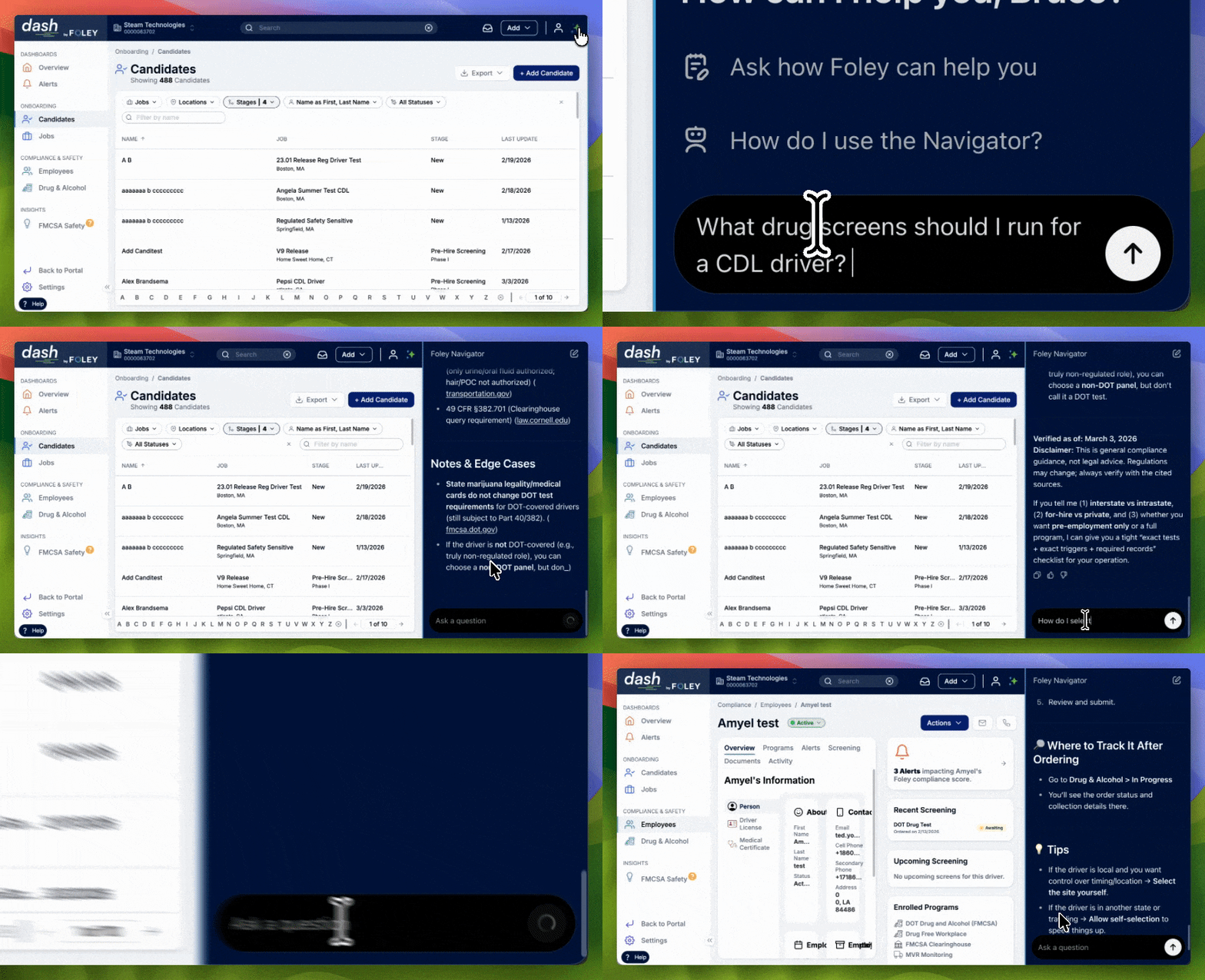
Foley Navigator AI
Foley's built-in AI assistant, Navigator, surfaces compliance signals in plain language and tells you what they mean, what action to take, and what to document — without waiting on support or spending hours reading federal regulations.
Expert Compliance Support
Every Foley customer has access to knowledgeable, U.S.-based compliance specialists. Whether you're preparing for your first FMCSA audit or just trying to understand which regulations apply to your business, Foley's team is there to guide you through it step by step.
You Didn't Start Your Business to Become a Compliance Expert
But the reality is that once you put commercial vehicles on the road, compliance comes with the territory. The good news is that you don't have to figure it out alone, and you don't have to let compliance paperwork take over your schedule.
Foley makes it simple, organized, and manageable for fleets of any size.
Ready to See How It Works?
Get a free demo of the Foley platform and see exactly how small fleets like yours manage FMCSA compliance without the headaches.
A Foley compliance expert will walk you through the platform, answer your questions, and help you understand what your specific operation actually needs to stay compliant and protected.
Related Articles
The Ultimate FMCSA & DOT Compliance Checklist
Top 5 Compliance Mistakes Made by Commercial Fleet Teams
DVIR Compliance: How to Complete Your Reports Correctly
.webp)